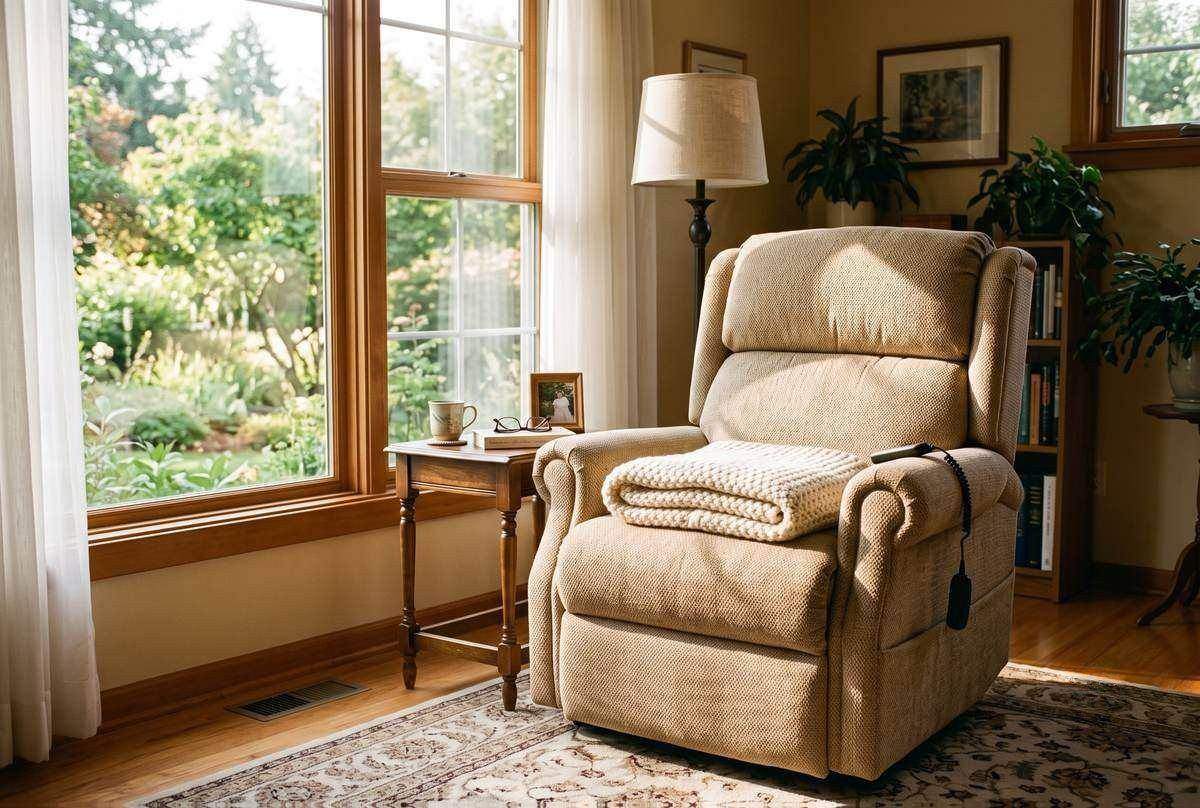
The chair was the first thing I noticed when I walked into Vivienne's living room last spring. Wide, the color of wet sand, angled toward the window with a little wired remote tucked into the seam of the cushion. She was seventy-three. Her hips had worn down to the point where rising from her old armchair took three tries and, on the bad mornings, a word or two she wouldn't have wanted printed in a family newspaper. Her daughter had heard somewhere that Medicare buys these chairs. Vivienne wanted to know if that was true.
I'll tell you what I told her over tea, because it's the honest place to start. Medicare will help. It will not buy the chair.
What Medicare pays for is the motor, the lifting mechanism that tilts the seat forward and eases you to your feet. Nothing else. Not the frame, not the upholstery, not the heat or the massage or the pocket on the side for your reading glasses. On a chair that might run you fifteen hundred dollars or more, Medicare's share covers a part worth a couple hundred. That surprises people, and I understand the disappointment. But knowing where the line falls, exactly, is the difference between getting the help that exists and giving up on all of it.
Let me walk you through it plainly, the way I wish someone had for Vivienne before the rumor reached her.
What Medicare Covers, and What It Won't
A lift chair, to Medicare, is really two things wearing one slipcover. There's the recliner, which is furniture. Medicare doesn't buy furniture for anyone. And there's the seat-lift mechanism, the motor and framework that raise and tilt the seat until standing becomes possible. That second piece has its own billing code, E0627, and Part B treats it as durable medical equipment. Same category as walkers, canes, and hospital beds.
So the way it works in practice is this. You buy the whole chair. Medicare, if you qualify and do the paperwork right, reimburses the portion tied to that lifting motor. Reimburses, I should say, not discounts at the register. The money comes back after, not off the top.
A lift chair belongs in the same conversation as the rest of your mobility aids, one tool among several for the right person. And if the goal is staying in your own home safely, moving from room to room without fear, it sits inside the larger picture of aging in place that so many of us are quietly planning for.
Do You Qualify? The Four-Part Test
Most of the yes-or-no lives right here, so read it slowly. Medicare's own policy lays out four conditions, and you generally need all four.
- Severe arthritis of the hip or knee, or a severe neuromuscular disease. A sore back or general stiffness won't clear this bar. The condition has to be significant and documented.
- You are completely unable to stand up from a regular armchair. Not "it's hard." Unable. If you can rise from an ordinary chair with effort, Medicare's position is that you don't need the mechanism.
- Once you're on your feet, you can walk. On your own, or with a cane or a walker, but you can move. The lift is meant to solve the standing, not the walking.
- Your doctor prescribes it as part of a treatment plan meant to improve your condition or slow its decline.
There's one more piece your physician's records have to show: that other treatments were tried first and didn't restore your ability to stand on your own. Medication, physical therapy, that sort of thing. I won't tell you it takes a set number of months, because it doesn't, and anyone who quotes you a hard timeline is guessing. What matters is that the effort is there in the chart.
Vivienne cleared all four. Her arthritis was severe and long-documented, she truly could not rise unaided, she walked fine once she was up, and her doctor had already put her through a round of physical therapy that didn't hold. For someone whose knees and hips are the real problem, this is often the case. If arthritis is the root of it, it's worth reading up on what arthritis does to an aging body, because the more precisely your doctor names the condition, the smoother the paperwork goes.
Why a Wheelchair Usually Changes the Answer
A hard one, this. I've watched it catch families off guard. If you use a wheelchair, you generally won't qualify.
The logic, once you see it, holds together. The mechanism is approved for people who can't stand but can walk once they're standing. A person who relies on a wheelchair usually needs help transferring, not help standing-and-walking. Different need, different equipment. It feels unfair in the moment. It's simply how the criteria are drawn.
The Math: What You'll Actually Pay
Now the numbers, because this is the part Vivienne's daughter really wanted.
Two costs sit side by side. First, the mechanism that Medicare will consider. In most places it's approved at somewhere around two hundred seventy to three hundred dollars, though the exact figure shifts depending on where you live. Medicare pays about eighty percent of that. Your share is the other twenty percent, call it fifty-five or sixty dollars, but only after you've met your Part B deductible, which in 2026 is $283.
Second, and it's the number that stings: the rest of the chair. That's yours in full. If the recliner cost fifteen hundred dollars and the mechanism accounts for three hundred of it, you are paying the twelve hundred plus your small slice of the mechanism, every dollar of the furniture landing squarely on your side of the ledger.
So don't picture Medicare knocking eighty percent off the price on the showroom floor. Picture it covering most of one modestly priced part. Still worth having. Just not the windfall the rumor promises.
A lift chair is one honest line item among many, the kind that adds up quietly when you're figuring out what aging in place really costs.
How to Actually Get One
Order matters. Do it out of sequence and you can lose the coverage entirely. The path that works looks like this.
- Start with your doctor. You need a prescription, and you need the medical necessity documented in your chart against those four conditions. Medicare retired the old paper form for this (a certificate called the CMS-849) back in 2023, so don't let a supplier send you chasing one. The proof now lives in your chart: your doctor's notes have to show the diagnosis, the failed alternatives, and the plan.
- Buy from a Medicare-enrolled supplier that accepts assignment. People skip this step, and it's the costly one. A supplier who accepts assignment agrees to Medicare's approved amount, which keeps your out-of-pocket lowest. You can find one at medicare.gov/medical-equipment-suppliers. When you call, ask two plain questions: do you bill Medicare for the E0627 lift mechanism, and do you accept assignment.
- Be careful where you shop. A lift chair from a general furniture store or an everyday online retailer usually can't be billed to Medicare at all, no matter how well you qualify. The chair might be lovely. If the seller isn't enrolled, Medicare's share vanishes.
- Let the supplier file the claim. An enrolled supplier normally submits it for you. If for some reason you paid upfront yourself, you can file your own claim using Form CMS-1490S, the Patient's Request for Medical Payment, with an itemized bill attached. Do it within one calendar year of the purchase. Processing often takes several weeks, so don't panic at the silence.
I know that's a lot of steps for one chair. Every one of them, though, protects you from paying out of pocket for something Medicare would have covered.
When Medicare Says No
Denials happen, and usually for reasons you can see coming.
The big three: the four conditions weren't documented clearly enough in your records, the chair came from a supplier who wasn't Medicare-enrolled, or the person primarily uses a wheelchair. When a supplier suspects the claim won't clear medical necessity, they'll ask you to sign an ABN, an Advance Beneficiary Notice, acknowledging you may owe the cost. Sign it with your eyes open. It means the supplier already has doubts.
If you're denied and you believe you meet the criteria, you have the right to appeal, and the appeal often turns on getting your doctor to spell out the medical necessity in fuller, plainer language. Not even close to hopeless. It just takes a second look at the paperwork.
Advantage, Medigap, Medicaid, and Veterans
A few of you aren't on Original Medicare, or you carry extra coverage, so the picture shifts a little.
Medicare Advantage has to cover at least what Original Medicare does. But plans commonly add prior authorization and require you to use in-network suppliers. Call your plan before you buy anything. Ask what they need in advance, or you may find yourself paying for a misstep a single phone call would have prevented.
Medigap. If you have a supplement plan that covers your Part B coinsurance (Plan G is the common one now), it pays that twenty percent on the mechanism, so your out-of-pocket on the covered part can drop close to nothing. It still won't touch the rest of the chair. If you're unsure what your plan handles, our guide to Medicare supplement insurance lays out which plans cover what.
Medicaid varies entirely by state and waiver. Some states help substantially, others barely at all. Your state Medicaid office is the only reliable source, and you'll typically need a letter of medical justification and prior approval before you buy.
Veterans, a word of caution, because there's a lot of bad information floating around. Those home-improvement grants you may have heard about do not cover lift chairs. They're meant for structural changes to a home, not removable furniture. That doesn't mean the VA has nothing for you. It means the right move is to call your VA prosthetics office and ask directly about other pathways rather than assuming. If you're sorting through the wider landscape of veterans' benefits for senior care, start there.
What These Chairs Cost, and How to Shop
Set the coverage aside for a moment and talk about the chairs themselves, because the range is wide. A basic lift chair starts around three hundred dollars. A high-end one can run past three thousand. Consumer Reports has tested a wide range of models.
Most of the price difference comes down to how far the chair reclines, which the industry sorts into three types:
- Two-position chairs have a single motor and recline slightly, good for reading and rising, less so for stretching out flat.
- Three-position chairs lean back much further, close to horizontal.
- Infinite-position chairs use two motors so the back and footrest move independently, and they lay nearly flat. These are the ones people who can't sleep in a bed often need, and they cost the most.
I confess I sank into one of those infinite-position models at a medical supply showroom last year and nearly fell asleep before the salesman finished his pitch. Comfortable is not the question, though. Covered is. Buy for the body you have, not the features on the tag. Wilbur, a man from our Tuesday coffee group, bought a top-of-the-line chair with heat and massage he never once used, then learned the furniture store couldn't bill Medicare for a nickel of it. He'd have been just as comfortable, and several hundred dollars richer, in a two-position model from an enrolled supplier. Match the chair to how you actually live.
What I Told Vivienne
We finished the tea. I wrote the important numbers on the back of an envelope and told her the truth doesn't have to be discouraging just because it's smaller than the rumor.
Medicare wasn't going to hand her a free recliner. But it was going to help with the one part that mattered most, the motor that would give her back the simple dignity of standing up in her own living room without asking anyone. She qualified. She did the steps. The chair arrived in June, and the last time we spoke she told me she'd stopped dreading the moment of getting up.
So remember this when a benefit turns out narrower than you hoped. Find the exact edge of what's covered, stand on it, and claim every inch that's yours. Then call your doctor, and let the rest follow.
Narrow isn't the same as nothing.