The son walked into the memory unit at quarter past nine on Father's Day morning carrying a small white bakery box, a folded photograph in his shirt pocket, and the kind of nervous shoulders I have seen on a hundred adult children before him. The hallway smelled of coffee and disinfectant. Somewhere down the corridor a television was playing a hymn. He stopped at his father's door. He took a breath. He knocked even though he didn't have to.
I was visiting a friend two doors down. I watched him stand there for a long second, gathering himself. I have learned not to look away from these moments. They are sacred without anyone calling them that.
This is what Father's Day looks like for a growing number of us now. June is Brain Awareness Month, and the timing is not lost on me. Somewhere between 6 and 7 million Americans are living with Alzheimer's disease, according to the Alzheimer's Association, and most of them have adult children walking into rooms like that one, carrying small bakery boxes, hoping today will be a good day.
If you are one of those children, sit with me a minute.
What Stage He's In Changes Everything
A Father's Day visit with a man in early-stage dementia is not the same as a visit with a man in middle stage, and neither is the same as a visit with a father who no longer reliably speaks. The instinct to plan one big day for everyone tends to backfire. Match the visit to the stage.
In the early stage, your father is still mostly your father. He may forget where he put his glasses, repeat a story he told you Tuesday, get turned around on a familiar route. Plan something close to what you would have done five years ago, but trim the edges. A short outing to a place he loves. Lunch at his usual diner, not a new restaurant. A grandchild on his lap for thirty minutes, not a houseful of relatives for four hours.
In the middle stage, the world has narrowed. He may not remember your wife's name. He may ask the same question six times. He may insist his mother is coming to pick him up, and his mother has been gone for forty years. Bring the visit to him. Familiar chair, familiar room. Keep the group small — two faces at a time, three at the most. Plan a morning visit, not an afternoon one. The body fatigues even when the heart doesn't.
In the late stage, language thins. Recognition flickers. He may not know your name and may still settle when you take his hand. This is when presence does the work that conversation used to do. Sit with him. Hold his hand. Hum something he sang in church. Let the silence be enough.
The Ninety-Minute Window
I tell families this and they almost always look surprised. A good visit with a parent who has dementia is shorter than you think. About ninety minutes is the upper limit for most middle-stage visits, sometimes less. Past that, you are usually visiting your own anxiety more than you are visiting your father.
Keep the room calm. Lower the television. Turn off anything that beeps. Bring fewer faces at once. A whole pack of grandchildren tearing through a memory unit may feel like love to the family. To a man whose brain is working overtime to make sense of one face, it is a flood.
Leave before the energy curdles. The visit you cut short while everyone is still smiling will become the memory he carries, even if he can't name what he carried.
What to Bring That Actually Lands
Father's Day gift guides do not work for fathers with dementia. The marketing assumes a father who can read the manual, troubleshoot the app, and thank you in a sentence. The fathers I sit with cannot, and the gifts that land for them are quieter, simpler, and more sensory than anything in a Sunday circular.
Bring familiar food. Not a new bakery, not a fussy charcuterie board. The pound cake his sister used to make. A jar of pickles from the brand his wife always bought. The barbecue from the place he took your family every summer. The taste of something familiar reaches a part of the brain that words can't get to anymore.
Bring music from when he was sixteen to twenty-five. Not the lullabies of his old age. The songs he was falling in love to, the songs that played at the prom, the songs from the radio in his first car. The National Institute on Aging notes that music tied to a person's young adulthood often remains accessible long after other memories have faded. I have watched a man who couldn't remember his wife's name sing every word of a Sam Cooke song. The brain holds onto melody the way roots hold onto soil.
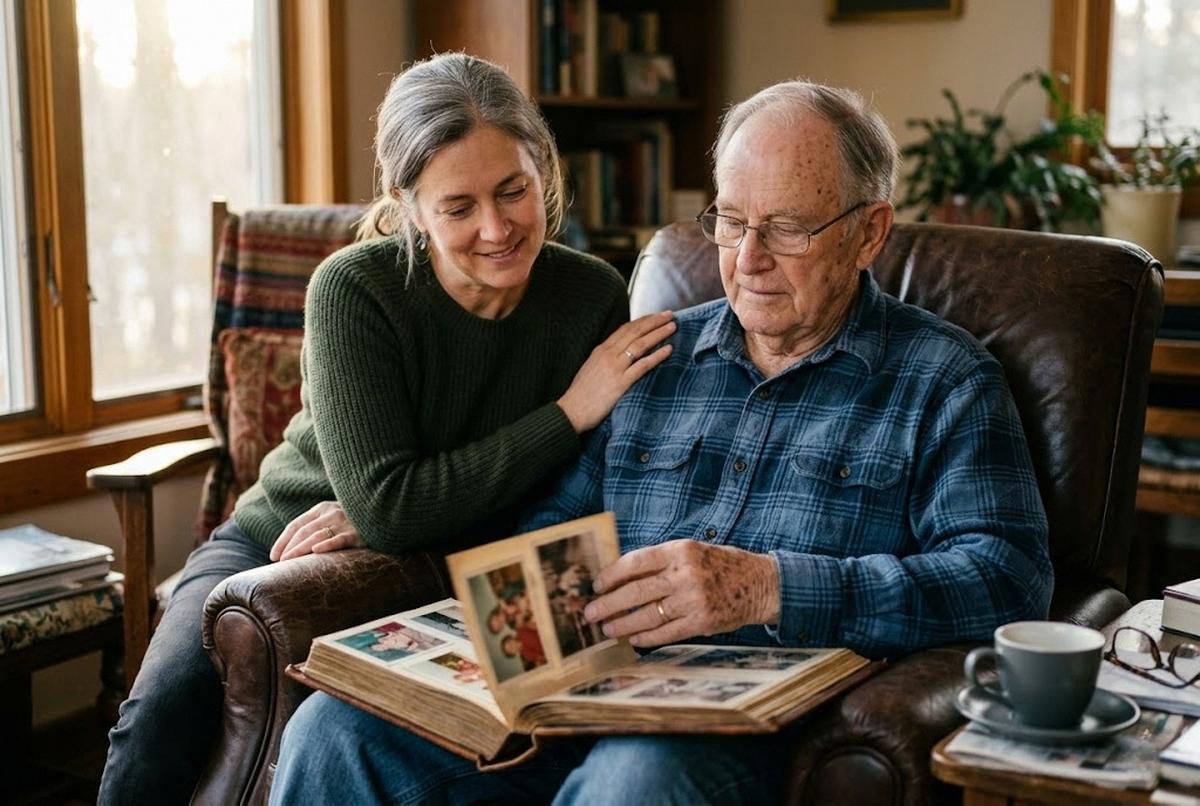
Bring a photo album with names written under the faces. Not a digital frame. A real album with pages he can turn. Write under each photo who is in it and what year. "Robert and Carol, 1968, the year you got married." "You and Daddy, fishing at Lake Murray." The labels matter more than you think. They give him something to read out loud. They give you something to read together.
A weighted lap pad, the kind sold for sensory regulation, runs about forty dollars and settles many fathers in the middle and late stages. A soft polo shirt, easy to pull on, in a color he always liked. A simple watch with large numbers and no smart features — he still wants to know the time, he just can't manage a phone.
What to Leave at the Store
Nothing new with a screen. Not a tablet you'll teach him to use, not a smart speaker, not a video doorbell so he can see his grandchildren. The learning curve a younger brain barely notices is, for him, an exhausting puzzle that ends in frustration. He will associate the gift with the failure, and the gift will end up in a drawer.
Nothing complicated. No board games with rules. No card games beyond what he's played his whole life. No coloring books that suggest you think he is a child.
Nothing overwhelming. A bouquet so large he can't see over it. A balloon arrangement that bobs in the corner of his vision and won't sit still. A card with glitter that flakes onto everything. The senses are working harder than they used to. Less is more. Always.
When He Repeats Himself, or Doesn't Know You
Here is what I have learned in forty years of sitting with families through this: arguing with a brain that no longer makes the same connections is like arguing with the weather. You will lose. Worse, you will leave him distressed and yourself wrung out, and neither of you will remember why.
When he asks the same question for the fifth time, answer it the fifth time the way you answered it the first. Same tone. Same warmth. He is not testing you. He is genuinely meeting the question fresh each time. The repetition is in your experience, not his.
When he looks at you and doesn't know who you are, do not say, "Daddy, it's me, your son." That sentence asks him to perform a recognition he can't make, and the failure becomes a small wound in the middle of a visit that was supposed to be tender. Try instead: "Hi. I'm Michael. I'm so glad to see you today." Reintroduce yourself like a kind stranger. He will often relax. The pressure to remember is the heaviest weight in the room. Lift it off him.
If he calls you by his brother's name, or his father's, answer to it. The relationship he is reaching for is real even if the name is wrong. He is reaching for someone he loved. Let him have that. You are not lying when you sit beside him as the person he thinks you are. You are loving him in the only language he has left.
This is what Naomi Feil called validation. Acknowledge the feeling underneath the confusion. "You miss your brother. I miss him too." "Daddy worked hard, didn't he." The facts may have drifted. The feelings haven't.
If the agitation tends to climb in the late afternoon — a pattern called sundowning — plan your Father's Day visit for the morning. The hours after lunch are not the hours to ask his brain to manage company.
A Story I Carry
I sat with a daughter named Althea last spring at a memory care facility outside Asheville. Her father had been a high school principal — a tall, formal man, the kind who wore a tie to dinner. By the time I met him he was in the late middle stage, sometimes lucid for an hour and then gone again for a day.
Althea had brought a recording on her phone. Her father, twenty years earlier, leading the alma mater at her graduation. She set the phone on the bedside table. She turned it on quietly. She didn't make a thing of it.
He lifted his head. He didn't say anything. But his hand moved across the blanket and found hers, and his thumb moved in a small, deliberate circle on the back of her hand — the same way, she told me afterward, he had held her hand in church when she was a child during the long sermons. He had been gone for most of the morning. For four minutes, listening to himself singing twenty years ago, he was completely there.
When the recording ended he closed his eyes. She didn't try to bring him back. She sat with him another half hour, holding the hand that had remembered her before his face did.
This is what I want you to know on Father's Day. Connection survives the memory. The pathways that carry love are older than the pathways that carry names. He may not know you the way he used to. He still knows you the way the body knows.
The Caregiver in the Room
If you are reading this and you are the one doing the day-in, day-out caring — not a Father's Day visit, but the Tuesday and the Wednesday and the 3 AM — I want to say this directly. You cannot pour from an empty cup. The cup has been empty for a while. Refilling it is not selfish. It is the only way this lasts.
The Alzheimer's Association runs a 24/7 helpline at 800-272-3900. Real people answer, day and night, in more than 200 languages. Call when the visit goes sideways. Call at midnight. Call when you don't know what you need. They will help you find a name for it.
Look into the PACE program if your father is over 55 and meets the medical criteria. PACE — Programs of All-Inclusive Care for the Elderly — covers respite, day programs, and in-home support, often at low or no cost. It is one of the most underused resources in elder care. Medicare also covers up to five consecutive days of inpatient hospice respite care for any father enrolled in hospice, which means you can have a real night's sleep, a real weekend, without the spiral of guilt.
Watch yourself for the signs that the caregiving is starting to take you down. The exhaustion that doesn't lift after a night's sleep. The flatness. The short fuse. The mornings you sit in the car for ten minutes before you can go in. These are not character flaws. They are the body telling you it has been carrying too much for too long.
If your father is starting to refuse care — refusing to bathe, refusing to take his medication, refusing to let an aide in the door — the question of how to help a parent who refuses help is its own quiet study. It is not stubbornness. It is fear with nowhere to go. There are gentler approaches than the ones you may be reaching for.
And if you are still trying to sort out whether what you're seeing in your father is dementia or the kind of forgetting that comes with normal aging, start there. The distinction matters, and you do not have to make it alone.
After the Visit
Driving home from a memory unit on Father's Day is its own private weather. Some of you will cry in the parking lot. Some of you will be numb until you get home. Some of you will feel a strange, guilty lightness — a visit that went better than you expected, and now what do you do with the relief.
Let whatever comes, come. There is no right way to leave. Some of the families I have walked beside take a long way home, stopping at a diner for coffee. Some go straight to a sibling's house and sit on the porch. Some drive to a trail and walk for an hour. The body knows it has been carrying something heavy. Give it somewhere to set the weight down.
What I would ask you to remember, before you start mentally cataloguing what didn't go right — what he didn't say, what he didn't recognize, the moment when the visit cracked — is what did happen. The hand he held. The song he hummed. The quiet ten minutes when he looked out the window with you and didn't need to say anything.
Fathers' Day with a father who has dementia is not the day you used to have. It is a different day, asking different things of you. But it is still a day you spent with him. He felt your presence even where he could not name it. The body remembers the warmth of someone sitting beside it long after the mind has lost the words.
Somewhere in him, the part that is still your father felt you there. You came, and that was the whole point. That has always been the whole point.
May your visit be gentler than you fear. May the song he loved find him today.