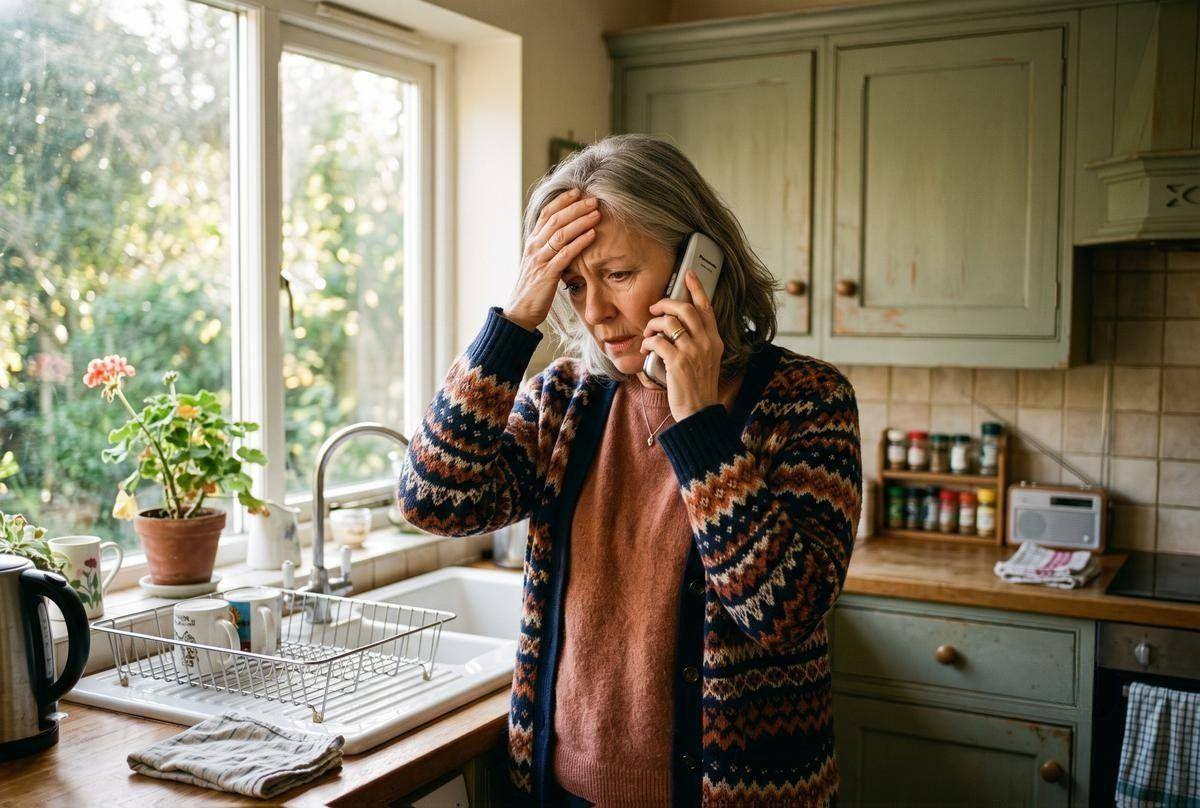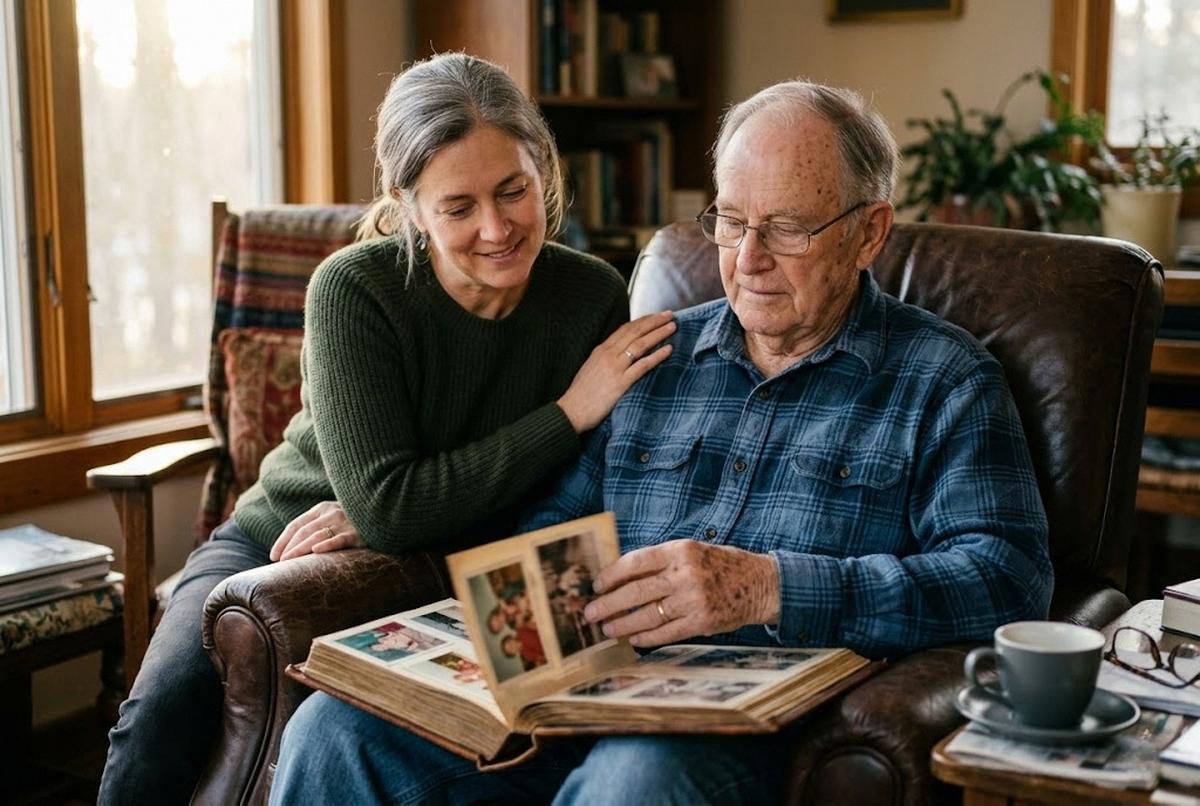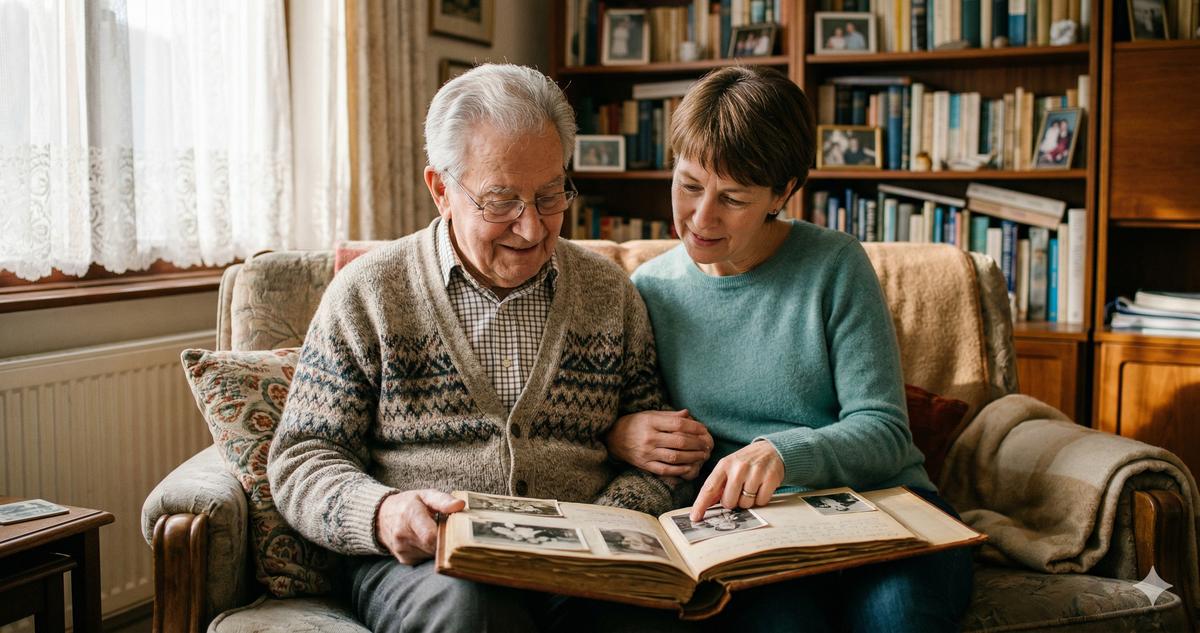
My daughter Amara called on a Saturday morning in February while I was pulling dead basil stalks from the raised beds in my backyard. Gloves on, knees on the kneeling pad, phone wedged between my shoulder and my ear. She didn't start with hello. She started with a question.
"Mom, how did you know? With Grandma. How did you know it wasn't just forgetting?"
Standing up too fast was the first mistake. My back reminded me I'm sixty-eight. The basil stalks dropped into the wheelbarrow and I pulled off one glove, pressed the phone properly against my face, and said, "Tell me what's happening."
A coworker at her agency in Atlanta had a father who'd started repeating questions within the same conversation. Same story twice at dinner, not weeks apart but minutes apart. The family couldn't tell if a seventy-nine-year-old man was simply slowing down or losing ground. The coworker asked Amara because she knew about her grandmother. And Amara called me because she remembered the years I don't talk about often enough.
The real answer takes longer than a phone call. So here it is.
What Normal Aging Does to Memory
Our brains change as we age. This is not disease. It is biology.
The hippocampus, the region most involved in forming new memories, shrinks approximately 1 to 2 percent per year after sixty, according to research in the Proceedings of the National Academy of Sciences. Blood flow decreases. Neurotransmitters slow their delivery. Processing speed drops.
What does this look like? Forgetting a name at a dinner party and remembering it an hour later in the car. Walking into the kitchen and blanking on why you went in there. Taking longer to learn a new phone or a new route to the pharmacy.
Annoying. Sometimes embarrassing. Not dangerous.
The National Institute on Aging calls this "age-related memory change." The distinction worth carrying in your pocket: in normal aging, the memory is still in there. It just takes longer to surface. The word sits on the tip of your tongue. The name comes back. The reason you walked into the kitchen arrives ten minutes later while you're watering the plants. The filing cabinet works fine. The retrieval system runs a little slower.
Every person over sixty at Seasons of Grace has laughed nervously about this. The worried joke about senior moments. The half-serious "I think I'm losing it" over Tuesday morning coffee. I laugh with them, because I forget words too. Last week I called the colander a "pasta drainer thing" for a solid thirty seconds before the right word showed up. Humbling and ordinary and not a reason to panic.
The Signs That Aren't Normal
But some things aren't the slow retrieval of a word that eventually comes. Some things are the word never arriving at all. The file missing, not misfiled.
Sylvia was seventy-six when her daughter brought her to Seasons of Grace. Retired school cafeteria manager, strong opinions about cornbread, thirty years of remembering every child's name on the lunch line. Her daughter sat beside her and said, quietly: "She asked me the same question four times on the drive here. Not over the week. In twenty minutes."
That distinction matters more than almost anything else about memory loss versus dementia.
The Alzheimer's Association publishes ten early warning signs. They are worth knowing because they differ from normal aging in ways you can actually observe:
- Memory loss disrupting daily life. Forgetting entire conversations. Asking the same question repeatedly within minutes. Relying on family members for information you used to handle alone
- Getting lost in familiar places. Not a wrong turn in a new city. Driving to the grocery store you've shopped at for fifteen years and blanking on the route home
- Trouble with familiar tasks. Forgetting how to operate the washing machine. Losing track of how to pay bills you've paid monthly for years
- Confusion about time or place. Losing track of the season entirely. Not understanding where you are or how you got there
- New problems with words. Stopping mid-sentence with no idea what you were saying. Calling objects by wrong names consistently
- Poor judgment. Giving large sums to telemarketers. Wearing a winter coat in July. Neglecting hygiene in someone who was always meticulous
- Withdrawal from activities. Not from pain. Because conversation has become too hard to follow
- Personality changes. Suspicion of family members. Sudden anxiety in comfortable settings. Agitation arriving like weather
Families also notice misplacing things in strange places (keys in the refrigerator, a wallet in the oven) and trouble following a television plot or keeping track of monthly bills when both used to be effortless.
None of these alone proves dementia. Together, or worsening over months, they warrant a doctor's visit. Not next quarter. Soon.
The Space Between: Mild Cognitive Impairment
A middle ground exists, and it has a name. Mild Cognitive Impairment, or MCI, sits between normal age-related changes and dementia. Measurable cognitive decline greater than expected, but daily life still manageable. The person knows something is off. Their family knows too. But the lights are on.
The Alzheimer's Association estimates 12 to 18 percent of adults over sixty have MCI. Not all will develop dementia, and keeping the brain engaged may matter more than people realize. About one-third of those with Alzheimer's-related MCI progress to dementia within five years. Others stay stable. A small percentage improve.
During my mother's early years, before Alzheimer's took the question off the table entirely, this in-between space gave me the most trouble. The not knowing. Watching for signs the way you watch a weather forecast, except the storm might never come, or it might arrive so gradually you can't name the moment the sky changed.
MCI is diagnosed through cognitive testing, medical history, and sometimes brain imaging. The Montreal Cognitive Assessment, or MoCA, takes about ten to fifteen minutes. Your doctor can administer it or refer you to a neuropsychologist. MCI is not a sentence. It is information. And information gives you options.
Your Parent's Annual Wellness Visit Includes a Free Screen
Most families don't know this.
Medicare covers a free Annual Wellness Visit for every beneficiary. Not the same as a regular physical. The Annual Wellness Visit includes a cognitive screening at zero out-of-pocket cost. The Affordable Care Act mandated it. Your parent walks in, and part of the visit is a structured evaluation of memory and thinking.
The catch: not every doctor performs the cognitive screening thoroughly unless you ask. A 2019 study in the Journal of General Internal Medicine found fewer than half of eligible Medicare beneficiaries received a cognitive assessment during their wellness visit. Fewer than half.
So ask. Before the appointment, call the office and say: "My mother is coming in for her Annual Wellness Visit. Please make sure the cognitive screening is included." Put it in writing. A sticky note in her purse. Something she can hand to the nurse.
If the screening raises concerns, Medicare Part B covers a more comprehensive cognitive assessment and care plan. After the 2026 Part B deductible of $283, your parent pays 20 percent coinsurance, with referral to a neurologist or geriatric specialist for definitive testing.
A screening is a starting point, not a diagnosis. But without a starting point, everything after is guesswork.
How to Bring This Up Without Starting a War
I know. You've been dreading this part.
Your parent doesn't think there's a problem. Or they do know, and the knowing terrifies them so deeply they've decided pretending is safer. I understand the impulse. I watched my mother master it for longer than I should have allowed.
Reginald, a retired railroad engineer in his late seventies, came to a caregiver session I led last autumn with his son Vernon. Vernon had noticed his father putting soup cans in the bathroom cabinet, calling the dog by a name from fifteen years ago. When Vernon brought it up, Reginald said: "I'm sharp as a tack. You're the one who can't find his car keys." The room laughed. Vernon's face was tight.
What I told Vernon, and what I'll tell you: lead with love, not evidence. Don't arrive with a list of everything they've forgotten. Don't ambush them at Thanksgiving dinner with three siblings nodding along.
Try: "Dad, I love you and I want to make sure we're taking care of everything. Your doctor's visit is coming up. Would you mind if they checked your memory, just so we have a baseline? Like getting your blood pressure checked."
Baseline. Information. Not accusation. Framing it as routine removes some of the sting.
And if they refuse? Their right, and also heartbreaking. I've sat with enough families to know there's no magic phrase unlocking a closed door. Sometimes the door opens after a fall, or a wrong turn taking an hour to correct, or a pot left on the stove until the smoke alarm goes off. My mother's door opened in 2000 when she drove to the Piggly Wiggly in Savannah and called me from the parking lot because she couldn't remember how to get home. Two miles.
You cannot force it. But you can keep asking gently, and be there when the moment arrives.
What Happens During a Cognitive Evaluation
Knowing what to expect makes everything less frightening.
The evaluation usually starts with a screening tool. The Mini-Mental State Examination, or MMSE, takes about ten minutes and covers orientation, attention, recall, and language. The MoCA is slightly more sensitive and adds executive function and visuospatial testing.
If either screening flags concerns, the next step is a referral to a neuropsychologist or neurologist. A full neuropsychological evaluation runs two to four hours: memory, attention, language, problem-solving, visuospatial skills. Plus a detailed medical history, medication review, and blood work to rule out treatable causes like thyroid dysfunction, vitamin B12 deficiency, or infections.
Brain imaging may follow. An MRI shows structural changes. A PET scan detects amyloid plaques associated with Alzheimer's. And in 2023, the FDA approved Leqembi (lecanemab), the first drug shown to slow cognitive decline in early-stage Alzheimer's. Early detection now means something it didn't five years ago.
Not a verdict. A map. And a map only helps if you pick it up before you're already lost.
Resources and the Call You Can Make Tonight
The Alzheimer's Association 24/7 helpline: 1-800-272-3900. Real people, every hour. Not a recording. Not a phone tree. Someone who will listen while you describe what you've been noticing about your mother, your father, your spouse. Call at midnight, because midnight is when the worry arrives loudest, and someone will pick up.
They also run ALZConnected, a free online community for caregivers. Local chapters offer support groups in every state, many free.
For a geriatrician or memory clinic, the Eldercare Locator at 1-800-677-1116 connects families to local Area Agencies on Aging with dementia-specific programs.
And if your parent has received a diagnosis, or you suspect one is coming, start the conversation now about advance healthcare directives. Power of attorney. Financial plans. Living arrangements. These conversations are brutal. They are also the kindest thing you can do while your parent can still participate in the decisions shaping their care.
Don't wait for certainty. Certainty is a luxury this road does not offer.
What I Wish I'd Known Then
I cared for my mother through four years of Alzheimer's, through the sundowning episodes and the drives between Asheville and Savannah every other week, working full-time, raising Amara alone. Signs I missed. Signs I explained away because the alternative was too frightening.
The first sign wasn't dramatic. She started buying the same can of green beans every time she went to the store. I found eleven cans in her pantry during a visit in 1999. Told myself she just liked green beans. She did like green beans. But eleven cans.
What I wish I'd known: early intervention doesn't mean early despair. It means more time. Time to plan. Time to say the things worth saying while the person you love can still hear them. Time to grieve in manageable pieces instead of all at once when the dam breaks.
The morning Amara called, I was standing in my garden with dirt under my nails and the Blue Ridge foothills half-hidden in February fog. I told her what I've told you here. And then I told her the thing my mother said during one of her last clear conversations, sitting on the porch of her house on East 38th Street in Savannah, sweet tea in her hand, mockingbird going wild in the crepe myrtle.
"Baby, don't be afraid to look. Whatever you find, it's better than not knowing."
She was talking about something else entirely. But she was right about this too.
If you're sitting with this question tonight, turning it over the way you'd turn a stone in your hand, I want you to hear something clearly. Noticing is not betrayal. Asking is not giving up on someone. Calling the doctor, scheduling the screening, writing down what you've observed, this is not panic. It is the purest kind of love.
Mary Oliver wrote: "Someone I loved once gave me a box full of darkness. It took me years to understand that this, too, was a gift."
May you have the courage to open the box. And may you not have to open it alone.