Editor's note (May 2026): This guide has been fully rewritten to reflect California's reinstatement of the Medi-Cal asset limit on January 1, 2026. The asset test that was eliminated in 2024 is back, and this guide now covers the current rules.
Last September, I was at my desk around 9:30 at night, reviewing a client's estate plan. Maggie was reading in the next room, and I could hear her turning pages. Something by Ann Patchett. My phone buzzed. A text from a financial planner I know in Sacramento, a woman named Marlene who handles elder law referrals on the West Coast: "Ben, California ran a full year with no asset limit for Medi-Cal, and first-time senior enrollment more than doubled. You should write about this."
I set my calculator down and read it twice. No asset limit. Not a higher limit. Not a generous limit. No limit at all. For a year and a half, California told its seniors it no longer cared how much they had saved.
And then the state changed its mind. On January 1, 2026, California brought the asset test back. So if you're reading this in 2026, the headline has flipped: there is an asset limit again. But here is the part that still matters, and the reason this guide is worth your time. California set that new limit at $130,000 for an individual, not the $2,000 you'll find in most of the country. Michigan went from $2,000 to $9,950 and even that felt like progress. Florida still sits at $2,000, barely enough to cover a month of groceries. California, even after reversing course, left its seniors with sixty-five times the cushion Florida allows.
Why the reversal? That doubling Marlene mentioned. Once the limit vanished, seniors who had been eligible on income all along finally enrolled, and the caseload, and its cost, climbed fast enough that the 2025-26 state budget reinstated the test to slow the spending. The whiplash is real, and I won't pretend otherwise. But the bones of California's program are still unusually generous, starting with the fact that it isn't even called Medicaid. It's Medi-Cal. Same federal framework, same basic structure, but the name is different and so is almost everything else. The state runs its program through 58 county offices, each with its own staff and its own processing quirks. It offers In-Home Supportive Services (IHSS), a program so unlike anything in other states that families moving from Florida or Michigan don't believe me when I describe it.
I sat in my study thinking about my mother Ruth. She's 89, in assisted living in Hartford, and every Sunday I drive 90 minutes to visit her. Her care costs $7,200 a month. Connecticut's asset limit is $1,600. We spent months on a legally compliant spend-down when she first needed help: prepaid funeral, home repairs, legal fees, the entire checklist I've walked a hundred families through. If she'd been in California, almost none of it would have been necessary. Even under the reinstated $130,000 limit, her modest savings would have sat untouched.
What follows is the guide I'd hand to any family with a parent in California who needs long-term care. Every dollar amount, phone number, and form name is California-specific.
Medi-Cal Is Not Your State's Medicaid
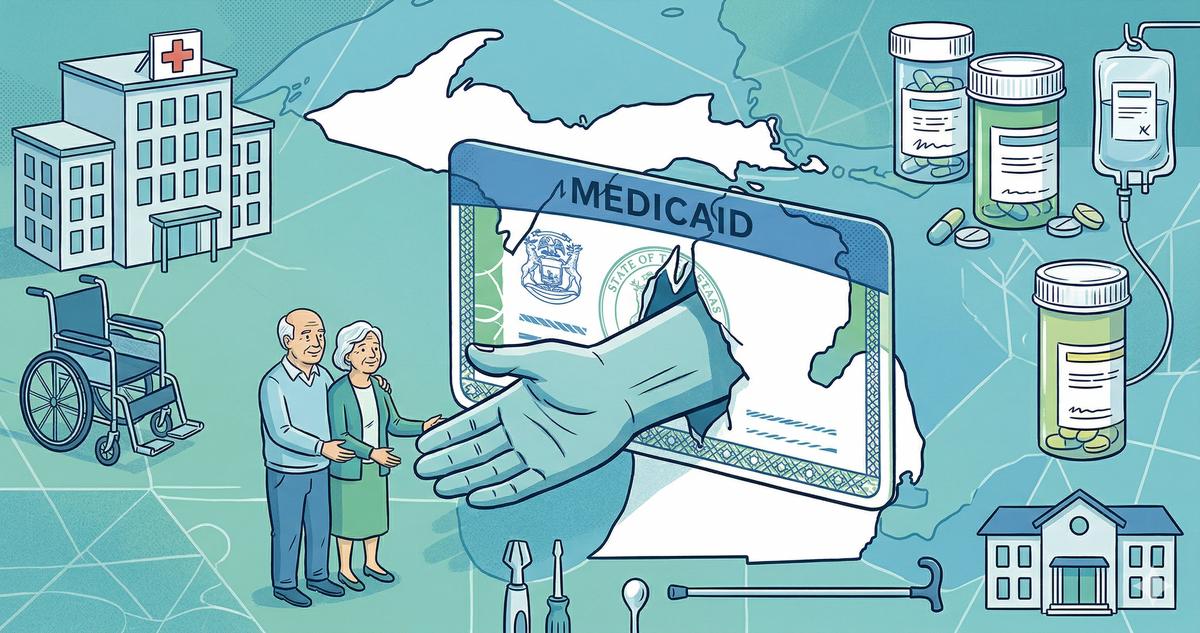
California's Medi-Cal program covers over 15 million residents, making it the largest Medicaid program in the country by enrollment. For seniors needing long-term care, the system works differently from what you'll find in almost any other state.
Three structural differences matter immediately.
First, county administration. Unlike states where a single agency processes all applications, California delegates Medi-Cal eligibility to county social services departments. If your parent lives in Los Angeles County, you'll work with the Department of Public Social Services (DPSS). In San Francisco, it's the Human Services Agency. In San Diego, the Health and Human Services Agency. Each county has its own office, its own application center, and its own processing timeline. The experience varies depending on where your parent lives.
Second, Medi-Cal Managed Care. Most Medi-Cal beneficiaries are enrolled in managed care plans rather than receiving services on a fee-for-service basis. Your parent will choose (or be assigned) a managed care plan to coordinate their healthcare. Plans vary by county. In Los Angeles, options include L.A. Care Health Plan and Health Net. In San Diego, it's Molina and Community Health Group. Knowing which plans operate in your parent's county matters because networks, covered providers, and responsiveness differ.
Third, CalAIM. California launched its CalAIM (California Advancing and Innovating Medi-Cal) initiative to restructure how the state delivers services. For seniors, the most relevant piece is Enhanced Care Management (ECM) and Community Supports, which provide coordinated care for high-need populations including older adults with complex conditions. If your parent has multiple chronic illnesses or is transitioning out of a hospital, CalAIM's ECM program assigns a care manager who coordinates everything: medical visits, social services, housing support. It's the kind of program worth fighting to get enrolled in, though the process takes persistence.
The 2026 Asset Limit: $130,000
Here's where California still diverges from nearly every other state, even after the 2026 reversal.
Asset limit: $130,000 for an individual ($195,000 for a couple, plus $65,000 for each additional household member). That's the rule as of January 1, 2026. Countable assets above that line will disqualify your parent, the same way they would in any other state. But hold that $130,000 up next to the $2,000 limit Florida and most of the country still use. On top of the home, a car, and a prepaid funeral (none of which count), your parent can keep up to $130,000 in countable savings and still qualify. In practical terms, the large majority of seniors who need Medi-Cal are nowhere near that ceiling.
How we got here matters, because the rules whipsawed. California Assembly Bill 133, signed in 2021, phased out the asset test in two stages: the limit rose from $2,000 to $130,000 on July 1, 2022, then disappeared entirely on January 1, 2024. For two years there was no asset test at all. Then the 2025-26 state budget reversed course, and on January 1, 2026, the $130,000 limit came back. So if you find an older guide (or an older version of this one) promising "no asset limit," that window has closed. The current rule is the $130,000 cap, and it applies to aged, blind, and disabled Medi-Cal, to nursing home coverage, and to home and community-based services.
Income limits depend on the eligibility pathway:
For seniors 65 and older (Aged & Disabled Federal Poverty Level program): The income limit is 138% of the Federal Poverty Level, which for 2026 is approximately $1,836 per month for an individual or $2,490 for a couple. This is the pathway most seniors use.
For SSI recipients: If your parent receives Supplemental Security Income, they are automatically enrolled in Medi-Cal. No application needed. The enrollment is linked to SSI eligibility.
For the Aged, Blind, and Disabled Medically Needy program: If your parent's income exceeds the standard limits, California offers a share-of-cost pathway. Medical expenses are deducted from income until the remainder falls below the Maintenance Need Income Level (MNIL), which is $600 per month for an individual. The share of cost, meaning what your parent pays before Medi-Cal kicks in, equals their income minus $600. So if your parent's income is $2,400 per month, their share of cost is $1,800. Medi-Cal covers everything after.
For nursing home residents: The income threshold for Medi-Cal long-term care is $2,982 per month (300% of SSI). If your parent's income exceeds this, California allows an income trust similar to a Miller Trust, though it's far less common here because most seniors qualify through the standard pathways or the share-of-cost program.
Personal needs allowance: $35 per month. When your parent is in a nursing home on Medi-Cal, they keep $35 per month for personal expenses. The rest of their income goes toward the cost of care. I know. Thirty-five dollars. It's the lowest in the country and it's been at $35 since 1989. There's been talk in Sacramento about raising it for years. So far, nothing.
Irene was 74, a retired librarian from San Bernardino County whose daughter reached out to me through a workshop attendee. Irene had $89,000 in savings, money she'd been terrified to touch because she thought spending it wrong would disqualify her from Medi-Cal. She'd been eating canned soup for dinner three nights a week to preserve her savings. Her daughter found the pantry stacked with Campbell's chicken noodle. Twelve cans deep!
Irene qualified for Medi-Cal. At $89,000, her savings sat comfortably under California's $130,000 limit, so they never threatened her eligibility. She'd been rationing soup for eight months based on outdated information from a neighbor who remembered the old $2,000 rule.
IHSS: California's Home Care Program
If there's one program setting California apart from every other state, it's In-Home Supportive Services. IHSS is the reason families relocate to California for elder care. I'm not exaggerating!
IHSS provides personal care services to Medi-Cal beneficiaries who are aged (65+), blind, or disabled and need help to remain safely in their homes. (If you're weighing the real costs of aging in place, IHSS changes the math dramatically.) The program pays for a caregiver, and here's the part most people don't expect: the caregiver can be a family member. Your daughter. Your son. Your spouse. California will pay them an hourly wage to provide your care.
The services covered include:
- Housecleaning and meal preparation
- Laundry
- Grocery shopping and errands
- Personal care (bathing, grooming, dressing, oral hygiene)
- Feeding and meal cleanup
- Paramedical services (administered by a non-medical person under medical supervision, such as wound care, injections, catheter care)
- Accompaniment to medical appointments
- Protective supervision for those with cognitive impairments who can't safely be left alone
Each recipient is assessed individually by a county social worker who determines how many hours per month they need. The maximum is 283 hours per month, roughly 9.4 hours per day, which constitutes a near-full-time caregiver. Hours are assigned based on functional need. Someone who needs help only with housecleaning and meal prep might receive 40 hours per month. Someone who needs full personal care and protective supervision could receive the maximum.
The IHSS provider (caregiver) wage varies by county. In Los Angeles County, it's about $19.64 per hour as of 2026. In San Francisco, it reaches $23.00. The statewide floor is $16.90 (California's minimum wage), and counties update their rates roughly twice a year. These wages are paid by the state and county, not by your parent. Your parent pays nothing for IHSS services.
Theodore was 81, a retired machinist from Bakersfield. When I heard "retired machinist" I thought of my father Arthur, who spent 40 years at Pratt & Whitney. Same generation, same hands-on work, same stubbornness about asking for help. Theodore's daughter applied for IHSS after he fell twice in one month. The county assessed him at 195 hours per month. His daughter became his paid IHSS provider at Kern County's rate, around $16.90 per hour. That's roughly $3,295 per month, paid by the state, for his daughter to provide care she'd been providing for free. The family went from drowning to stable in a single enrollment!
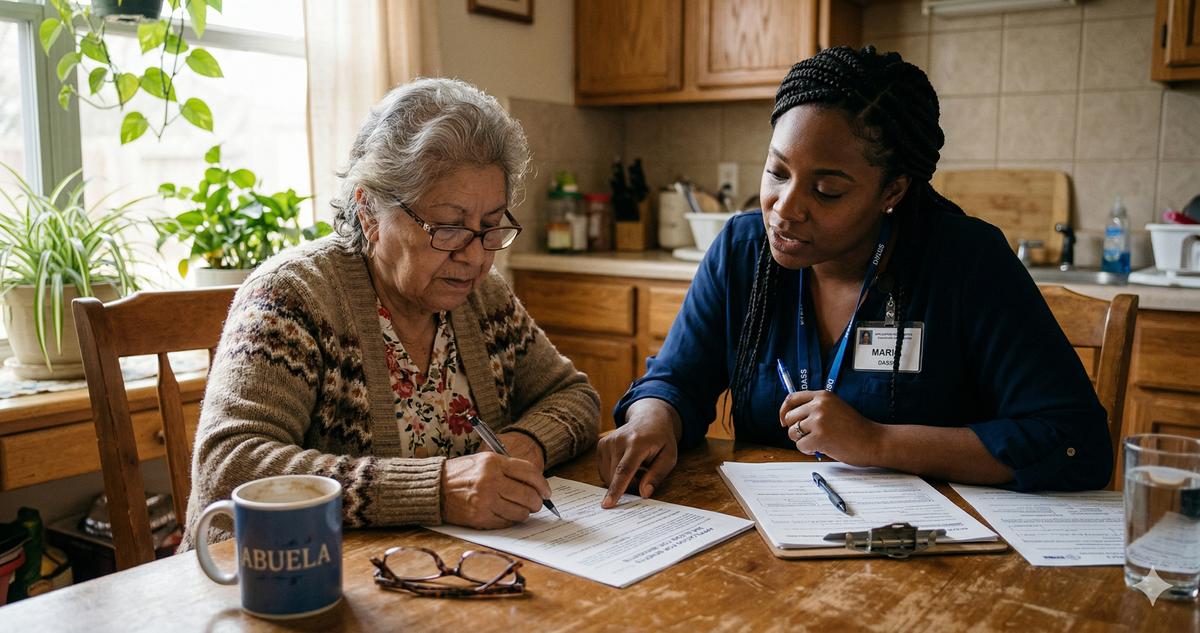
To apply for IHSS, contact your parent's county social services department or call the statewide IHSS information line. After the application, a county social worker will schedule an in-home assessment, usually within 30 days. Bring a list of everything your parent needs help with. Be specific. Don't say "she needs help around the house." Say "she cannot lift her arms above her shoulders, which means she can't wash her own hair, reach the upper cabinets, or hang laundry. She fell getting out of the bathtub on March 3rd and again on March 19th." The assessment determines hours. Specificity determines the assessment.
CBAS and MSSP: Additional Community Programs
California runs two additional programs for seniors most states don't offer.
Community-Based Adult Services (CBAS) is California's version of adult day health care, but with a medical component going well beyond what most states provide. CBAS centers offer nursing care, physical and occupational therapy, mental health services, meals, social activities, and transportation, all in a structured daytime setting. Your parent attends a CBAS center during the day and returns home in the evening.
CBAS eligibility requires Medi-Cal enrollment and a determination the individual would otherwise need nursing home placement. The program is available only through Medi-Cal managed care plans. Your parent's managed care plan authorizes CBAS services and coordinates enrollment.
There are approximately 275 licensed CBAS centers statewide, concentrated in urban areas. Los Angeles County alone has over 70. Rural areas have fewer options, which is the program's primary limitation.
Multipurpose Senior Services Program (MSSP) is a care management and service coordination program for frail seniors at risk of nursing home placement. MSSP provides a case manager who coordinates services including adult day care, housing assistance, home modifications, respite care, transportation, and protective supervision.
MSSP eligibility: 65 or older, certified as needing nursing home level of care, enrolled in Medi-Cal. The program operates through 40 MSSP sites statewide, each managed by a local organization (often the Area Agency on Aging).
The practical difference between IHSS, CBAS, and MSSP is scope. IHSS pays for a caregiver in your parent's home. CBAS provides structured daytime care at a center. MSSP assigns a case manager who coordinates multiple services. Many California seniors use two or all three simultaneously.
Spousal Protections
When one spouse needs Medi-Cal-funded nursing home care and the other remains at home (a situation covered in our national Medicaid and assisted living overview), California follows the federal spousal impoverishment protections, and with the asset test back in 2026 those protections matter again.
Here's how it works in 2026. The spouse who stays home (the "community" spouse) can keep up to the Community Spouse Resource Allowance (CSRA), which is $162,660 this year. That figure is set federally, so it's the same in Florida or Michigan. What's different in California is the other half: the spouse who needs care (the "institutionalized" spouse) can keep up to $130,000, where most states hold that spouse to $2,000. Add it up and a California couple can protect roughly $293,000 in countable assets, plus the exempt home and a car, and still qualify, about $130,000 more than the same couple could shelter in Florida.
The income protections still apply:
Minimum Monthly Maintenance Needs Allowance (MMMNA): $4,067 per month (2026). If the community spouse's own income falls below this, they can divert a portion of the institutionalized spouse's income to reach the floor.
Excess shelter allowance. If the community spouse's housing costs (mortgage or rent, property taxes, insurance, utilities) exceed a standard amount, the MMMNA can be increased. This is calculated on a case-by-case basis and matters enormously in California, where housing costs in Los Angeles, San Francisco, and San Diego routinely dwarf the national average.
Roberta was 72, living in a two-bedroom apartment in Glendale. Her husband Gordon, 78, needed memory care after an Alzheimer's diagnosis progressed to the point where she couldn't manage his wandering. Their combined savings were $167,000. In Florida, Gordon would have needed to spend down to $2,000. In Michigan, to $9,950. In California, the couple's $167,000 was fully protected. Gordon could keep up to $130,000 as the institutionalized spouse, and Roberta's share fell well within her $162,660 CSRA, so there was nothing to spend down. Her rent was $2,850 per month (typical for Glendale), and the excess shelter allowance pushed her MMMNA above the standard floor. Gordon's Social Security and pension covered his share of cost at the nursing facility. If you're also wondering what happens to a spouse's Social Security after they pass, the answer matters for long-term financial planning. Roberta kept her savings.
I told this story to a colleague in Connecticut and he asked me to repeat the numbers. Twice. In his state, that same couple would have been spending down to almost nothing.
Estate Recovery: What Happens After Death
California changed its estate recovery rules significantly in recent years, and the current rules are more favorable to families than in most states.
Under federal law, states must attempt to recover Medicaid costs from the estates of deceased beneficiaries. California's Department of Health Care Services (DHCS) operates the Medi-Cal Estate Recovery program. But in 2017, California narrowed the scope of what it recovers.
Prior to 2017, California recovered costs for all Medi-Cal services received after age 55, which could include doctor visits, prescriptions, and outpatient care, not just nursing home costs. Assembly Bill 833 (2016) limited recovery to only nursing facility services, IHSS, and certain home and community-based services. Routine Medi-Cal costs like doctor visits and medications are no longer subject to estate recovery.
What this means in practice: if your parent received Medi-Cal for 10 years but only spent the last 18 months in a nursing facility, California can only recover the cost of those 18 months, not the decade of general Medi-Cal coverage.
Key estate recovery rules in California:
- Recovery only from the probate estate. If assets pass outside probate (through a living trust, joint tenancy, or beneficiary designations), they are generally not subject to recovery.
- Recovery is deferred while a surviving spouse is alive. No claim is filed until both spouses have passed.
- A hardship waiver is available. If estate recovery would result in an heir losing their primary residence or a family business, DHCS may reduce or eliminate the claim.
- The claim expires if not filed within one year of the beneficiary's death.
A revocable living trust (common in California, where high home values make probate especially slow and costly) typically removes the home from the probate estate. The home passes to beneficiaries without going through probate and without being subject to Medi-Cal estate recovery. No special deed required. No five-year look-back concern. The trust your parent may already have in place does the work.
But, and I have to say this, don't assume. Have an elder law attorney review the trust language. A poorly drafted trust, or one never funded (meaning the house was never actually transferred into the trust), won't provide the protection you expect.
The Look-Back Period
California uses a 30-month look-back for nursing home Medi-Cal, not the 60-month window most other states use. Read it again. Thirty months, not five years. That's a real, lasting advantage.
But there's a 2026 wrinkle, and it matters. While the asset test was gone (2024 through 2025), the look-back was largely a dead letter. With no asset limit, there was little reason to give assets away to qualify, and little reason for the state to scrutinize transfers. That changed on January 1, 2026. With the $130,000 asset limit back, transfer penalties are live again, and gifting or selling assets for less than fair market value can once more delay your parent's coverage.
Here's the part to understand. The reinstated look-back only counts transfers made on or after January 1, 2026, and it is phasing in: the window grows one month at a time until it reaches the full 30 months in July 2028. So a gift your parent made back in 2023 or 2024 is not penalized, but one made now is squarely in play. The look-back applies to nursing home Medi-Cal under the Aged, Blind, and Disabled pathway.
How the penalty works: the state divides the amount transferred by the average monthly cost of private nursing home care, which California sets at $14,440 for 2026. Transfers smaller than that monthly figure are not counted at all, and a person whose assets are already under the limit can gift freely.
Evelyn, 80, from Riverside County, gave her grandson $25,000 in early 2026, a few months before she needed nursing home care. Because the gift came after January 1, it fell inside the new look-back. Dividing $25,000 by the $14,440 divisor produced a penalty of roughly 1.7 months of ineligibility, during which the family paid out of pocket. In Florida, with its 60-month look-back, the same gift would have been caught too. The lesson holds in either state: once an asset test is in place, gifts inside the look-back window carry consequences, so plan any transfers with an elder law attorney before you make them.
How to Apply: Step by Step
Here's exactly what to do. In order.
Step 1: Determine which county handles your parent's application.
Medi-Cal applications are processed by the county where your parent lives. Find the county social services office:
- Los Angeles County DPSS: (866) 613-3777, dpss.lacounty.gov
- San Francisco HSA: (415) 557-5000, sfhsa.org
- San Diego HHSA: (866) 262-9881, sandiegocounty.gov/hhsa
- Orange County SSA: (800) 281-9799, ssa.ocgov.com
- Sacramento County DHA: (916) 874-3100
For any county, you can start with the statewide Medi-Cal line: 1-800-541-5555.
Step 2: Apply online, by mail, by phone, or in person.
Online: Use Covered California at CoveredCA.com or BenefitsCal at BenefitsCal.com (California's newer integrated benefits portal). The online application for Medi-Cal is the SAWS 2 Plus (Statewide Application for Social Services). It takes 20-40 minutes to complete.
By phone: Call 1-800-541-5555 (Medi-Cal hotline) and request a phone application. Available Monday through Friday, 8 AM to 5 PM Pacific.
By mail or in person: Download the SAWS 2 Plus application from your county's website or pick up a copy at the county social services office. Mail it to the county office or hand-deliver it.
Step 3: Gather supporting documents.
Because California's look-back runs 30 months rather than the 60 months Florida and Michigan use, you won't need five full years of bank statements. But with the asset test back in 2026, you will need to document your parent's countable assets. What you will need:
- Proof of identity (driver's license, state ID, passport)
- Proof of California residency (utility bill, lease, mortgage statement)
- Proof of citizenship or immigration status
- Social Security number
- Proof of income: Social Security benefit verification letter (request at ssa.gov or call 1-800-772-1213), pension statements, any other income documentation
- For couples: both spouses' income documentation
- If applying for nursing home Medi-Cal: medical records, physician's certification of need for skilled nursing care
Step 4: Complete the medical eligibility determination (for long-term care).
If your parent needs nursing home or home-based long-term care, a medical assessment determines whether they meet the Nursing Facility Level of Care (NF-LOC) standard. This assessment is typically coordinated by the managed care plan or the county. Your parent must need substantial assistance with Activities of Daily Living or have a medical condition requiring skilled nursing oversight.
Step 5: Enroll in a Medi-Cal managed care plan.
Once approved, your parent selects a managed care plan. Most counties require managed care enrollment. Health Care Options, California's enrollment broker, helps beneficiaries choose: call 1-800-430-4263 or visit healthcareoptions.dhcs.ca.gov.
Step 6: Apply for IHSS (if seeking in-home care).
IHSS requires a separate application through the county social services department. After the application, a county social worker schedules an in-home assessment. Apply as soon as Medi-Cal eligibility is confirmed, or even simultaneously, since both processes can run in parallel.
Step 7: Respond to every county request immediately.
California counties must process Medi-Cal applications within 45 days (or 90 days for disability-related applications). But requests for additional documentation pause the clock. When the county sends a notice asking for your parent's pension statement or proof of residency, respond the same day if possible. Missing a 10-day response window can result in denial.
Processing time: 45 days for standard Medi-Cal applications. Up to 90 days for Aged, Blind, and Disabled pathways. IHSS assessments are typically scheduled within 30 days of application.
If You're Denied
Denials happen, even in a state as generous as California. Common reasons include income above the threshold without a share-of-cost determination, incomplete documentation, failure to respond to a county verification request, or a finding your parent doesn't meet the nursing facility level of care.
Your right to appeal:
California calls it a State Fair Hearing, administered by the California Department of Social Services (CDSS). You have 90 days from the date on the denial notice to request a hearing.
How to request a hearing:
- Call: 1-800-952-5253 (State Hearings Division)
- Online: acms.dss.ca.gov
- By mail: California Department of Social Services, State Hearings Division, P.O. Box 944243, Sacramento, CA 94244-2430
An administrative law judge reviews the case. You can present documents, bring witnesses, and have an attorney or advocate represent you.
Free legal help for Medi-Cal appeals in California:
- Health Consumer Alliance: 1-888-804-3536 (statewide Medi-Cal help line, available in multiple languages)
- Legal Aid societies by county: Find yours at LawHelpCA.org
- Justice in Aging: justiceinaging.org (specializes in Medi-Cal for older adults)
- Bet Tzedek Legal Services (Los Angeles): (323) 939-0506
- HICAP (Health Insurance Counseling and Advocacy Program): 1-800-434-0222 (free Medicare and Medi-Cal counseling)
Every Number, Website, and Form You Need
I keep a printed copy of this section in my files. You should too.
State Agencies:
- Medi-Cal Hotline: 1-800-541-5555
- DHCS (Department of Health Care Services): dhcs.ca.gov
- BenefitsCal (online application portal): BenefitsCal.com
- Covered California: CoveredCA.com
- Health Care Options (managed care enrollment): 1-800-430-4263, healthcareoptions.dhcs.ca.gov
- IHSS statewide information: cdss.ca.gov/ihss
- State Hearings Division: 1-800-952-5253
- California Department of Aging: aging.ca.gov
Key County Offices:
- Los Angeles County DPSS: (866) 613-3777
- San Francisco HSA: (415) 557-5000
- San Diego County HHSA: (866) 262-9881
- Orange County SSA: (800) 281-9799
- Sacramento County DHA: (916) 874-3100
- Alameda County SSA: (510) 263-2420
- Riverside County DPSS: (877) 410-8827
Key Forms:
- SAWS 2 Plus: Statewide Application for Social Services (Medi-Cal application)
- MC 210: Medi-Cal supplemental information form
- SOC 295: IHSS application (In-Home Supportive Services Program Application)
- SOC 426: IHSS Reassessment/Change Reporting Form
- MC 4035: Share of Cost Information Notice
Free Counseling and Legal Help:
- Health Consumer Alliance: 1-888-804-3536
- HICAP (Health Insurance Counseling): 1-800-434-0222
- Legal Aid at Work: legalaidatwork.org
- LawHelpCA: lawhelpca.org (directory of free legal services by county)
- Justice in Aging: justiceinaging.org
- National Academy of Elder Law Attorneys: naela.org
- Eldercare Locator: 1-800-677-1116
- Benefits screening: benefitscheckup.org
California PACE Providers:
- On Lok PACE: San Francisco, onlok.org (the original PACE program, founded 1971)
- AltaMed PACE: Los Angeles County, altamed.org
- Center for Elders' Independence: Alameda and Contra Costa counties, cei.elders.org
- Brandman Centers for Senior Care: Reseda (LA), brandman.org
- San Diego PACE: St. Paul's PACE, stpaulspace.org
- CalOptima PACE: Orange County, caloptima.org
- Inland Empire Health Plan PACE: Riverside/San Bernardino, iehp.org
For Veterans:
- VA Aid and Attendance: 1-800-827-1000 (2026 maximums: about $2,424/month for a single wartime veteran, about $1,558/month for a surviving spouse)
- CalVet (California Department of Veterans Affairs): 1-800-952-5626, calvet.ca.gov
What I'd Tell Sarah and David
I don't usually end these guides with personal notes. The Florida guide ends with what I'd tell you at a kitchen table, and the Michigan guide does too. But this one's different, because writing about California's system, a state that still lets seniors keep a real cushion of savings instead of stripping them to $2,000, made me think about my own kids.
Sarah is 28, a pediatric resident at Yale-New Haven with $247,000 in student loans. David is 31, working in tech in Austin with an apartment full of standing desks and no renter's insurance. They're decades away from needing any of this. But decades pass. I know because I watched them pass for my father Arthur, who went from a man who could machine a turbine blade to a man who clapped when the TV crowd clapped because he couldn't follow the game anymore.
What I'd tell them, and what I'd tell you, is California got something right. The idea of a person who saved responsibly their entire life having to drain every account to $2,000 before they can receive help? Always cruel. It punished the prepared. California, even after bringing its asset test back, still refuses to strip seniors to $2,000. It lets them keep $130,000. Your savings, by and large, stay yours, and the state helps you anyway.
If your parent lives in California and needs care, call 1-800-541-5555 tomorrow. The Medi-Cal hotline. Tell them your parent's county, their age, and their income. Ask about IHSS. Ask about managed care enrollment. Ask about CBAS if your parent needs daytime supervision. The person on the other end has answered this question a thousand times. Let them answer it for you.
And if your parent doesn't live in California, if they're in a $2,000-asset-limit state, watching their savings with one eye and their health with the other, find an elder law attorney through NAELA (naela.org) and start planning now. Not next month. Not when things get worse. Now. The rules are complicated. The paperwork is thick. But the programs exist because someone, somewhere, decided your parent's final years shouldn't be spent in fear.
My mother Ruth asked me last Sunday if I'd eaten lunch. I said I had, even though I hadn't. She worries. She's 89, her memory comes and goes, but she still worries about whether her son is eating. I want her last years to have as little fear in them as possible. I want the same for your parent.
Find a HICAP counselor in your parent's county. One phone call to 1-800-434-0222. They do this every day and they'll walk you through it.