Eighty-three hundred dollars. That is roughly the median cost of a funeral with a viewing and a burial in this country, according to the most recent national data from the National Funeral Directors Association. Add a cemetery plot, a headstone, and the fee to open and close the grave, and a family can clear eleven or twelve thousand dollars before the flowers are paid for.
Almost nobody explains the useful part during the worst week of someone's life: a large share of that bill is optional, and federal law gives you more power to lower it than the industry likes to advertise. I've spent 35 years helping older people protect money they worked decades to earn. Funerals are the one purchase where grief does the negotiating, and the result is exactly what you'd expect.
Let me walk you through what things actually cost, what you're allowed to refuse, and why the prepaid plan a salesperson is pushing may be the worst place to park the money.
What a Funeral Actually Costs
Start with the headline figures, and understand what they include. The most recent national survey puts the median funeral with viewing and burial at roughly $8,300. Swap the burial for cremation and you're at about $6,280. Both of those medians leave out the cemetery (no plot, no marker, no open-and-close fee), and they leave out what the trade calls cash-advance items, the flowers and death certificates and clergy honorarium the funeral home fronts on your behalf.
Here is where the money goes, and I'll use medians because the real numbers swing by region and by home. The basic services fee runs around $2,495. That one is non-declinable. Every funeral home charges it whether you choose burial or cremation, and you cannot opt out of it. After that, almost everything is a choice. Transferring the body to the funeral home: roughly $300 to $700. Embalming and preparation: about $845. A burial vault, the outer container the cemetery often requires: around $1,800. The casket is the big variable, with median prices running from $2,500 to well over $5,000. A viewing adds $400 to $800. The ceremony itself, another $400 to $800. The hearse, $300 to $500.
Notice how those pieces stack. The casket and the vault alone can outweigh every service the funeral director actually performs. A family in shock tends to read the package price at the top of the page and stop reading. Don't stop reading! The itemized list underneath is where your decisions live.
One caution about these figures. That national survey is done every other year, and the numbers I'm quoting are the latest published set, not fresh 2026 prices pulled this morning. Treat them as a reliable map, not a live GPS. Your local costs may sit above or below them.
The Number They Quote Is Rarely the Number You Pay
The package price a funeral home quotes almost never includes the cemetery. That is a separate business, a separate bill, and it is not small.
A plot, a headstone, and the fee to open and close the grave commonly add another $2,000 to $5,000 on top of the funeral home's charges. So the family that budgeted $8,300 for a burial can find the true, all-in figure closer to $11,000 or more once the ground is accounted for. The cremation median has the same gap built in: it excludes the cemetery items and the cash-advance markups a home may quietly add to what it paid the florist. Ask, in writing, what is bundled and what is not. The word "complete" on a brochure has no legal definition.
Your Rights Under the Funeral Rule
Most people have never heard of the Funeral Rule, and it is one of the strongest consumer protections you'll ever use. The Federal Trade Commission has enforced it since 1984. It exists because, before it, families were routinely told they had to buy the package or nothing.
Here is what the rule guarantees you. You can get a printed, itemized General Price List, in person, that you are allowed to keep and take home. You can get prices over the phone without giving your name. You must be shown separate price lists for caskets and for outer burial containers. You can buy à la carte, picking only the goods and services you want, with no forced package. You can supply your own casket or urn bought elsewhere, and the funeral home cannot charge you a handling fee for it. Embalming is not required by law in most situations; choosing direct cremation or an immediate burial avoids it entirely. And any markup on those cash-advance items has to be disclosed.
That's a genuinely powerful set of rights. The problem is that funeral homes don't always honor them. In an undercover sweep the FTC reported on in 2024, callers phoned 278 funeral homes. During business hours, 7 percent still wouldn't give prices over the phone. After hours, 26 percent wouldn't. Both numbers are violations of a rule that has been law for four decades.
And don't expect the fine print to modernize soon. The FTC opened a review back in November 2022 and held a workshop in September 2023, but it has finalized no changes. As of today, funeral homes are still not required to post prices online. Phone and in person are the only guaranteed ways to comparison shop. I find that maddening in a year when I can price a refrigerator from my recliner, but the reality is what it is, so plan around it.
The Prepaid Trap
This is the section I most wanted to write, because it's where I watch careful, responsible people lose money by trying to do the right thing.
Prepaying your funeral feels like a gift to your children. You lock in today's price, you spare them the decisions, you check the box. The trouble is what happens to your money between the day you hand it over and the day it's needed, which could be fifteen or twenty years later. Where does it sit? Who controls it? And what happens if the funeral home closes, sells, or the owner turns out to be a thief?
State law is the whole ballgame here, and it is wildly uneven. Only about half the states require a funeral home to place 100 percent of your prepaid money in trust. New York and New Jersey do. New York even requires a full refund plus interest if you cancel a revocable plan. Hawaii requires only 70 percent, meaning up to a third of your payment can be spent by the business the day it clears. This is general information, not legal advice, and the details turn entirely on which state you're in, so confirm your own state's rule before you sign anything.
Now the part that keeps me up. When the money isn't fully protected, it can vanish. In Huron County, Michigan, a funeral director was charged in late 2025 and sentenced in May 2026 after prosecutors said he misused prepaid funds from more than 200 families, with a restitution figure that ran to roughly $1.1 million. In Connecticut, a funeral home operator was charged in 2025 in a case involving more than 120 customers whose prepaid money, prosecutors say, was never placed in escrow. Those are not exotic outliers. The Funeral Consumers Alliance reports that at least a third of the complaints it receives involve prepaid funerals: survivors who never knew a plan existed, terms nobody understood, a surprise balance still owed at the worst possible moment.
Even when no crime is involved, prepaid plans strand money. Move to be near your daughter in another state and your plan may not travel. The home that holds your contract closes, and your family is left arguing with whoever bought the assets. That is why the Funeral Consumers Alliance, AARP, and the Consumer Federation of America all say the same thing: in most cases, don't prepay. The premiums can end up equaling the payout, and the money is far too easy to lose.
The Safer Way to Set the Money Aside
So how do you protect your family from a five-figure bill without handing your cash to a funeral home for twenty years? You keep control of it.
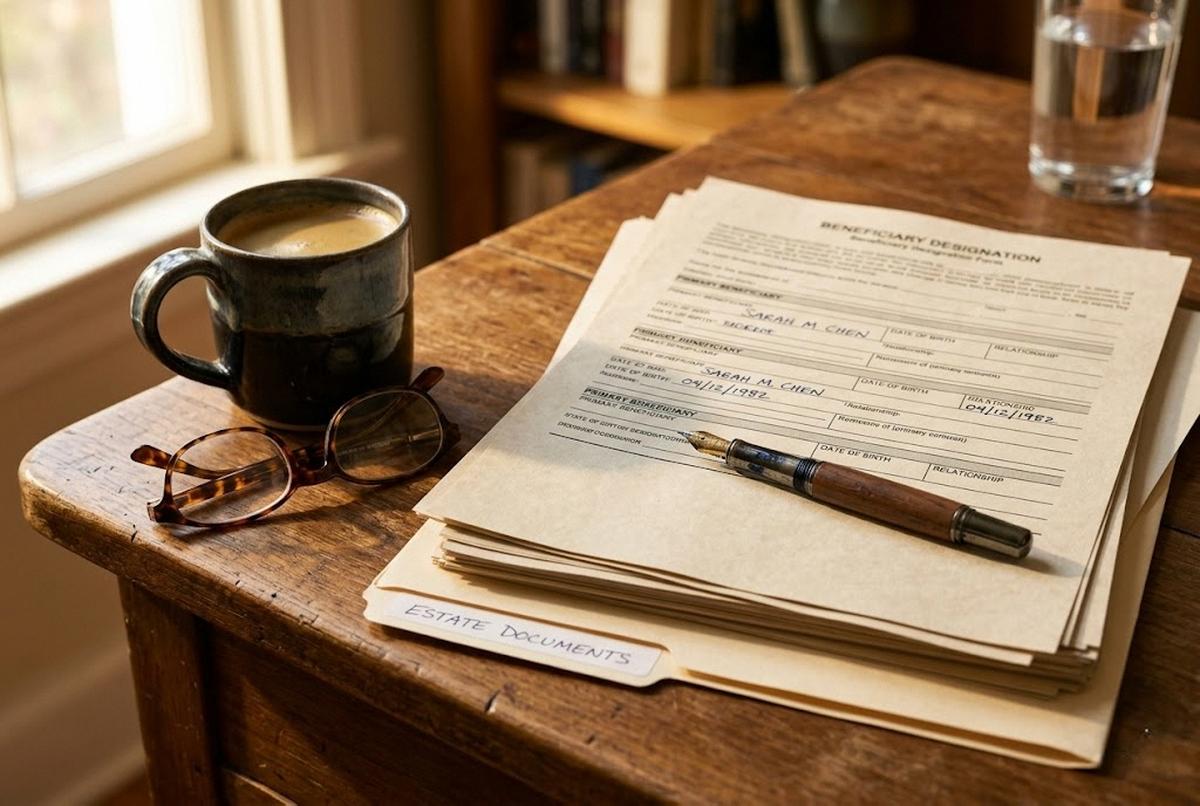
The tool I steer nearly everyone toward is a payable-on-death bank account, sometimes called a Totten trust. You open a regular savings account at your own bank, name a beneficiary (the person who'll handle your arrangements), and that's it. While you're alive, it is 100 percent your money. You can spend it, move it, add to it, close it. The bank owes the funeral home nothing.
When you die, your named beneficiary brings a death certificate to the bank and the funds are released to them directly, usually within days, with no probate delay. That speed matters, because funeral bills come due immediately while the rest of an estate can be tied up for months. A payable-on-death account gives your family cash exactly when they need it, at a price you controlled, from a bank that answers to federal deposit insurance rather than to one funeral home's bookkeeping.
Set the balance to your own estimate of a dignified, honest funeral, the same way you'd treat any other line in a retirement budget. If it helps you think it through, our guide on how to leave an inheritance walks through the same beneficiary logic for the rest of your accounts.
The One Time Prepaying Makes Sense
There is exactly one situation where I tell clients to prepay, and it's a big one: Medicaid.
If you may need Medicaid to pay for a nursing home, you face an asset limit that is brutally low, generally around $2,000 for a single applicant, with modest variation by state. Money above that line has to be spent down before you qualify. Ordinary gifts trigger a five-year look-back penalty. But an irrevocable funeral trust does not. It's a recognized exception: money moved into a properly structured irrevocable funeral trust stops counting as an asset and does not set off the look-back clock. You are converting countable cash into a prepaid, dedicated funeral fund the program allows you to keep.
The caps vary. Many states allow roughly $15,000 in an irrevocable funeral trust; Georgia caps it near $10,000; Pennsylvania ties the limit to the local average funeral cost plus 25 percent; and about half the states set no dollar cap at all. One catch worth knowing: if the funeral ends up costing less than the trust holds, the leftover generally goes to the state, not to your heirs, so don't overfund it. Sit down with an elder law attorney before you set one up. This corner of the topic is where a mistake gets expensive and hard to undo. It also belongs in the same conversation as the rest of your estate planning documents, not off in its own file.
Cheaper, Honest Options
Not every family wants the full production, and there is nothing cold about wanting a simpler goodbye.
Direct cremation is the least expensive route most people choose. The median runs around $2,200, with the market ranging roughly from $1,000 to $3,600 depending on where you live. Direct burial, a simple burial soon after death with no embalming and no viewing, runs about $5,100. Both skip embalming and the formal viewing, which is where a large chunk of a traditional bill comes from. Cremation is now what most families pick: the rate is around 63 percent and climbing toward an estimated 82 percent by 2045.
There are other paths, and interest in them is real — more than six in ten people now say they'd consider a green option. Natural or green burial, without embalming chemicals or a concrete vault, is legal in every state, though not every cemetery is equipped for it. Human composting is legal in a growing number of states, starting with Washington in 2019 and reaching New Jersey, the fourteenth, in September 2025. Whole-body donation to a medical or research program is another option; most programs cover transportation within a set distance, the cremation, and the return of ashes at no charge, though your family still pays for the death certificate and any service you hold. Home burial exists too, but the rules swing sharply by state and even by town, so check your own state and local zoning before you count on it.
Who Actually Helps Pay
People assume the government pitches in on funerals. It barely does, and the gap between what people expect and what exists causes real hardship.
Start with the one most people have heard of: Social Security. Its lump-sum death payment is $255. That is not a typo. And it has never once been adjusted for inflation since it was set, a benefit that would buy a fraction of a single casket today. It generally goes only to a surviving spouse who was living with the deceased, with limited eligibility for a child, and you have to claim it within two years. If you've recently lost a husband or wife, our piece on what happens to your spouse's Social Security covers the far more important survivor benefits alongside it.
Veterans get meaningfully more. For deaths on or after October 1, 2025, the VA pays a burial allowance of up to $2,000 for a service-connected death or $1,002 for a non-service-connected death, plus a $1,002 plot allowance and a $441 headstone or marker allowance. Better still, an eligible veteran, and often a spouse or dependent, can be buried in a VA national cemetery at no cost for the plot, the opening and closing, and the government marker. Those dollar figures adjust roughly every October, and the full picture of what's earned is laid out in our guide to veterans benefits for senior care.
One more, narrowly. FEMA does provide funeral assistance, but only for deaths caused by a presidentially declared disaster, and only when the cost isn't covered another way. It is not a general funeral fund. The special COVID-era program has closed to new expenses after September 30, 2025.
Insurance, Prepaid, or Saving?
Which brings us to the products sold as the "responsible" way to plan: final-expense or burial insurance, often the guaranteed-issue kind that asks no health questions.
Be careful here. Guaranteed-issue burial insurance costs far more per dollar of coverage than an ordinary underwritten policy, commonly on the order of 30 to 50 percent more, and it pays out only a small amount. The consumer-advocate consensus, from the Funeral Consumers Alliance and others, is blunt: with these policies you'll often pay as much or more in total premiums than the policy will ever pay out, especially if you live a long life. For most people in reasonable health, a payable-on-death savings account beats it on every measure that counts — control, cost, and speed. I'd rather see your money in your own bank than in a policy built to profit from the years you keep breathing.
Your Move This Month
Here is the whole thing boiled down to steps you can take before the month is out.
- Get three price lists. Call or visit three funeral homes and ask for the General Price List. It's your right, it's free, and doing it now, well before you need one, is the single biggest money-saver in this entire article. Check whether your area has a Funeral Consumers Alliance chapter; many run local price surveys through funerals.org.
- Open a payable-on-death account. Set aside your own estimate at your own bank, name your beneficiary, and keep control.
- Skip the prepaid plan unless you're doing Medicaid planning with an attorney's help.
- Tell your family the plan. The best-funded arrangement in the world fails if nobody knows it exists.
Losing someone is hard enough without a bill nobody saw coming. You've handled harder decisions than this one. Take the first step this week, write it down, and hand your family a plan instead of a guessing game. The grief will come either way; the financial ambush doesn't have to.