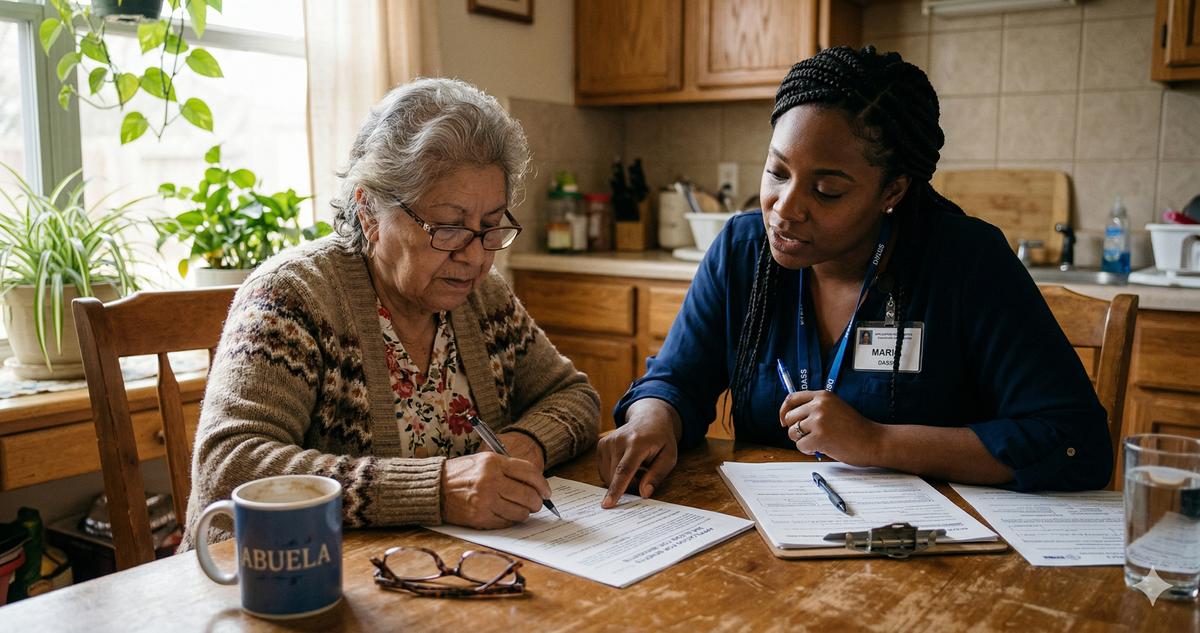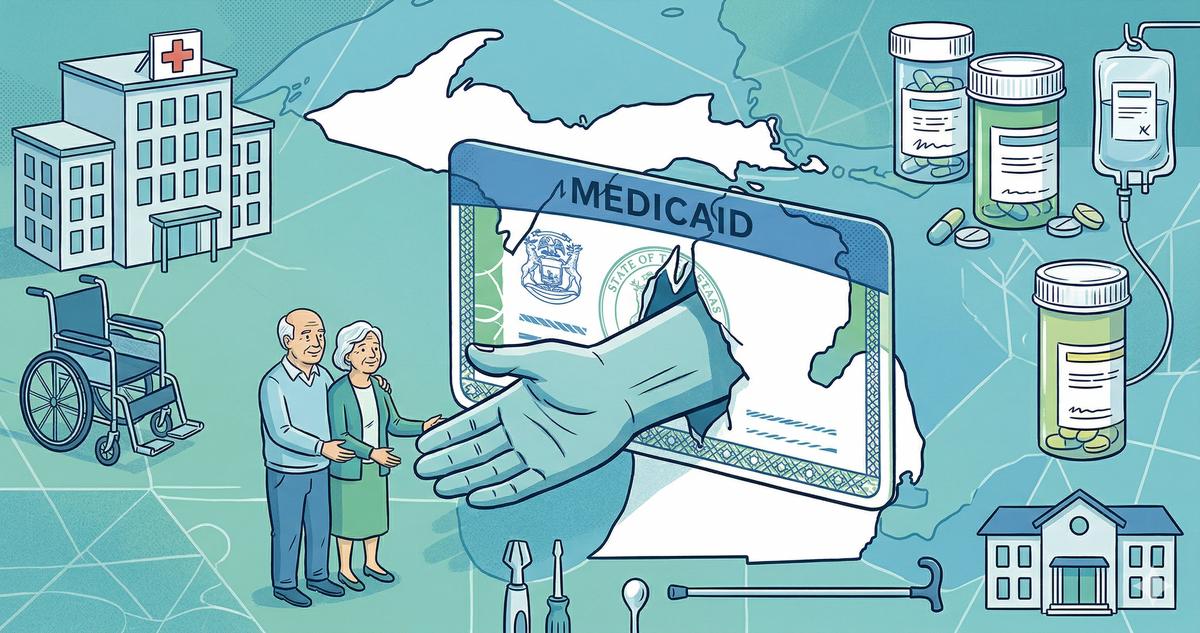
Florida's personal needs allowance for Medicaid nursing home residents is $160 per month. That's the amount your parent gets to keep for themselves after Medicaid takes over. A hundred and sixty dollars for toothpaste, a magazine subscription, a birthday card for a grandchild. I've been doing financial planning for 35 years, and that number still stops me cold every time I write it down.
But what most families miss while fixating on the $160: Florida spent over $14 billion on Medicaid long-term care in fiscal year 2025. The program works. It pays for nursing homes, assisted living services, home health aides, adult day programs, and a dozen other supports that keep seniors safe and cared for. These programs are funded and processing applications every day. Getting access requires paperwork, patience, and a plan.
I got a voicemail at 6:22 on a Thursday evening while walking to my car after a late meeting. A woman named Elaine, calling from Clearwater. Her mother had broken a hip. The discharge planner at Morton Plant Hospital told her a skilled nursing facility would cost $11,905 per month. Her mother had $47,000 in savings and a Social Security check of $1,580. The math didn't work, and Elaine knew it before she dialed my number.
I called her back from the parking lot. Sat in my car for 41 minutes walking her through the basics. What follows is the guide I wished existed when Elaine called. Every dollar amount, form number, and phone number is Florida-specific. If you've already read our national overview of Medicaid and assisted living coverage, you know the federal framework. This is the Florida playbook.
Florida Medicaid Is Different
Most states run Medicaid on a fee-for-service model where the state pays providers directly. Florida doesn't. Since 2014, Florida has operated its Statewide Medicaid Managed Care (SMMC) program, funneling nearly all Medicaid beneficiaries into private managed care plans. Think of it as Medicaid administered through insurance companies.
For seniors who need long-term care, the relevant program is SMMC Long-Term Care (SMMC-LTC). The state contracts with managed care plans like Aetna Better Health, Humana, Molina, and UnitedHealthcare Community Plan. Your parent enrolls in one of these plans, and the plan coordinates all their long-term care services.
Florida also never expanded Medicaid under the Affordable Care Act, which matters for adults under 65 but is largely irrelevant for seniors on the long-term care track. If your parent is 65 or older and needs nursing home or home-based care, the eligibility pathway runs through the Institutional Care Program (ICP) for nursing homes or the SMMC-LTC waiver for community-based services.
One more thing worth knowing early: Florida updated its managed care contracts in February 2025 under what's called SMMC 3.0. New plan options, new service requirements, some reshuffling of which plans operate in which regions. If you're reading older guides online, some plan names and regional assignments may be outdated.
Who Qualifies: Income and Asset Rules
Florida follows the federal framework, but the specifics matter. Getting one number wrong can mean a denial that takes months to resolve.
Income limit: $2,982 per month. That's 300% of the Supplemental Security Income Federal Benefit Rate for 2026. Social Security, pensions, annuity payments, rental income, and IRA distributions all count. If your parent's total monthly income falls at or below $2,982, they meet the income threshold.
If income exceeds $2,982, your parent needs a Qualified Income Trust (Miller Trust). No exceptions. Florida is an income-cap state with no wiggle room.
Asset limit: $2,000. Two thousand dollars. Not $9,950 like Michigan. Not $9,000 or $5,000. Two thousand dollars in countable assets for a single applicant. Florida's limit is among the lowest in the nation, and it means virtually every applicant needs a spend-down strategy.
Home equity limit: $752,000. The home is exempt from the asset calculation as long as your parent lives there or intends to return (a legal declaration, not a physical requirement), and the equity is under this threshold.
Personal needs allowance: $160 per month. After Medicaid kicks in, your parent keeps $160 for personal expenses. The rest of their income goes toward the cost of care.
Community Spouse Resource Allowance (CSRA): Up to $162,660. If your parent has a spouse who remains in the community, the healthy spouse can keep up to $162,660 in countable assets.
Minimum Monthly Maintenance Needs Allowance (MMMNA): $2,644 per month base. The community spouse is guaranteed at least this much monthly income.
Florida also offers a Medically Needy pathway for applicants whose income exceeds the cap but who have extraordinary medical expenses. Under this program, medical costs are subtracted from income until the applicant falls below the threshold. It's complex, rarely used for long-term care, and almost always less practical than a Miller Trust. But it exists.
What Counts as an Asset (and What Doesn't)
The $2,000 limit sounds devastating until you understand what doesn't count.
Countable assets include checking and savings accounts, CDs, stocks, bonds, mutual funds, non-exempt life insurance cash value, investment real estate, and any IRA or 401(k) not in payout status.
Exempt assets include:
- Primary residence (equity under $752,000, with intent to return or a spouse living there)
- One vehicle, regardless of value
- Household goods and personal belongings
- Irrevocable prepaid funeral contract and burial trust (unlimited value in Florida, which I'll explain shortly)
- Term life insurance of any face value
- Whole life insurance with face value under $2,500
- Wedding and engagement rings
- Property essential for self-support
The IRA question trips up more families than anything else. In Florida, an IRA or 401(k) in payout status (meaning your parent is taking regular distributions, including Required Minimum Distributions) is treated as income, not an asset. The monthly distribution counts toward the $2,982 income cap, but the account balance itself isn't a countable asset. An IRA not in payout status? The entire balance is countable. In my experience, that single distinction has saved families hundreds of thousands of dollars.
Virginia was 77, a retired bookkeeper from Fort Myers. Her daughter called me in a panic because she'd told her mother she'd need to sell the house before applying for Medicaid. The house was worth $340,000. Completely exempt. Nobody needed to sell anything. The daughter had read something online, drawn the wrong conclusion, and Virginia had spent three days believing she was about to lose the home her late husband built the porch on in 1996. Twenty minutes on the phone explaining exempt assets, and I could hear the relief come through. That's the sound that keeps me in this work.
The Spend-Down: Getting from $47,000 to $2,000
Florida's $2,000 asset limit means almost every applicant needs a spend-down. The gap between what your parent has and what Medicaid allows is real, and closing it legally requires a plan.
What makes Florida's spend-down different from other states: Florida allows unlimited prepaid irrevocable funeral trusts. No cap. In most states, burial trusts are capped at $12,000 to $15,000. Florida has no statutory maximum for an irrevocable funeral contract. A $25,000 funeral and burial package is permissible. So is $35,000, if the funeral home will write the contract. No other spend-down tool in the state comes close to that flexibility.
Seven legitimate spend-down strategies in Florida:
- Irrevocable prepaid funeral contract. Budget $15,000 to $30,000 through a Florida-licensed funeral home. Lock in current pricing. The contract must be irrevocable, meaning your parent can't cancel it and get the money back. Most major funeral homes and SCI-affiliated facilities in Florida handle these routinely.
- Home repairs and improvements. The home is exempt. Spending countable assets on an exempt asset is perfectly legal. Hurricane-impact windows run $8,000 to $20,000 for a typical Florida ranch home. Roof repairs, HVAC replacement, bathroom accessibility modifications. All permissible. If your parent's home needs modifications for safety and accessibility, the spend-down period is the time.
- Pay off debts. Mortgage balance, car loan, credit cards, medical bills. Every dollar paid toward existing debt is a dollar legally removed from countable assets.
- Vehicle purchase or replacement. One vehicle is exempt regardless of value. If your parent's car is aging, replacing it during the spend-down makes financial and practical sense.
- Medical expenses not covered by Medicare. Dental work (crowns, dentures, implants), hearing aids ($2,000 to $6,000 per pair), prescription eyeglasses, home medical equipment, wheelchair modifications. Medicare's gaps are wide enough to absorb significant spend-down dollars.
- Prepay insurance premiums. Medicare Part B, Medigap supplemental insurance, Part D prescription coverage. Paying several months or a year ahead reduces countable assets while maintaining essential coverage.
- Legal fees. Elder law attorney for Medicaid planning, Miller Trust setup, Enhanced Life Estate Deed, power of attorney, healthcare directive. These services cost $2,000 to $5,000 in Florida and pay for themselves many times over.
Now. The warning.
Norman was 80, a retired electrician from Jacksonville. Good man. Generous man. Too generous, as it turned out. Over two Christmases, he'd given $28,000 to his four grandchildren: $3,500 each, two years running. Birthday checks, graduation gifts, and a $4,000 contribution toward his oldest granddaughter's nursing school tuition. He didn't think of any of it as a financial transaction. He thought of it as being a grandfather.
When he applied for Medicaid after a series of small strokes, every one of those gifts appeared in the look-back review. Florida's penalty divisor for 2026 is $10,645 per month (the average monthly cost of nursing home care in the state). The calculation: $28,000 divided by $10,645 equals 2.63 months. Nearly three months of nursing home care that Norman's family had to cover out of pocket before Medicaid would pay a cent.
The gifts and the penalty cost exactly the same amount. Nobody in the room missed the irony.
The Look-Back Period
Sixty months. Five years. Every financial transaction your parent made during that window will be examined when they apply for Medicaid in Florida.
The Department of Children and Families (DCF), which processes Medicaid applications in Florida, reviews bank statements, investment accounts, property records, and any documentation of money leaving your parent's control. They're looking for transfers made for less than fair market value. Gifts, essentially.
When they find one, the penalty calculation is straightforward. Total value of improper transfers divided by $10,645 (Florida's 2026 penalty divisor) equals the number of months your parent is ineligible for Medicaid benefits. During that penalty period, your parent is technically eligible but receives nothing. Someone has to pay.
The violations I see most often:
Birthday and holiday checks. $500 to a grandchild, four times a year, for five years. Add it up: $10,000 in penalties waiting to happen.
Charitable donations. Gladys was a retired schoolteacher from Gainesville, 79, who'd sung in her church choir since 1988. For six years before her Medicaid application, she'd donated $3,000 annually to the choir's building fund and youth music program. Eighteen thousand dollars total. She had the cancelled checks to prove every gift was genuine, charitable, and made with zero intent to hide assets from Medicaid. Didn't matter. The state treated each donation as a transfer for less than fair market value. The penalty period was just under two months. Two months her daughter covered by draining her own emergency fund.
Adding a child to a bank account. Parents add adult children as joint account holders for convenience, to help pay bills, to have access in an emergency. Florida treats this as a transfer of 50% of the account balance to the child on the date they were added. A $60,000 savings account with a child added as joint holder? Medicaid sees a $30,000 transfer.
Selling property below market value. A $200,000 condo sold to a nephew for $120,000 creates an $80,000 transfer. Divided by $10,645, that's a 7.5-month penalty period. More than $79,000 in nursing home costs somebody has to cover!
The look-back is retrospective. Your parent can't undo transfers already made. But they can stop making new ones immediately, and they can work with an elder law attorney to determine whether any exceptions apply to past transactions.
Spousal Protections: What the Healthy Spouse Keeps
When one spouse needs Medicaid-funded long-term care in Florida and the other remains at home, federal spousal impoverishment protections prevent the community spouse from losing everything.
Let me walk through the math with a real scenario.
Clifford and his wife Virginia lived in Boca Raton. Both retired. He was a former hotel manager, she'd worked in accounts payable at a medical supply company. Clifford, 82, developed vascular dementia and needed memory care. Their combined countable assets totaled $220,000: two savings accounts, a small brokerage account, and a CD.
The CSRA calculation: take the couple's combined countable assets ($220,000), divide by two ($110,000). Since $110,000 falls between the 2026 minimum ($32,532) and maximum ($162,660), Virginia keeps $110,000. Clifford's half must be spent down to $2,000 before he qualifies.
Actually, let me back up on one thing. The CSRA only applies at the "snapshot" date, which is the first day of the first continuous period of institutionalization. If Clifford entered a nursing home or hospital on March 15, the couple's assets on March 15 determine the CSRA. Assets acquired or spent after that date don't change the calculation. Getting the snapshot date right matters enormously.
Virginia's income protections were equally important. Her Social Security was $1,380 per month. The MMMNA floor in 2026 is $2,644. Because her income fell below that threshold, she could divert $1,264 of Clifford's pension and Social Security to bring her up to $2,644. Without that diversion, she couldn't have covered her mortgage, insurance, and utilities.
Three things the community spouse should know:
- The home is always exempt when the community spouse lives there. Always. Regardless of value (though the equity limit applies if the community spouse moves out or dies).
- One vehicle is exempt. Virginia kept their 2019 Toyota Camry without question.
- The community spouse can request a fair hearing to increase the CSRA above the standard calculation if they can show the standard allowance is insufficient to generate the MMMNA. This process is called a "fair hearing increase" and it's underused.
If you're concerned about what happens to a spouse's financial security after one partner enters care, understanding how Social Security survivor benefits work is part of the larger picture.
SMMC-LTC Waiver: Home and Community-Based Care
Most families don't want a nursing home. They want Mom in an assisted living facility that feels like home, or better yet, receiving care in her own home. Florida's SMMC-LTC program is the pathway.
Under SMMC-LTC, eligible seniors receive long-term care services through a managed care plan rather than directly from the state. Your parent chooses a plan (Aetna Better Health, Humana, Molina, Simply Healthcare, Sunshine Health, or UnitedHealthcare Community Plan, depending on the region), and that plan arranges and pays for services.
Services covered under SMMC-LTC include:
- Nursing facility care
- Assisted living facility services (services only, not room and board)
- Home health aide and personal care
- Adult day health care
- Respite care for family caregivers dealing with burnout
- Home-delivered meals
- Personal emergency response systems
- Medical equipment and supplies
- Transportation to medical appointments
- Caregiver training and support
- Home modifications (ramps, grab bars, bathroom modifications)
The enrollment process has specific steps, and skipping any of them stalls the application.
Step 1: Call the Elder Helpline at 1-800-963-5337. The Aging and Disability Resource Center (ADRC) line is operated by the Florida Department of Elder Affairs (DOEA). They conduct an initial screening to determine whether your parent may qualify.
Step 2: If the screening suggests eligibility, DOEA schedules a Comprehensive Assessment and Review for Long-Term Care Services (CARES) assessment. A CARES assessor visits your parent (in the hospital, nursing home, or at home) and evaluates their functional needs using DOEA Form 701B. This assessment determines whether your parent meets nursing home level of care.
Step 3: Simultaneously, your parent applies for Medicaid through DCF (financial eligibility). The CARES assessment handles medical eligibility. Both must be approved.
Step 4: Once approved, your parent selects a managed care plan during an enrollment period. If no selection is made, the state auto-assigns one.
One thing families don't expect: the waitlist. SMMC-LTC waiver slots aren't unlimited. Florida uses a priority scoring system based on medical need, risk of institutionalization, and whether the applicant is currently in a nursing home. Higher-priority applicants move faster. Lower-priority applicants wait.
A retired nurse's aide from Sarasota, 78, applied for SMMC-LTC after a fall left her needing daily help with bathing and transfers. Her CARES assessment confirmed nursing home level of care. Her Medicaid application was approved in 60 days. And then she waited. Eleven months on the priority list before a slot opened in her region. During those 11 months, her daughter provided most of her care, driving from Bradenton three times a week, rearranging her work schedule, burning through personal days. The program eventually came through. But those 11 months cost the family in ways no program can reimburse.
If your parent is already in a nursing home and wants to transition to community-based care, the waitlist is typically shorter. Nursing home residents receive priority scoring because the state saves money by moving them into less expensive community settings. For families weighing costs, our breakdown of what it really costs to age in place can help frame the financial comparison.
Miller Trust (Qualified Income Trust)
If your parent's monthly income exceeds $2,982, Florida requires a Qualified Income Trust before Medicaid will approve the application. No negotiation. No alternative calculation.
The concept is simple even if the execution requires an attorney. Your parent creates an irrevocable trust. Each month, the portion of income exceeding $2,982 is deposited into a dedicated bank account held by the trust. Once income is in the trust, it's no longer counted as your parent's income for Medicaid purposes. The trustee (usually an adult child) distributes funds according to Medicaid rules: patient responsibility payment to the care facility, Medicare premiums, and the $160 personal needs allowance. Any balance remaining in the trust at your parent's death goes to the state to reimburse Medicaid costs.
Cost to set up: $500 to $1,500 through a Florida elder law attorney. Some attorneys include it in a broader Medicaid planning package.
The mistake I see constantly: families wait until after the Medicaid application to set up the Miller Trust. The application gets denied for excess income. Then they scramble to find an attorney, establish the trust, open the bank account, and reapply. The whole process restarts. Months lost.
Norman's sister-in-law called me about her mother, an 84-year-old widow in Pompano Beach whose combined Social Security and small pension came to $3,142 per month. Just $160 over the $2,982 cap. One hundred sixty dollars! Without a Miller Trust, her mother was completely ineligible for Medicaid despite having only $1,200 in savings. The income cap is absolute. She found an elder law attorney in Broward County who set up the trust in two weeks. Total cost: $750. That $750 solved a $160-per-month problem that would have otherwise blocked her mother from $11,000-per-month nursing home coverage.
Get the Miller Trust done before you file the application. Not after.
PACE: The All-in-One Alternative
PACE (Program of All-Inclusive Care for the Elderly) operates differently from every other Medicaid long-term care program. Instead of coordinating services across multiple providers, PACE becomes your parent's entire care system. One team. One location for day services. One phone number when something goes wrong at 2 AM.
Florida's PACE providers as of 2026:
- InnovAge (Orlando and Tampa service areas)
- MorseLife PACE (Palm Beach County)
- Florida PACE Centers (Miami-Dade County)
- PACE of Southwest Florida (Lee and Collier counties, covering Fort Myers and Naples)
Eligibility: age 55 or older, living in a PACE service area, and certified as needing nursing home level of care. If your parent qualifies for both Medicare and Medicaid (dual-eligible), PACE costs nothing. Zero premiums. Zero copays. Zero deductibles. For those with Medicare only, there's a monthly premium, but it often costs less than the combined expense of Medigap, Part D, and supplemental care services. If your parent purchased long-term care insurance years ago, review that policy before exploring PACE or SMMC-LTC.
The trade-off is real, though. Your parent must receive all primary care and specialist referrals through the PACE center's medical team. They can't keep their current doctor.
Clifford's brother, a retired postal worker from Weston, was eligible for both PACE (through the Miami-Dade program) and SMMC-LTC. He'd been seeing a cardiologist at Cleveland Clinic Florida for eight years. A doctor who knew his history, knew his medications, knew his blood pressure ran asymmetrically high in his left arm. He chose SMMC-LTC specifically to keep that cardiologist. The PACE medical team was excellent. But eight years of cardiac history with one physician was worth more to him than the convenience of a single program managing everything.
Not every trade-off has a right answer.
MEDS-AD, QMB, SLMB, and QI: Programs Most Families Overlook
Florida has several Medicaid programs for seniors who don't qualify for full long-term care Medicaid but still need help. These are chronically underused.
MEDS-AD (Medicaid for the Aged and Disabled): Covers adults 65+ or those with disabilities who have income up to 88% of the federal poverty level ($1,255/month in 2026 for an individual) and assets under $5,000. MEDS-AD provides full Medicaid benefits including doctor visits, prescriptions, hospital stays, and some home health services. It won't cover nursing home care, but it fills Medicare's gaps.
QMB (Qualified Medicare Beneficiary): Pays your parent's Medicare Part B premium ($202.90/month in 2026), deductibles, and copays. Income limit: 100% of the federal poverty level ($1,427/month in 2026). Asset limit: $9,430 for an individual.
SLMB (Specified Low-Income Medicare Beneficiary): Pays the Medicare Part B premium only. Income limit: 120% of the federal poverty level ($1,713/month). Same asset limit as QMB.
QI (Qualifying Individual): Also pays the Part B premium. Income limit: 135% of the federal poverty level ($1,927/month). Same asset limit.
What many people don't realize is these programs can save a senior $2,000 to $5,000 per year in Medicare costs. And QMB, SLMB, and QI applications don't affect eligibility for other programs. They're add-ons, not alternatives.
If your parent doesn't qualify for long-term care Medicaid but is struggling with Medicare premiums and copays, run the numbers on QMB first. The application goes through the same DCF portal (MyACCESS), and many families qualify without knowing it.
Protecting the Home
Florida's homestead protections are among the strongest in the nation. Article X, Section 4 of the Florida Constitution shields homestead property from forced sale by most creditors. But Medicaid estate recovery operates in a different legal lane, and families who assume the homestead exemption protects them after death are in for a painful surprise.
While your parent is alive and on Medicaid, the home is exempt. Full stop. Nobody can force a sale. If a spouse lives there, the exemption continues indefinitely.
After death, Florida's Medicaid Estate Recovery Program (MERP) activates. The state sends a claim to the estate for the total amount Medicaid spent on the beneficiary's care. The primary target: the home.
Gladys, the retired schoolteacher from Gainesville I mentioned earlier, wasn't just dealing with the donation penalty. Her husband had been on Medicaid-funded nursing home care for three years before he died. Three months after the funeral, she received a letter from the Florida Agency for Health Care Administration. The claim: $186,000. Because he'd predeceased her and the home was in both their names, the MERP claim couldn't be enforced while she lived there. But the claim attached to the property. When she eventually wanted to sell and move closer to her daughter in Jacksonville, that $186,000 lien complicated everything.
Protection tools in Florida:
Enhanced Life Estate Deed. Florida recognizes this instrument, which works like the Lady Bird deeds used in states like Michigan. It allows your parent to transfer the home to a beneficiary upon death while retaining full ownership, use, and control during life. The property passes outside probate, which in Florida means it passes outside the reach of MERP. No look-back penalty. No loss of homestead exemption. Cost: $300 to $800 through an attorney, plus recording fees.
Irrevocable Medicaid Asset Protection Trust (MAPT). For families planning five or more years in advance, transferring the home into an irrevocable trust removes it from the estate entirely. The five-year requirement is critical: the transfer must clear the look-back period. Advance planning, not crisis planning.
Joint tenancy with right of survivorship. If the home is owned jointly with a child, it passes to the child at death without going through probate. But adding a child to the deed is a transfer that triggers the look-back. Timing matters.
If your parent owns a home in Florida and might eventually need Medicaid, talk to an elder law attorney about an Enhanced Life Estate Deed now. Not when they're in the hospital. Now. The deed costs a few hundred dollars and takes a week to record. The MERP claim it prevents can be six figures. When thinking about protecting what you've built, our guide on estate planning fundamentals covers the broader picture.
How to Apply: Step by Step
Stop researching. Start acting. Here is exactly what to do, in order.
Step 1: Gather 60 months of financial records.
Bank statements for every account: checking, savings, money market, credit union. Investment and brokerage statements. Life insurance policies with face value and cash surrender value. Property tax bills. Vehicle titles. Pension award letters. Social Security benefit verification letter (request from ssa.gov or call 1-800-772-1213). Tax returns. Gift records. Trust documents. Annuity contracts. Any documentation of money moving in or out of any account over the past five years.
Florida's DCF will request all of this. Having it ready before you apply saves weeks.
Step 2: Determine monthly income and set up a Miller Trust if needed.
Add every income source. If the total exceeds $2,982, contact a Florida elder law attorney to establish a Qualified Income Trust before filing the application. The trust needs its own bank account, which takes a few business days to open.
Step 3: Call the Elder Helpline at 1-800-963-5337.
The ADRC line, operated by the Department of Elder Affairs. Request a CARES assessment for your parent. Explain the medical situation. If your parent is in a hospital or nursing home, mention that, since it often expedites scheduling.
Step 4: Apply for Medicaid through ACCESS Florida.
The online portal is MyACCESS at myflorida.com/accessflorida. Create an account, complete the application (Form CF-ES 2337, also known as the Application for Benefits), and submit electronically. If you can't apply online, call DCF at (866) 762-2237 or visit your local DCF service center.
You can also submit the paper application, Form 3008 (Application for Institutional Care Program benefits), directly to DCF. For nursing home Medicaid specifically, some facilities have Medicaid specialists who will help submit the application.
Step 5: Complete the CARES assessment.
A DOEA assessor will evaluate your parent using DOEA Form 701B. This determines whether your parent meets nursing home level of care. The assessment can happen in a hospital, nursing home, assisted living facility, or your parent's home. Be present if possible. Bring medical records, a medication list, and documentation of any recent hospitalizations, falls, or cognitive assessments.
Step 6: Respond to every DCF request immediately.
DCF will send verification requests. Additional bank statements, clarification on transfers, proof of asset values. Respond the same day if possible. Every unanswered request extends the timeline. I can't overstate this. When a letter arrives from DCF asking for your parent's credit union statement from April 2022, treat it like a fire alarm.
Step 7: Select an SMMC-LTC managed care plan (if approved for waiver services).
Once both medical and financial eligibility are confirmed, your parent will receive enrollment materials for choosing a managed care plan. Research the plans available in your parent's region. Compare provider networks, covered services, and member reviews. If no selection is made within the enrollment window, the state auto-assigns a plan.
Processing time: 45 to 90 days for Institutional Care Program (nursing home) Medicaid. SMMC-LTC waiver approval may take longer due to priority-based waitlists.
If You're Denied
Denials happen. They happen to families who did everything right and missed one form. They happen to families whose caseworker miscounted an asset. And they happen to families who genuinely don't qualify but might with a small adjustment.
Common denial reasons in Florida:
- Countable assets above $2,000 (sometimes a forgotten account or an IRA not in payout status)
- Income above $2,982 without a Miller Trust in place
- Incomplete documentation (missing bank statements from the look-back period)
- Failure to respond to a DCF verification request within the deadline
- CARES assessment finding the applicant doesn't meet nursing home level of care
Your right to appeal:
Florida grants a fair hearing through the Department of Children and Families. You have 90 days from the date on the denial notice to request a hearing. Do it immediately. Don't wait.
To request a fair hearing, call the DCF Office of Appeal Hearings at (850) 488-1429 or submit a written request to the address on your denial notice. An administrative law judge will review the case. You can present documents, bring witnesses, and have an attorney or advocate represent you.
In my experience working with families across states, roughly 40% of Medicaid denials are overturned on appeal when proper documentation is provided. The most common outcome: the family provides a bank statement or explanation letter the original caseworker didn't have, and the denial gets reversed.
Free legal help for Medicaid appeals in Florida:
- Florida Legal Services: (850) 385-7900, floridalegal.org
- Legal Aid Society in your county (find through floridalegal.org)
- Florida SHINE (Serving Health Insurance Needs of Elders): 1-800-963-5337
- Florida Health Justice Project: healthjusticeproject.org
Every Number, Website, and Form You Need
Print this page. Tape it to the refrigerator.
State Agencies:
- Elder Helpline / ADRC: 1-800-963-5337 (starting point for all senior services)
- DCF Customer Call Center: (866) 762-2237
- MyACCESS online portal: myflorida.com/accessflorida
- Agency for Health Care Administration (AHCA): (888) 419-3456, ahca.myflorida.com
- Department of Elder Affairs (DOEA): (850) 414-2000, elderaffairs.org
- Statewide SMMC-LTC Enrollment Broker: 1-877-711-3662
Key Forms:
- CF-ES 2337: Application for Benefits (general Medicaid, via MyACCESS)
- Form 3008: Application for Institutional Care Program (nursing home Medicaid)
- DOEA Form 701B: CARES assessment instrument (completed by assessor)
Free Counseling and Legal Help:
- SHINE (Serving Health Insurance Needs of Elders): 1-800-963-5337
- Florida Legal Services: (850) 385-7900, floridalegal.org
- Florida Bar Elder Law Section: floridabar.org
- Academy of Florida Elder Law Attorneys (AFELA): afela.org
- National Academy of Elder Law Attorneys (NAELA): naela.org
- Eldercare Locator: 1-800-677-1116
- Benefits screening: benefitscheckup.org
PACE Providers in Florida:
- InnovAge: Orlando and Tampa (innovage.com)
- MorseLife PACE: Palm Beach County (morselife.org)
- Florida PACE Centers: Miami-Dade County (floridapace.org)
- PACE of Southwest Florida: Lee and Collier counties
For Veterans:
- VA Aid and Attendance: 1-800-827-1000 (up to $2,431/month for qualifying veterans or surviving spouses)
- Florida Department of Veterans' Affairs: (727) 319-7400, floridavets.org
DCF Office of Appeal Hearings: (850) 488-1429
What I'd Tell You at the Kitchen Table
Elaine got her mother approved. It took 67 days, a Miller Trust (her mother's pension plus Social Security put her $94 over the income cap), and a spend-down that included prepaying a funeral, replacing a 15-year-old air conditioning unit, and paying off a $3,200 credit card balance. The CARES assessor came to Morton Plant Hospital on day 11. DCF requested three additional documents. Elaine had them faxed within 24 hours each time.
Her mother is in a skilled nursing facility in Clearwater now. Medicaid covers the cost. The house is in her mother's name with an Enhanced Life Estate Deed naming Elaine as the remainder beneficiary. The monthly personal needs allowance is $160.
Remember that number from the opening? A hundred sixty dollars. It's still not much. But it's $160 your parent keeps while a program covering $11,905 per month handles the rest. The gap between $160 and $11,905 is the gap this guide exists to close.
If you were sitting across from me right now, at your parent's kitchen table in Tampa or Tallahassee or Fort Lauderdale, with a stack of bank statements and a cup of coffee going cold, I'd tell you three things.
First, call the Elder Helpline at 1-800-963-5337 today. Not tomorrow. Today. Tell them your parent's county, their medical situation, and that you need to start the CARES assessment process. That single call puts the machinery in motion.
Second, find an elder law attorney through AFELA (afela.org) or NAELA (naela.org). Budget $1,500 to $3,500 for a Florida Medicaid planning package. Compare that to $11,905 per month in nursing home costs. A SHIP counselor can sit with you for free. Use them.
Third, the system is cruel in its complexity but not in its intent. The money exists. The programs exist. Eligibility comes down to documentation. Every bank statement, every medical bill, every letter from a doctor matters.
You can do this!
The forms can wait until morning. Tonight, just make a list of your parent's medications and monthly income. That's your starting line.