On January 2nd, the second business day of 2026, I got three phone calls before lunch. All three callers asked the same question: did the price of my medication actually go down?
The answer, for all three, was yes. But the savings weren't what they expected. One caller, a 71-year-old retired insurance adjuster from Norwalk named Norbert, had been paying $467 per month out of pocket for Eliquis through his Part D plan. He'd read a headline claiming Medicare negotiated Eliquis down to $231 per month — a 56% reduction. He assumed his copay would drop by half. It didn't. His new copay was $42 per month instead of $73. Real savings, absolutely. But not the dramatic cut the headlines promised.
Norbert's confusion is the most common problem I've encountered since January. The negotiated prices are real. They're historic. For the first time in Medicare's 60-year existence, the federal government sat across a table from pharmaceutical companies and said: this is what we'll pay. Ten drugs. Billions of dollars in projected savings. But between the negotiated price and the number on your pharmacy receipt, there are layers of insurance math determining what you actually owe.
What follows is the drug-by-drug breakdown, and what you should do if your Part D plan hasn't caught up yet.
How We Got Here
The Inflation Reduction Act, signed in August 2022, gave Medicare the authority to negotiate prices on certain high-cost drugs for the first time. Before the IRA, Medicare was legally prohibited from negotiating. Prohibited. The Veterans Affairs system has negotiated drug prices since 1992. Medicaid gets mandatory rebates. Private insurers negotiate constantly. But Medicare Part D, which now covers more than 50 million people, was required by law to accept whatever price the manufacturer set.
CMS selected the first 10 drugs for negotiation in August 2023, ran negotiations through 2024, announced final prices on August 15, 2024, and the new prices took effect January 1, 2026.
Why only 10? The law phases in gradually. Ten Part D drugs in the first round, 15 more selected in 2025 (prices effective 2027), another 15 Part B and Part D drugs in 2026 (effective 2028), and 20 per year after 2029. For now, it's these 10.
To qualify, a drug had to be single-source brand-name (no generics available), covered under Part D, on the market at least seven years (or 11 for biologics), and among the highest-spending drugs in the Medicare program. CMS ranked eligible drugs by total Part D spending and picked from the top.
The pharmaceutical industry fought back hard. Merck, Bristol-Myers Squibb, Johnson & Johnson, AstraZeneca, Boehringer Ingelheim, and PhRMA all filed lawsuits arguing the program was unconstitutional. Every challenge so far has failed.
All 10 Drugs: What They Treat, Old Price vs. New
I keep a printed version of these numbers in my office. When a client walks in with a Part D question, I slide it across the desk.
Eliquis (apixaban) prevents strokes and blood clots in people with atrial fibrillation. The most-prescribed of the 10, used by roughly 3.7 million Medicare enrollees. Old list price: approximately $521/month. Negotiated price: $231/month. A 56% reduction.
Jardiance (empagliflozin) treats Type 2 diabetes and heart failure. About 1.6 million enrollees. Old price: ~$573/month. Negotiated: $197/month. A 66% cut.
Xarelto (rivaroxaban) is another blood thinner, similar to Eliquis but dosed differently. Roughly 1.3 million enrollees. Old price: ~$517/month. Negotiated: $197/month. A 62% reduction.
Januvia (sitagliptin) treats Type 2 diabetes. About 869,000 enrollees. Old price: ~$527/month. Negotiated: $113/month. The steepest percentage drop of the 10, at 79%.
Farxiga (dapagliflozin) covers Type 2 diabetes, heart failure, and chronic kidney disease. Roughly 799,000 enrollees. Old price: ~$556/month. Negotiated: $178.50/month. A 68% reduction.
Entresto (sacubitril/valsartan) treats heart failure. About 587,000 enrollees. Old price: ~$628/month. Negotiated: $295/month. A 53% cut.
Enbrel (etanercept) for rheumatoid arthritis, psoriasis, and psoriatic arthritis. Roughly 48,000 Medicare enrollees. Old price: ~$7,106/month. Negotiated: $2,355/month. A 67% reduction. The most expensive drug on the list by a wide margin.
Imbruvica (ibrutinib) treats blood cancers including chronic lymphocytic leukemia and mantle cell lymphoma. About 20,000 enrollees. Old price: ~$14,934/month. Negotiated: $9,319/month. A 38% reduction, the smallest percentage cut but still a massive dollar amount.
Stelara (ustekinumab) for psoriasis, psoriatic arthritis, Crohn's disease, and ulcerative colitis. Roughly 22,000 enrollees, administered as an injection every 8-12 weeks. Old price: ~$13,836/dose. Negotiated: $4,695/dose. A 66% reduction.
Fiasp and NovoLog insulin (insulin aspart) are rapid-acting insulins for Type 1 and Type 2 diabetes. Combined enrollment: about 777,000. Old price: ~$495/month. Negotiated: $119/month. A 76% cut. Worth noting: the $35 monthly insulin cap under the IRA already limited most seniors' out-of-pocket costs before this negotiation, so the practical savings here flow mainly to the Medicare program rather than to individual enrollees.
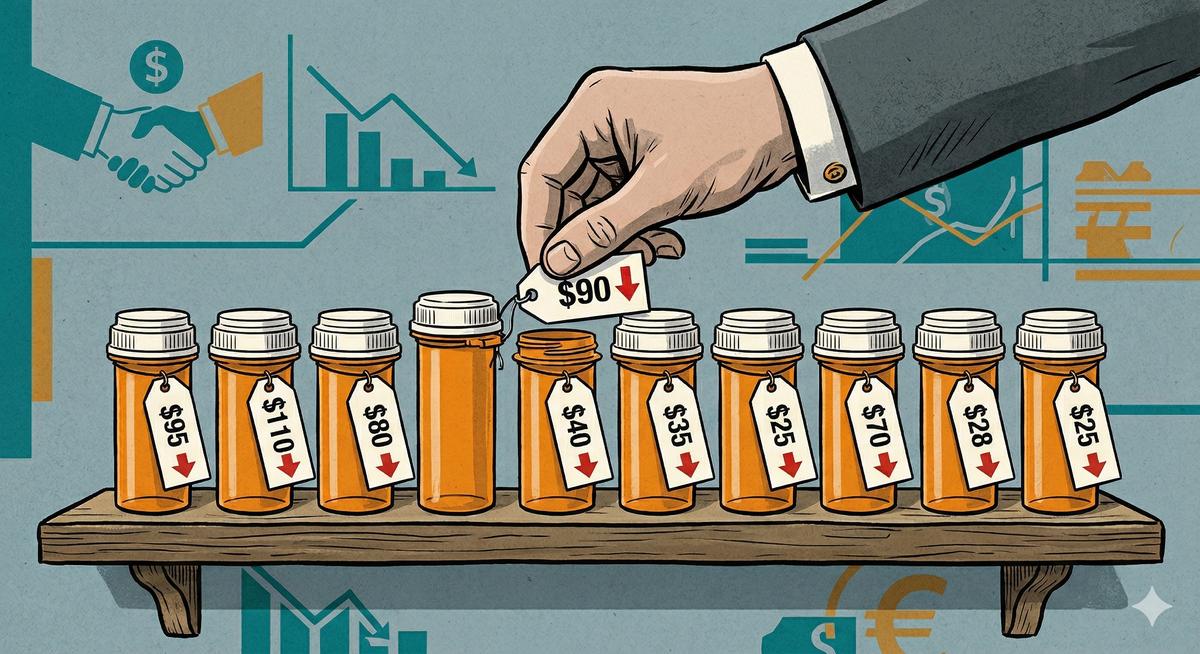
Ten drugs. Reductions ranging from 38% to 79%. Total Medicare Part D spending on these 10 drugs was approximately $50.5 billion in 2023, the year CMS used for selection. The combined effect is staggering on paper. But what matters is the line on your pharmacy receipt, and for that, you need to understand Part D cost-sharing.
What You Actually Pay: The Part D Math
Norbert's confusion started right here, and it's where most headlines mislead people.
The negotiated prices above are what Medicare pays the manufacturer. Not your copay. Your out-of-pocket cost depends on your specific Part D plan's formulary tier, copay or coinsurance structure, whether you've met your deductible, and where you are in the coverage phases.
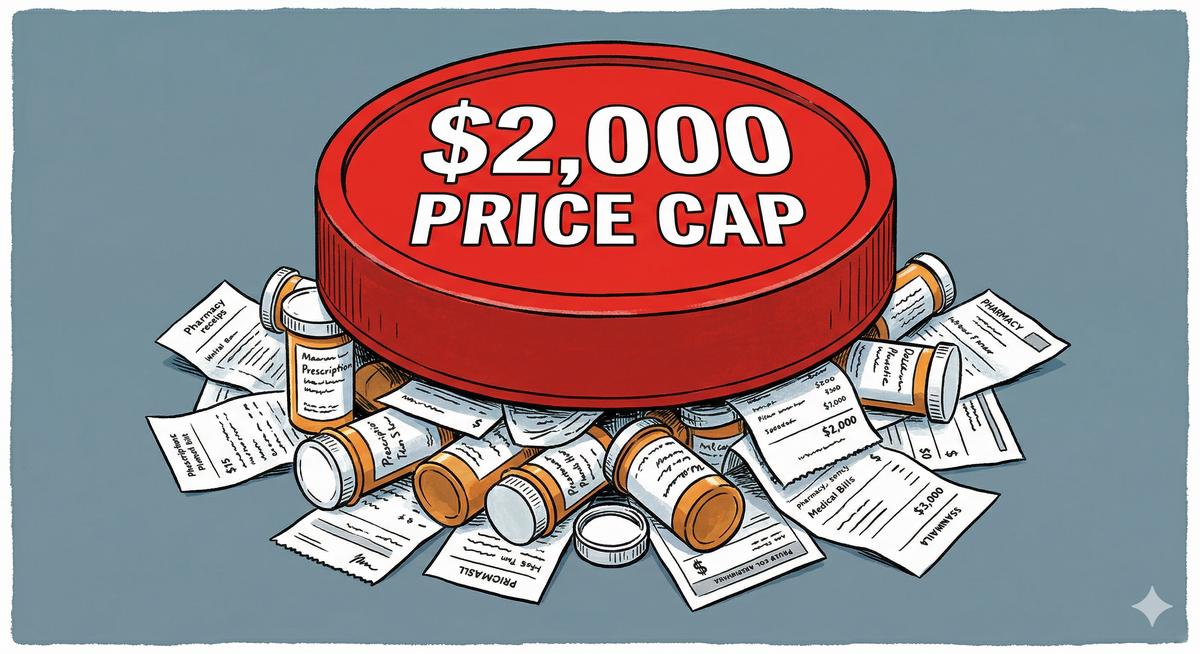
Part D in 2026 has a simpler structure than it used to, thanks to the IRA's annual out-of-pocket cap. The cap launched at $2,000 on January 1, 2025, and because it's indexed each year, it's $2,100 for 2026. Once you've spent $2,100 out of pocket on covered drugs in a calendar year, you pay nothing for the rest of the year. Nothing. It changes the math for anyone on expensive medications.
Before you hit the cap, your costs depend on your plan. A typical 2026 Part D plan structures tiers like this:
- Tier 1 (preferred generics): $0-$5 copay
- Tier 2 (non-preferred generics): $10-$20 copay
- Tier 3 (preferred brands): $35-$50 copay
- Tier 4 (non-preferred brands): 25-33% coinsurance
- Tier 5 (specialty): 25-33% coinsurance
Eliquis sits on Tier 3 in many plans at a $42-$47 monthly copay. In other plans it's Tier 4 at 25% coinsurance, which on a $231 negotiated price works out to about $58 per month. Either way, the lower negotiated price means your coinsurance percentage applies to a smaller base amount. You pay less even if your cost-sharing percentage stays the same.
For the specialty drugs — Enbrel, Imbruvica, Stelara — the annual cap matters most. Before 2025, a single month of Imbruvica could have pushed a patient into the catastrophic coverage phase, still owing 5% of costs indefinitely. Now? You hit $2,100, and you're done.
I ran the numbers for a client on Entresto and Jardiance simultaneously. Under her 2024 plan structure, her combined annual out-of-pocket drug costs were approximately $4,800. In 2026, between the negotiated prices and the $2,100 cap, her maximum exposure is $2,100. Period. She's saving $2,700 a year. Her property tax bill in Fairfield.
How to Check Whether Your Plan Reflects the New Prices
Not every Part D plan updated seamlessly on January 1st. If you take one of these 10 drugs, verify now.
Log into your Part D plan's online portal or call the number on the back of your insurance card. Ask specifically: "What is the negotiated price my plan is paying for [drug name] in 2026, and what is my copay based on that price?"
Then check your January pharmacy receipt or Explanation of Benefits. Compare the drug cost listed against the negotiated prices I listed above. If the plan is showing a cost significantly higher, something hasn't updated. Call 1-800-MEDICARE (1-800-633-4227) and report the discrepancy. CMS has stated all Part D plans must apply the Maximum Fair Prices. Plans that don't comply face penalties.
A woman at my Westport Senior Center workshop in February raised her hand and said her January Farxiga copay was identical to her December copay. Hadn't changed by a penny! I told her to call the plan immediately. Turned out the plan had updated the price in their system but hadn't recalculated her specific copay structure. They corrected it within a week and refunded the overpayment. She would not have noticed if she hadn't kept those receipts.
Keep your receipts.
The Out-of-Pocket Cap and the Prescription Payment Plan
I need to separate this from the negotiation discussion because the two provisions work in tandem, and most people conflate them.
Starting January 1, 2025, the IRA capped total out-of-pocket Part D spending at $2,000 per year (indexed since then to $2,100 for 2026). Before 2025, Medicare Part D had no annual out-of-pocket maximum. None. You could owe $5,000, $10,000, $15,000 in a year for covered drugs and there was no ceiling. Let me repeat: no ceiling.
The cap covers all Part D enrollees, standalone plans and Medicare Advantage drug coverage alike. It includes your deductible, copays, and coinsurance. Once you hit the cap — $2,100 in 2026 — your plan covers 100% of remaining drug costs for the rest of the calendar year.
And most people miss this part: you can spread that amount across the year through the Medicare Prescription Payment Plan, which lets you pay out-of-pocket drug costs in monthly installments. No interest. No fees. You opt in through your Part D plan.
For seniors on specialty drugs like Enbrel at $2,355/month or Imbruvica at $9,319/month, the negotiated price is almost irrelevant to their personal costs. They'll hit the cap within weeks regardless. The negotiated prices save the Medicare program billions (which keeps everyone's premiums lower), but for individual patients on specialty medications, the cap is the real protection.
For seniors on mid-range drugs like Eliquis, Jardiance, or Entresto, both provisions matter. Lower negotiated prices reduce your monthly copays. The $2,100 cap catches you if the bills pile up.
15 More Drugs Coming in 2027
CMS announced the second round of 15 drugs selected for negotiation on January 17, 2025. Prices take effect January 1, 2027; the final negotiated numbers were published November 30, 2025.
The Round 2 drugs include several you might recognize:
- Ozempic, Rybelsus, and Wegovy (semaglutide), Type 2 diabetes and weight management
- Trelegy Ellipta, COPD and asthma
- Xtandi, prostate cancer
- Pomalyst, multiple myeloma
- Ibrance, breast cancer
- Ofev, idiopathic pulmonary fibrosis
- Linzess, irritable bowel syndrome with constipation
- Calquence, blood cancers including chronic lymphocytic leukemia
- Austedo, tardive dyskinesia and Huntington's chorea
- Breo Ellipta, COPD and asthma
- Tradjenta, Type 2 diabetes
- Xifaxan, irritable bowel syndrome with diarrhea and hepatic encephalopathy
- Vraylar, bipolar disorder and schizophrenia
- Janumet, Type 2 diabetes
- Otezla, psoriasis and psoriatic arthritis
If you take any of these, your costs could drop significantly in January 2027.
A third round of 15 drugs (including Part B drugs administered in doctors' offices, like certain cancer infusions) was selected in early 2026, with prices effective in 2028.
My son David called from Austin last month. He doesn't take any medications — he's 31 and thinks he's immortal, as 31-year-olds do — but he'd seen a news segment and wanted to understand the negotiations. "Dad, is the government actually telling pharma companies what to charge?" Not exactly. CMS sets a ceiling price, and the manufacturer can accept it or withdraw the drug from Medicare and Medicaid entirely. No company has withdrawn. The financial penalty for refusing is an excise tax starting at 65% of the drug's U.S. sales revenue and escalating to 95%. Ninety-five percent! At those numbers, withdrawal isn't a business decision.
David thought about it. "So it's a negotiation the way a speeding ticket is a negotiation." Close enough.
What to Do If You're Still Paying Too Much
If you take one of these 10 drugs and your costs haven't dropped, or if you're on medications not in the first round, here's where to start.
Review your Part D plan during Open Enrollment. Every October 15 through December 7, you can switch plans. Use the Medicare Plan Finder to compare formularies and copays for your specific medications.
Ask about the Prescription Payment Plan. If paying the cap up front is hard to manage, monthly installments help. Contact your Part D plan to enroll.
Check for Extra Help. If your annual income is below $23,475 (individual) or $31,725 (couple) and your assets are limited, you may qualify for this Low-Income Subsidy. Call Social Security at 1-800-772-1213 or apply at ssa.gov/medicare/part-d-extra-help.
Talk to your doctor about alternatives. For blood thinners, discuss whether changes to your Medicare Advantage plan better fits your clinical and financial situation. For Type 2 diabetes, Jardiance, Farxiga, and Januvia work differently, and the cheapest option on your formulary might not be the negotiated drug.
Watch your IRMAA exposure. If your income triggers the Medicare surcharge, your Part D premium climbs too. Managing modified adjusted gross income through strategies like careful Roth conversions can keep total Medicare costs lower.
The Bigger Picture
CMS projects the first 10 negotiated prices will save Medicare $6 billion in the first year and roughly $100 billion over the next decade. HHS's ASPE estimates the out-of-pocket cap will save enrollees $7.4 billion annually. Combined, these are the most significant structural changes to Part D since the program launched in 2006.
But ten drugs is a start, not a solution. The law caps the program at 20 new drugs per year starting in 2029. At that pace, decades. And drug makers will keep raising prices on non-negotiated drugs to compensate. Actually, they already are. Prices on drugs not yet selected rose a median of 4.5% in 2025, according to an analysis by 3 Axis Advisors. The system adapts.
What I'd Tell You Over Coffee
Walter was the third call on January 2nd. Retired high school principal from Darien. Seventy-four years old. He'd been on Xarelto for six years after a pulmonary embolism, and he'd spent most of those years in the Part D donut hole — the old coverage gap where costs used to spike. He told me the donut hole was gone. (It is, as of 2025.) He told me his Xarelto copay dropped from $89 to $47 in January. And then he said something I've been turning over since.
"Ben, I spent nine years paying more for this pill than I paid for my first car. A '68 Dodge Dart. Blue. $800 from a lot on the Post Road."
I laughed. He wasn't wrong about the math. At $517 per month over nine years, Walter had paid roughly $55,800 for Xarelto. His Dodge Dart cost $800. The medication keeping him alive cost 70 times more than the car he drove to work every morning for a decade.
The negotiated prices won't undo what Walter already paid. They won't refund Norbert's years of $467-per-month Eliquis bills. They won't reimburse the woman from my workshop for her overpaid January. But they change the trajectory. For the 3.7 million seniors on Eliquis alone, every month from here costs less than the month before it.
If you take one of these 10 drugs, check your January and February pharmacy statements this week. Confirm your plan is applying the negotiated price. Call 1-800-MEDICARE if something looks wrong. (And watch for Medicare scams from callers claiming to help with the new pricing.) If your Social Security check feels a little less stretched this month, this is part of the reason.
The system moved. Slowly, reluctantly, with lawsuits and lobbying and every obstacle the industry could throw. But it moved. Ten drugs today. Fifteen more next year.
Not enough. But not nothing, either.
Walter's still taking his Xarelto. Every morning, with breakfast. He just pays less for it now.