The smell hit me before I saw what was happening. Wet earth, iron, something green and stubborn pushing through cold ground. I was kneeling in my community garden plot on Haywood Road last Saturday morning, pulling spent kale stalks from the raised bed, when my neighbor Clement lowered himself onto the bench beside the water spigot and said, without any preamble at all, "Eleanor, I fell again."
Clement is seventy-eight. Retired carpenter. Built half the bookshelves in West Asheville, or so he claims, and his hands still look like they could. But his legs have been telling a different story for the past two years. He'd tripped over a garden hose in his own backyard, caught himself on the fence, wrenched his shoulder. Third fall since October.
"My doctor says I need to strengthen my legs," he told me, pulling a leaf off his boot. "But I walk every day. I walk two miles."
My trowel went down. Because what I wanted to say, and what I did say, is something I've been telling people at Seasons of Grace for years now, and the research keeps proving it right: walking is wonderful. Walking is not enough.
If you are over seventy and you could do only one kind of exercise for the rest of your life, the evidence says choose strength training. Not walking. Not swimming. Not the elliptical at the Y. Resistance exercise — the kind that asks your muscles to push, pull, lift, and hold against something heavy enough to make them work. I know that sounds counterintuitive. Cardio has owned the conversation for decades. But for staying independent, preventing falls, protecting bone density, and keeping the muscle mass your body is quietly losing every year, nothing else comes close.
What's Happening to Your Muscles Right Now
This part is hard to hear, so I'll say it plainly.
After age 30, we lose 3 to 8 percent of our muscle mass per decade. After 60, the rate accelerates. By 80, many of us have lost 30 to 50 percent of the muscle we carried at our peak. The medical term is sarcopenia, and it is not a disease in the way most people think of disease. It's a process. Relentless, silent, and happening to every single one of us.
A 2023 study in The Lancet Healthy Longevity found sarcopenia affects an estimated 10 to 27 percent of adults over 60 worldwide, with rates climbing sharply past 80. The consequences aren't abstract. Reduced grip strength. Difficulty rising from a chair. Balance problems that turn a loose rug into a hospital stay. The CDC reports that more than one in four adults 65 and older falls every year, and falls are the leading cause of injury death in that age group. Over 44,000 older adults die from falls annually in the United States.
That number makes me angry every time I read it, because a significant portion of those falls are preventable. Not with better lighting or grab bars, though those matter. With stronger muscles.
If you're taking GLP-1 medications like Ozempic or Mounjaro, the urgency doubles. Up to 40 percent of weight lost on those drugs is lean muscle, not fat. Strength training isn't optional for GLP-1 users over 65. It's the counterweight.
The Exercises That Actually Work
No, I am not a personal trainer. Twenty-five years as a wellness counselor taught me what happens to people who move and what happens to people who don't. What matters is which exercises actually work, which ones the research supports, and which ones the seventy-four-year-olds in my Tuesday group actually do.
You don't need a gym. You don't need expensive equipment. You need your body, maybe a chair, and eventually a set of resistance bands or light dumbbells.
Bodyweight exercises to start with:
- Sit-to-stands. Sit in a sturdy kitchen chair. Stand up without using your hands. Sit back down slowly. That's one. Do five. Work up to ten. The single most functional strength exercise for anyone over 70 because it directly trains the motion that keeps you independent: getting out of a chair, off a toilet, out of a car
- Wall push-ups. Stand arm's length from a wall, palms flat. Bend your elbows, lean in, push back. Start with eight. It strengthens your chest, shoulders, and arms without loading your wrists the way a floor push-up does
- Standing heel raises. Hold the back of a chair. Rise onto your toes. Lower slowly. Fifteen repetitions. Your calves and ankles are the first line of defense when you stumble
- Single-leg stands. Hold a counter. Lift one foot an inch off the floor. Hold ten seconds. Switch. Balance is a muscle skill, and it responds to practice faster than almost anything else
When you're ready for more:
Resistance bands are extraordinary for this. A set of TheraBand latex-free bands costs under $15 on Amazon. Pearl, a retired school principal who's been coming to Seasons of Grace since 2018, started with the yellow band (lightest resistance) after her knee replacement and worked her way up to the green band over four months. Seated rows for her back. Lateral raises for her shoulders. Banded squats holding the kitchen counter. She told our group last month, "I can carry my own groceries from the car again. Both bags." She said it the way someone says they climbed Everest.
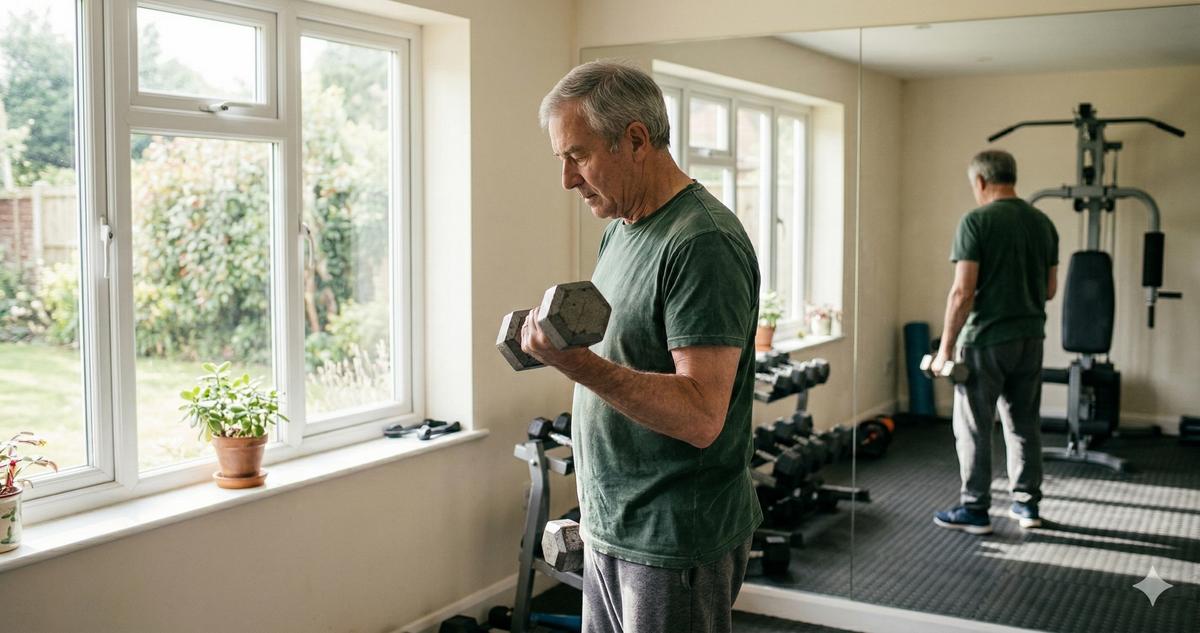
Light dumbbells, 2 to 5 pounds to start, add another layer. Bicep curls. Overhead presses, if your shoulders allow it. Goblet squats holding a single weight against your chest. The National Institute on Aging recommends strength exercises for all four major muscle groups (legs, hips, back, and arms) at least two days per week.
Two days. Not seven. Not five. Two.
A 2022 meta-analysis published in the British Journal of Sports Medicine, covering 16 studies and over 20,000 participants, found resistance training was associated with a 21 percent reduction in all-cause mortality in older adults. Twenty-one percent! Cardio alone didn't match that number for fall prevention or functional independence. The combination of both is ideal, but if you're choosing one, strength wins.
Two days a week. A kitchen chair. Your own body weight. The barrier to entry is almost embarrassingly low.
Starting Without Hurting Yourself
"I tried lifting weights once. Threw my back out." Roscoe, seventy-three, an Army veteran who joined our Tuesday group last fall, said this the way men of his generation often deliver medical information — half-joking, fully serious underneath.
His concern is valid. Starting wrong is worse than not starting. But starting wrong and not starting are not the only two options.
Talk to your doctor first, especially if you have heart disease, uncontrolled blood pressure, or joint replacements. Get clearance. Then ask for a referral to a physical therapist. Most people skip this step, and it's the most important one. A PT can assess your baseline strength, identify imbalances, design a program around your specific limitations, and teach you form that protects your joints instead of punishing them. Medicare Part B covers outpatient physical therapy. In 2026, there is no hard cap on PT visits; instead, claims exceeding $2,330 require additional documentation from your therapist confirming medical necessity.
If you're not sure where to start on your own, the National Institute on Aging offers a free exercise guide called "Go4Life" at go4life.nia.nih.gov. It includes illustrated strength exercises designed specifically for older adults, with modifications for different ability levels. I've printed copies for dozens of people at Seasons of Grace. The illustrations are clear, the language is respectful, and nobody is doing burpees!
Start lighter than you think you need to. Actually, start lighter than that. The biggest mistake I watch people make is grabbing the heaviest weight they can lift and calling it a workout. Progression matters more than intensity. Add one repetition per week. Add one pound per month. The body responds to consistency, not heroics.
What Lifting Does to Your Brain
The physical benefits are obvious. The cognitive ones are the surprise.
A 2025 study in GeroScience followed 334 adults aged 65 to 84 through a 12-month resistance training program and found significant improvements in executive function, working memory, and processing speed. Not walking. Not crossword puzzles. Lifting weights. The researchers hypothesized that resistance exercise triggers the release of BDNF, brain-derived neurotrophic factor, a protein that supports the growth of new neurons and strengthens existing connections.
This matters especially in conversation with what we know about brain training and cognitive health. The apps get the attention. The dumbbells get the results.
A woman named Iris, seventy-six, an artist who paints watercolors of the Craggy Gardens wildflowers and sells them at the River Arts District on weekends, told me something last spring that I wrote down in my journal that night. She'd been doing resistance band exercises three mornings a week for about five months. "I thought it would help my back," she said. "It did. But the thing I didn't expect? My painting got sharper. The colors I'm choosing are bolder. It's like the fog lifted and I didn't know there was fog."
No randomized controlled trial exists for that. But Iris is standing proof. Sometimes that's enough.
SilverSneakers, Medicare, and What It Costs
Money stops people. I've seen it.
The good news: SilverSneakers, the fitness program included in many Medicare Advantage plans, covers gym memberships at over 17,000 locations nationwide, including YMCAs, Anytime Fitness, and community recreation centers. The program is free to eligible members, not a discount, free. Check whether your plan includes it at silversneakers.com or call the number on the back of your Medicare Advantage card.
Silver&Fit and Renew Active (through UnitedHealthcare) are similar programs for plans that don't carry SilverSneakers. Between the three, most Medicare Advantage enrollees have access to some form of no-cost fitness benefit. Many of these programs also cover virtual classes, which matters if getting to a gym is the barrier.
Original Medicare (Parts A and B) does not cover gym memberships or fitness classes. But it does cover physical therapy, which can serve as the on-ramp. A PT can teach you the exercises, design the program, and set you loose with a plan that costs nothing to follow at home with a $15 set of bands and a kitchen chair.
No excuses left. Not really.
The Part That Has Nothing to Do With Muscles
Something shifted in me after Harold died. My body became a thing I was dragging around rather than living inside. Grief does that. It turns the body into luggage.
Nothing resembling strength training entered my life until 2012, three years after he was gone, when a colleague at the wellness center handed me a resistance band and said, "Just try the seated rows. Ten minutes. See what happens." Didn't want to. Was tired in a way that had nothing to do with sleep. But I did it. And something cracked open.
Not fixed. Cracked open. There's a difference.
The research on resistance training and mental well-being in older adults is striking. A 2024 review in Sports Medicine found strength training reduced depressive symptoms in adults over 60 by an average of 45 percent across 18 studies, outperforming antidepressant medication in several trials. Exercise triggers endorphin release, yes, but it also does something no pill can: it gives you back a sense of agency. You are not a patient. You are a person who just lifted something heavier than last week. That difference is enormous when the world is telling you to slow down.
For those of us who live alone, the confidence piece is life-changing. Carrying groceries. Opening a jar without asking someone. Getting up from the floor if you fall. These aren't fitness goals. They're independence.
Two Days a Week and a Kitchen Chair
Clement came back to the garden plot this past Saturday. He'd been to his doctor, gotten a PT referral, and had two sessions under his belt. He was doing sit-to-stands at home every morning, five at a time, using his dining room chair. "My wife thinks I've lost my mind," he said, grinning. "She asked me why I keep standing up and sitting down during the news."
He hadn't fallen again. It had only been three weeks. But his legs felt different, he said. Steadier underneath him. Like the ground was closer to where it was supposed to be.
I thought about that phrase the whole drive home. The ground closer to where it's supposed to be. Isn't that what all of us want, really? Not to be twenty-five again. Not to run marathons. Just to feel the floor solid under our feet and know our bodies will answer when we ask them to stand.
You don't need a gym. You don't need a trainer, though one helps. You need a chair, maybe a band, and two days a week.
Start tomorrow. Sit down. Stand up. Sit down again. The whole beginning is right there.
Mary Oliver wrote, "Someone I loved once gave me a box full of darkness. It took me years to understand that this too, was a gift." Our aging bodies are not the darkness. They are the box. And what we put into them — the effort, the consistency, the stubborn refusal to sit still when the world says we should — is the gift we give ourselves.
I hope your legs carry you well today. And tomorrow. And the day after that.