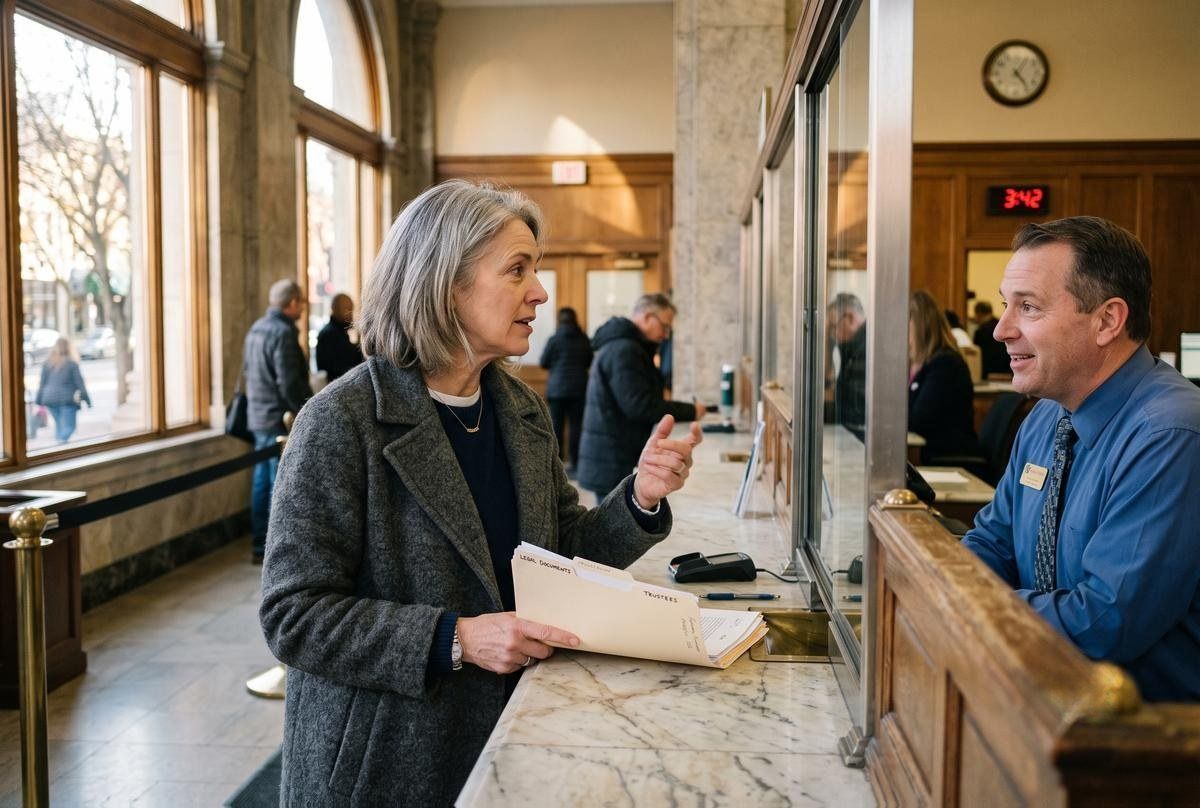
I met a woman named Dolores at a Westport library workshop two Memorial Days ago. She was 81, her husband Lawrence had died the previous October, and she'd come with a manila folder of paperwork because somebody at her church told her she should ask a financial planner about "the VA thing." Lawrence had served in Korea — fourteen months at Camp Casey, came home in 1954, drove a delivery route for Sealtest Dairy for the next forty years. Dolores had no idea his service had earned her anything. After he died she lived on his small Sealtest pension and her own Social Security. She was eating the same three meals on rotation and had stopped turning the heat above 64 because the oil bill scared her.
We sat in the corner of the library by the magazine rack and went through her folder. Lawrence's DD-214 was there, tucked behind their marriage certificate from 1957. He had served during a recognized wartime period. Dolores had unreimbursed medical expenses — the home aide who came three days a week, the Medicare supplement premium, prescriptions Medicare Part D didn't cover. By the end of forty minutes I could tell her, with reasonable confidence, that she likely qualified for around $1,400 a month in tax-free VA Aid and Attendance benefits. She stared at me. Then she said, very quietly, "Lawrence would have wanted me to know that."
This happens constantly. Aid and Attendance is the most underclaimed benefit in the VA system, and surviving spouses are the most underclaimed group within it. On Memorial Day, when the country thanks veterans, I want to talk about the widows.
What the Benefit Actually Pays in 2026
Let me name the numbers, because the numbers are the point. From December 1, 2025 through November 30, 2026, a surviving spouse with no dependents who qualifies for Aid and Attendance can receive up to $1,558 a month — that's $18,697 a year, tax-free, paid directly to the spouse. The 2.8% cost-of-living adjustment that kicked in December 1 raised the figure from the prior year's MAPR (Maximum Annual Pension Rate). If the surviving spouse has a dependent child, the maximum is higher, around $1,857 a month with A&A.
There are three rungs on this ladder, and they pay different amounts. The basic Survivors Pension for a single surviving spouse maxes out at roughly $975 a month ($11,699 a year). The Housebound rate, for a spouse who is substantially confined to her home, runs to about $1,191 a month ($14,298 a year). Aid and Attendance — the top rung, for someone who needs help with bathing, dressing, eating, or managing medications — pays the $1,558 figure. The amount you actually receive is the maximum minus your countable income, which I'll get to in a minute.
This is not a small benefit. For a widow living on $1,800 a month in Social Security, an extra $1,400 from the VA is the difference between scraping by and breathing. It pays the home aide. It pays the assisted-living shortfall. It is, in many cases, what keeps a widow from selling the house.
Who Qualifies — The Three Tests
Three tests have to be met, and all three matter.
Test one — the veteran's service. The deceased spouse must have served at least 90 days of active military duty, with at least one of those days falling during a recognized wartime period. He didn't have to see combat. He didn't have to leave the country. He just had to be in uniform during one of these windows: World War II (December 7, 1941 – December 31, 1946), Korean War (June 27, 1950 – January 31, 1955), Vietnam War (February 28, 1961 – May 7, 1975 for those who served in-country, or August 5, 1964 – May 7, 1975 for everyone else), and the Gulf War (August 2, 1990 – present, still officially open). He must have been discharged under conditions other than dishonorable. That's it for service.
Test two — the marriage and the spouse. The surviving spouse must have been married to the veteran at the time of his death and must not have remarried — unless the remarriage occurred after age 57, in which case it doesn't disqualify her (this rule changed in 2003 and a lot of widows still don't know it). There is no minimum length of marriage required for the basic benefit. There is no age requirement for the surviving spouse herself. A 52-year-old widow can qualify if she meets the medical and financial tests. So can an 88-year-old.
Test three — financial need. This is where the math gets technical, and where most denials happen. There are two pieces: the net worth limit and the income calculation.
The Net Worth Limit and What It Includes
The net worth limit for the 2026 benefit year is $163,699. That number adjusts annually with Social Security's COLA. Your house — the primary residence on a lot of two acres or less — does not count. Your car does not count. Most household furnishings and personal effects don't count. What does count: bank accounts, brokerage accounts, IRAs, annuities, second homes, rental properties, cash value of certain life insurance policies, and any assets you've transferred for less than fair market value within the look-back period.
The look-back is three years. If a widow gave her daughter $50,000 in 2024 to help with a down payment, and applies for A&A in 2026, that transfer can trigger a penalty period during which she's ineligible. The VA didn't always have a look-back; this rule went into effect October 18, 2018, and a lot of well-meaning families have run afoul of it because they didn't know.
Net worth includes the spouse's income, annualized, on top of asset value. So if a widow has $140,000 in savings and $30,000 a year in Social Security, the VA may add a portion of that income into the net worth calculation. The math is unkind to round numbers.
The Income Test — Where Medical Expenses Save You
Here is where most people give up too early. The VA doesn't just look at your gross income. It looks at your IVAP — Income for VA Purposes — which is your countable income minus unreimbursed medical expenses that exceed 5% of the MAPR.
Let me show you what that looks like with real numbers. Take a widow with $24,000 in annual Social Security. On paper, that exceeds the basic pension rate, so she'd appear ineligible. But she pays $1,800 a month for an assisted living facility, $187 a month for her Medicare Part B premium, $94 a month for a Medigap plan, $62 a month for Part D, and roughly $200 a month in out-of-pocket prescriptions and supplies. Her unreimbursed medical expenses run about $28,100 a year. Subtract those from her $24,000 income and her IVAP is, mathematically, zero. She qualifies for the full A&A maximum.
This is the calculation that gets botched on roughly half the applications I see. Caregiver costs count — including assisted living facility room and board if the resident requires assistance with activities of daily living. Home health aide costs count, even when the aide is hired privately rather than through an agency. In limited circumstances, payments to a family member who provides documented care can count, though the VA scrutinizes these closely and the family member generally has to be licensed or have a written care agreement in place. Medicare premiums count. Medigap premiums count. Long-term care insurance premiums count.
What doesn't count: groceries, utilities, ordinary housing costs, vitamins your doctor didn't prescribe.
The Form You Actually File
The form is VA Form 21P-534EZ — Application for Survivors Pension and/or Accrued Benefits. The EZ stands for the Fully Developed Claim process, which means if you submit all required evidence at the same time as the application, the VA processes it faster. "Faster" is relative. Plan on six to nine months for a decision, sometimes longer if the regional office is backed up.
What you submit with the form: a copy of the veteran's DD-214 (the discharge document), the marriage certificate, the death certificate, a complete list of medical expenses with documentation, bank and brokerage statements, and physician statements for the Aid and Attendance level — typically VA Form 21-2680, the Examination for Housebound Status or Permanent Need for Regular Aid and Attendance. The doctor fills it out. The widow doesn't.
If the application is approved, benefits are paid retroactively to the first of the month after the application was filed. Not approved month — application month. So filing matters even before all the documentation is collected; the Intent to File form (21-0966) locks in the effective date for up to a year.
Who to File With (and Who to Avoid)
This section is the one I argue with people about most. Filing for Aid and Attendance is free if you go through an accredited representative. There are three legitimate channels: a VA-accredited Veterans Service Organization (VSO) like the American Legion, VFW, or DAV; a state or county Veterans Service Officer; or a VA-accredited attorney or claims agent. All three are free for the application itself.
What I want you to avoid is the cottage industry of "VA pension planners" who advertise free seminars at restaurants and assisted living facilities. Many are insurance salespeople whose business model is moving a widow's assets into an annuity to get her below the net worth limit, and they earn a commission on the annuity. A widow in Bridgeport called me in 2022 after one of these meetings. The salesman had her halfway through paperwork to put $130,000 into a single-premium immediate annuity she didn't need and couldn't access in an emergency. She qualified without it. She had a perfectly clean path. The annuity would have served him, not her.
If someone offers to file your A&A claim for free but steers you toward a financial product, walk away. The VSO at your county courthouse will file the same paperwork without selling you anything. So will the local American Legion post.
Common Reasons Claims Get Denied
In no particular order: the wartime service window doesn't include the dates on the DD-214 (most often a discharge that ended just before the war began or just after it ended). The DD-214 is missing, and the family didn't request a replacement from the National Archives in St. Louis (free request, NA Form 13055 or the eVetRecs system online). The net worth calculation included assets that should have been excluded, or excluded assets that should have been included. The medical expense documentation was incomplete — receipts missing, the assisted living facility's monthly statement not itemized to show what portion was for care versus rent. The physician's 21-2680 form was filled out too vaguely to establish A&A need.
Denials are appealable. The Higher-Level Review process gives you another set of eyes at the regional office. The Board of Veterans' Appeals is the next step. Many initial denials are reversed on appeal, particularly when an accredited VSO handles the appeal and tightens the medical evidence.
How A&A Stacks With Other Benefits
A&A is non-taxable and doesn't reduce Social Security. It does count as income for Medicaid in most states, which complicates things for widows who are simultaneously trying to qualify for Medicaid long-term care. The two programs aren't designed to coordinate cleanly, and an elder law attorney is worth the consultation if both are in play. I cover the broader ground on veterans benefits for senior care in a longer guide, and the Medicaid intersection sits in does Medicaid pay for assisted living.
For widows weighing whether A&A makes assisted living workable versus staying in the family home, the math depends entirely on local care costs and the size of the house's equity. I walk through that calculation in how much it really costs to age in place. And if a long-term care insurance policy is in the picture, the coordination piece is laid out in what your long-term care insurance covers.
The Memorial Day Point
Dolores filed her 21P-534EZ in late June 2024 with help from the Connecticut Department of Veterans Affairs office in Rocky Hill. She was approved in February 2025 — eight months — at the full A&A rate, with retroactive payment to July 1. The retroactive check was just over $11,000. She used part of it to install a stair lift and the rest to settle the heating bill she'd been carrying. She wrote me a Christmas card last December that said, simply, "The house is warm."
Memorial Day is for the men and women who served. But the people they left behind earned something too. The benefit is sitting there, unclaimed, in over 65% of eligible cases, according to estimates the VA itself has acknowledged. If you're a widow of a wartime veteran, or you know one, the next step is a phone call. The national VA benefits line is 800-827-1000. Your county Veterans Service Officer is in the blue pages of the phone book or one Google search away. The American Legion will help you for free.
For anyone navigating the rest of what widowhood asks of a person — the practical and the not-practical — grief after losing a spouse is a different kind of guide, but it sits next to this one in my mind.
Lawrence served his country. Dolores is finally being thanked for it. Your husband served too. Find out what you've earned. It's not charity. He paid for it.