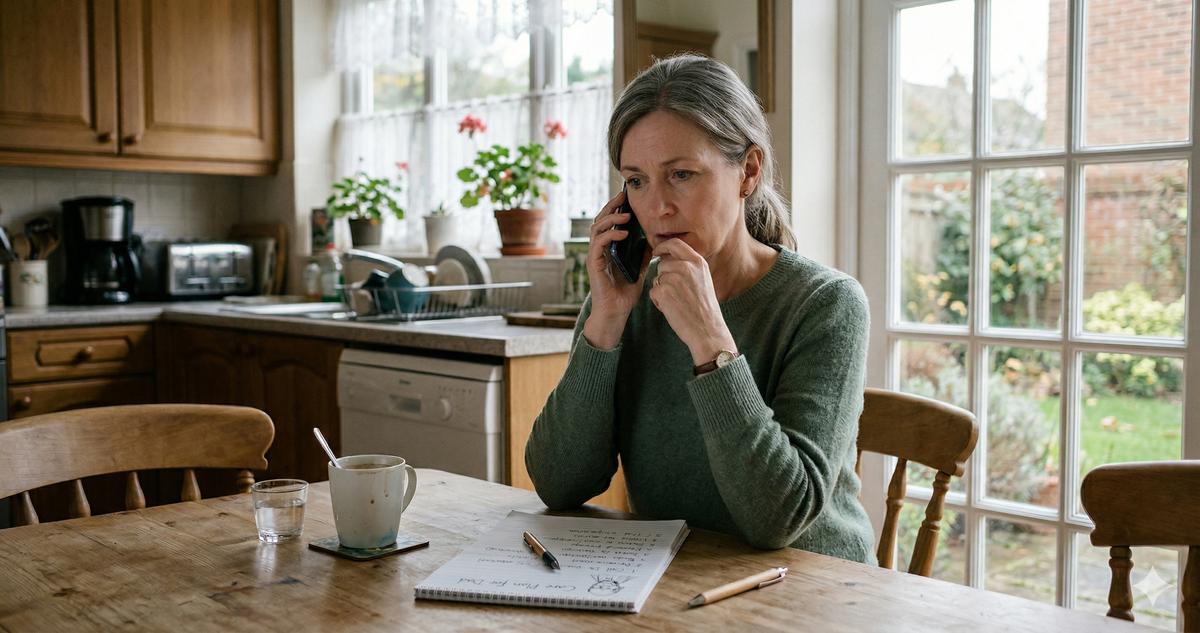
The phone rang at 9:47 on a Tuesday night last October. I was on the porch with a cup of chamomile and a half-finished crossword. The woman on the other end was crying so hard I had to ask her to slow down twice before I caught her name. She lived in Cincinnati. Her father lived alone in a townhouse outside Charlotte. He had just been discharged from the hospital after a fall, and the discharge planner had handed her a list of seven phone numbers and wished her luck.
She had spent four hours on those calls. Two went to voicemail. One was a home health agency that didn't take her father's insurance. One was a Medicaid line in the wrong county. By the time she got me, she hadn't eaten dinner. She said, "I don't even know what I'm asking you for."
What she was asking for, though she didn't have the words yet, was a geriatric care manager.
The Job Nobody Told You Existed
Most adult children find out about geriatric care managers the same way that woman did. At the bottom of a frantic week, after the system has already broken something. The job exists. It has existed for forty years. Hospital social workers know about it. Elder-law attorneys know about it. Almost nobody else does, until they need it badly.
The formal name shifted in 2015. The National Association of Professional Geriatric Care Managers became the Aging Life Care Association, and the credential is now called Aging Life Care Professional. Most families still say "geriatric care manager" because that's what the listing in the phone book said for thirty years. Both terms point to the same person.
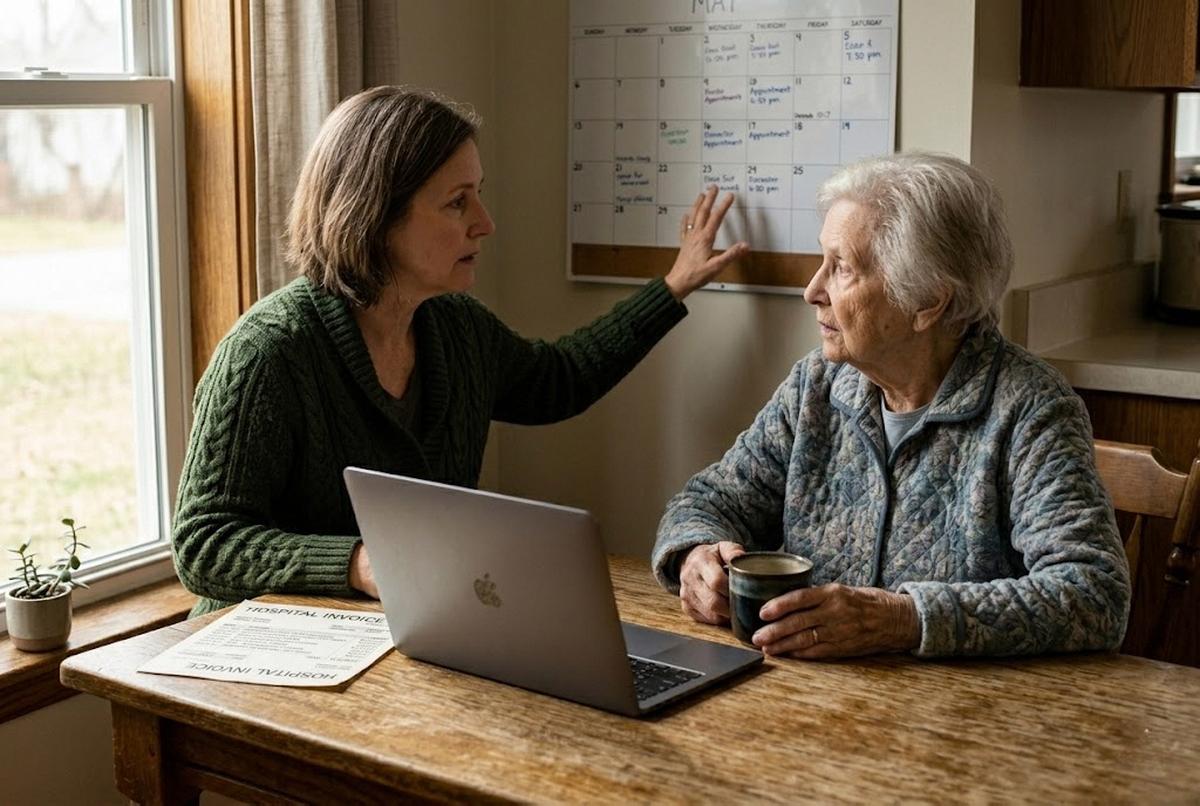
What that person does, in plain language, is this. They sit with your family, listen to what's actually happening, evaluate your aging parent in person, and build a care plan that covers every piece of the puzzle. Medical, cognitive, emotional, financial, legal, housing. Then they help you carry it out, or they hand you a roadmap clear enough that you can.
When You Should Pick Up the Phone
There are situations that call for one and situations that don't. I want to be honest about both.
If your mother is doing well, lives nearby, has one or two stable health conditions, and you have time to attend her doctor visits and read her mail, you probably don't need a care manager. You need a good primary care physician, a binder for her medications, and an honest conversation about advance directives.
The families I've seen actually need one fall into a few patterns.
Long-distance caregiving. When you live in Denver and your father is in Tampa, the math stops working. You cannot be the eyes in the room from two thousand miles away. A care manager becomes your local presence: visiting the home, attending appointments, calling you with what they observed. If this is your situation, our long-distance caregiving guide covers the larger picture.
A new dementia diagnosis. The medical visit ends. The neurologist hands over a prescription. And then everyone goes home and tries to figure out what to actually do tomorrow morning. A care manager who specializes in dementia knows the local memory care options, the day programs, the safety modifications, the conversations to have now while there's still time.
Discharge from the hospital. This is the moment families crater. Three days in a hospital bed, a stack of papers, a referral list, and your mother is going home with new medications, new restrictions, and a follow-up appointment in eleven days. A care manager called in within forty-eight hours of discharge can prevent the readmission that statistically follows.
Family conflict over care. When three siblings want three different things, and one of them lives with Mom and is exhausted, and another is across the country and feels guilty, and the third thinks everyone is overreacting, a care manager can act as the neutral expert in the room. I've watched this single intervention save relationships that were unraveling.
Refusal to accept help. When the parent who needs help is the parent saying loudly that they don't. A care manager who has navigated this hundreds of times can sometimes hear what the family member can't. We've written separately about the parent who refuses help, and a care manager is often the next step when those approaches stall. The same is true when the question is whether to bring in a home care agency. A care manager can vet the candidates with a trained eye.
What an Assessment Actually Includes
The first formal step is a comprehensive assessment. This is not a phone intake. It is a multi-hour visit, usually in the home, that touches seven domains. A skilled care manager will move through them in conversation rather than a checklist, but the bones are these.
Functional. Activities of daily living: bathing, dressing, toileting, transferring, eating, continence. Then instrumental activities: managing medications, cooking, shopping, finances, transportation, the telephone. The care manager observes, asks, and often quietly tests. Can your mother actually demonstrate using the microwave, or does she just say she can?
Medical. Diagnoses, medications (every bottle, on the table, counted), prescribers, recent hospitalizations, pending appointments, last lab work. Many assessments uncover medication conflicts the family didn't know about and the pharmacist couldn't see because three different doctors were prescribing.
Cognitive. Standardized screens like the Mini-Cog or MoCA, plus observation. Is your father masking? Is your mother covering for her husband? The skilled care manager can often see what a fifteen-minute office visit cannot.
Psychological. Mood, anxiety, social engagement, signs of depression. Geriatric depression is wildly under-diagnosed.
Social. Who is in the circle of support? Family, neighbors, church, community programs. Loneliness is a clinical risk factor, not a soft concern.
Financial and legal. Income, insurance, long-term care policies, advance directives, power of attorney, will. Care managers don't give legal advice. They identify gaps and refer. If you suspect Medicaid will be part of the picture, they'll flag it early.
Home safety. Stairs, throw rugs, bathroom layout, lighting, the temperature of the water heater. A care manager walks the house with the eye of someone who has seen every kind of accident.
The written assessment runs ten to thirty pages. It is, in my experience, the most useful document a family can have during a hard year.
What It Costs, Honestly
Hourly rates run $100 to $250. Most independent care managers sit in the $125 to $175 range. The initial assessment is billed as a flat fee, $150 to $750 depending on market and complexity. Ongoing oversight, if you continue, runs $400 to $800 a month for a few hours of work.
This is the part where families flinch. I understand. It is real money.
But here is the honest math I have watched work itself out for hundreds of families. The woman from Cincinnati spent four hours on hold and got nothing. A skilled care manager, in those same four hours, could have placed her father with a vetted home health agency, ordered the bath bench, scheduled follow-up appointments, faxed the medication list to his primary care doctor, and called her back with a written summary. Forty hours of phone calls compressed into four. At $150 an hour, that is $600 of bill. The forty hours she would have spent (distracted, missing work, crying in her car) has its own cost.
I'm not saying it's affordable for everyone. It isn't. I'm saying it's worth understanding the trade.
What Medicare and Insurance Actually Pay
The short answer is: almost nothing. The longer answer is worth knowing.
Original Medicare does not cover geriatric care management. Period. It is not a recognized benefit under Part A, Part B, or Part D.
Medicare Advantage plans. A small but growing number of MA plans offer care management as a supplemental benefit, particularly Special Needs Plans for chronically ill enrollees. Read the plan's Evidence of Coverage. The benefit, when it exists, is usually a limited number of hours per year.
Medicaid waivers. Some Home and Community-Based Services waivers include case management. The case manager assigned through Medicaid is not the same as a private Aging Life Care Professional. The function overlaps but the caseload is heavier and the choice is not yours.
Long-term care insurance. A handful of policies cover care management. Newer policies from Genworth, John Hancock, and Mutual of Omaha sometimes include it. Older policies almost never do. Read the schedule of benefits.
Veterans benefits. The VA's Aid and Attendance program does not pay care managers directly, but the monthly benefit (up to $2,795 for a veteran with a dependent in 2026) can be applied to one. Some VA medical centers also employ social workers who provide a partial equivalent at no cost. The waiting times vary, but the door is real.
For most families, though, this work simply comes out of pocket. Worth a phone call to your plan, but don't count on it.
How to Vet One Before You Hire
A former colleague of mine, a hospice nurse named Ruth who I worked alongside in Atlanta in the late 1980s, took a geriatric care management job after she retired from clinical work in 2012. She is the gold standard for what this work looks like. She is also the person who taught me what to ask.
Ask these questions, in this order, on the first phone call.
- Are you a member of the Aging Life Care Association? Membership requires verified credentials and adherence to a code of ethics. Three levels exist: Member, Advanced Professional, and Fellow. Anyone can hang a shingle and call themselves a care manager. ALCA membership is the minimum filter.
- What is your professional background? Look for nursing, social work, gerontology, or psychology. The Advanced Professional and Fellow levels require advanced degrees and clinical hours.
- Are you certified? Beyond ALCA, look for the CMC (Care Manager Certified) or C-ASWCM (Certified Advanced Social Work Case Manager) credentials. They aren't required, but they are signals.
- Will you provide three references? Not testimonials on a website. Real names of families who have worked with you, who you can ask to call me back. A care manager who hesitates here has something to hide.
- What is your fee structure, in writing? Hourly rate, what counts as billable time (travel? phone calls? emails?), how invoices are itemized, when payment is due.
- Do you have any financial relationships with the providers you recommend? This is the single most important question. A care manager who accepts referral fees from assisted living facilities or home care agencies is not your advocate. They are a salesperson. They should disclose this voluntarily and in writing.
- What is your scope of work? Will it be in writing? A reputable care manager will define exactly what they will do, what they won't, and how the engagement can end.
- Who covers when you are unavailable? Vacation, illness, weekends, emergencies. There should be a backup, and you should know their name.
- What is your caseload? A care manager carrying eighty active families is not giving any of them serious attention.
- Can we meet in person before signing anything? A free or low-cost initial consultation is standard. If it isn't offered, that is itself information.
The Red Flags That Should Make You Run
Not every person calling themselves a care manager is one. The industry is unregulated in most states, and the credentialing landscape is genuinely confusing for families. Anyone can print a business card. Anyone can build a website with stock photos of smiling older people and a tagline about compassion. Here are the warning signs that should not be negotiable, in roughly the order they tend to appear.
They accept referral fees from facilities or agencies and don't disclose it upfront. This is the biggest one. Fee-for-referral arrangements turn the care manager into a marketer. Walk away.
They refuse to put the scope of work in writing. "We'll figure it out as we go" is not a contract. It is the setup for a billing dispute.
They send vague invoices. "Care management services, 8 hours, $1,200" is not itemization. You should see the date, the activity, the duration, and the rate, line by line.
They pressure you to sign quickly. A reputable care manager expects you to take a few days. A bad one acts like the slot will disappear by Friday.
They are not licensed in their underlying profession (RN, LCSW, etc.) in your state.
They will not name their references, or the references they name turn out to be coworkers or relatives.
They carry no professional liability insurance. Ask. Ask to see the certificate.
And one more, harder to put into words: they don't ask your aging parent any questions. They talk only to you. The care manager who walks into your mother's home and treats your mother like a problem instead of a person is the wrong care manager. The right one will sit beside her, ask about the photo on the mantel, watch how she pours her own tea, and let the assessment be a conversation rather than an interrogation.
A Story About What This Work Looks Like When It Works
Claudette, a retired bookkeeper in her seventies who lived alone in West Asheville, came to one of our Tuesday circles two summers ago. Her husband had died eighteen months earlier. Macular degeneration. Mild atrial fibrillation. A knee that needed replacing. A refrigerator with three months of expired yogurt in it because she could no longer read the labels. She was, by every measure, in trouble.
Her daughter in Knoxville hired a care manager out of Charlotte after a panicked Sunday call. The care manager drove to Asheville on a Wednesday, spent five hours in the home, and produced a written assessment that ran nineteen pages. Among other things, the assessment identified that Claudette's cardiologist had prescribed a beta-blocker contraindicated with her glaucoma drops. Three doctors. Three pharmacies. Nobody had caught it. The family had been worried about her short-term memory. Her short-term memory was fine. She was being slowly poisoned by her own prescriptions.
The care manager fixed it in a week. She arranged a low-vision evaluation, a knee surgery consult, a meal delivery service, and a weekly check-in by a neighbor who had never been asked.
Claudette is still in her own home, two years on. The Knoxville daughter calls me sometimes, on bad weeks, and says the same thing each time. That bill was the best money our family has ever spent.
When You Can't Afford One
I know not every family can pay $1,500 for an assessment. So I want to name what is available below that price point, because the absence of money does not mean the absence of help.
Eldercare Locator at 1-800-677-1116 connects you to your local Area Agency on Aging, which usually offers free consultations.
Hospital social workers are free during a hospitalization. Use them aggressively. Ask for a meeting before discharge, not on the day of. They cannot follow your parent home, but they can build the bridge.
Aging Life Care Association maintains a referral directory at aginglifecare.org with a Find an Aging Life Care Expert tool. Some members offer pro bono consultations or sliding-scale fees. Ask.
Veterans Affairs social workers, for veterans and surviving spouses, do real care management as part of their job. They are overworked but free.
Faith communities and senior centers. Don't underestimate the parish nurse who has known your mother for forty years.
Ask. The information is rarely volunteered, but almost always available.
A Word About Carrying This
The families I see drowning are not failing. They are doing the work of three professionals (nurse, social worker, project manager) without training or sleep. If you are in that place right now, please hear me.
This season of life will ask everything of you. It is not weakness to call in someone who has done this hundreds of times before. It is wisdom. The same wisdom that lets a surgeon refer to a specialist, a lawyer co-counsel a hard case, a teacher ask the principal for help with a class she cannot reach.
Caregiver burnout is not a personal failure. It is the predictable cost of carrying a load that was never designed to be carried alone. A care manager, whether one you hire, or one you find through your local Area Agency on Aging, or the hospital social worker you finally take a meeting with, or the parish nurse who has been waiting for someone to ask, is one of the ways we share that load. There is no medal for refusing the help.
The woman from Cincinnati hired a care manager in Charlotte the next day. I haven't talked to her since the spring. The last email she sent me said three sentences: "He's home. He's safe. I slept for nine hours last night." I read it twice and went out to the porch.
We were not meant to walk this path alone. We never were. There are people whose entire profession is built around walking it with you, and the cost of admission is asking. That is, sometimes, the hardest part. So begin with a phone call. Or a question to the discharge planner. Or a quiet email to the AAA. The next step is smaller than you think it is, and you do not have to take it perfectly.