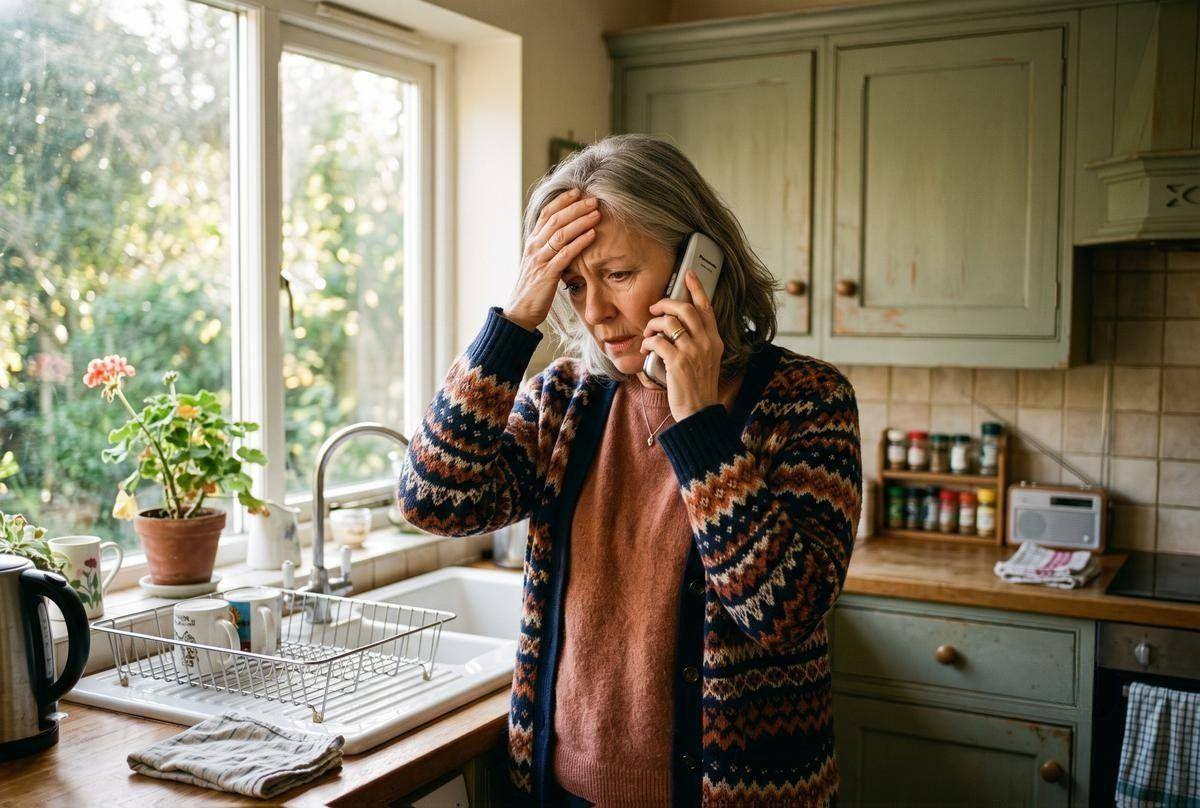
The reception desk at the emergency department was lit with that particular fluorescent light hospitals use, the kind that makes everyone look a little ill before anyone has even examined them. It was a Tuesday afternoon in March. A woman in her early seventies, gray hair cut short, a canvas bag slung across her chest, stood at the counter and said her wife had been brought in by ambulance an hour earlier. The young clerk looked at the screen, then at her, then back at the screen. "I'm sorry," he said. "We can only give updates to family."
She said it again. My wife. Forty-one years.
The clerk asked for paperwork.
She didn't have it with her. The marriage certificate was in a fireproof box in their basement in West Asheville. The medical power of attorney was filed with their family doctor. The HIPAA release was somewhere in a folder on her wife's desk. None of it was in her canvas bag, because nobody packs a legal file when an ambulance pulls into the driveway.
This was last year. Not 1985. Not 1995. Last spring.
A pastoral care colleague of mine, a hospice chaplain I've known for twenty years, was the one who got the call. She walked over from the chapel and sat with the woman in the family lounge and made the phone calls until somebody at the desk could verify what should not have needed verifying. By the time the woman was let back to see her wife, ninety minutes had passed. Her wife had been alone, frightened, and unable to communicate her medication list to the attending physician.
This is what aging without a safety net looks like for a lot of LGBTQ+ couples right now. Not the dramatic refusal you might imagine. Something quieter and more bureaucratic. A clerk doing what he was trained to do. A system that still, in 2026, treats same-sex spouses as a question to be answered rather than a fact to be honored.
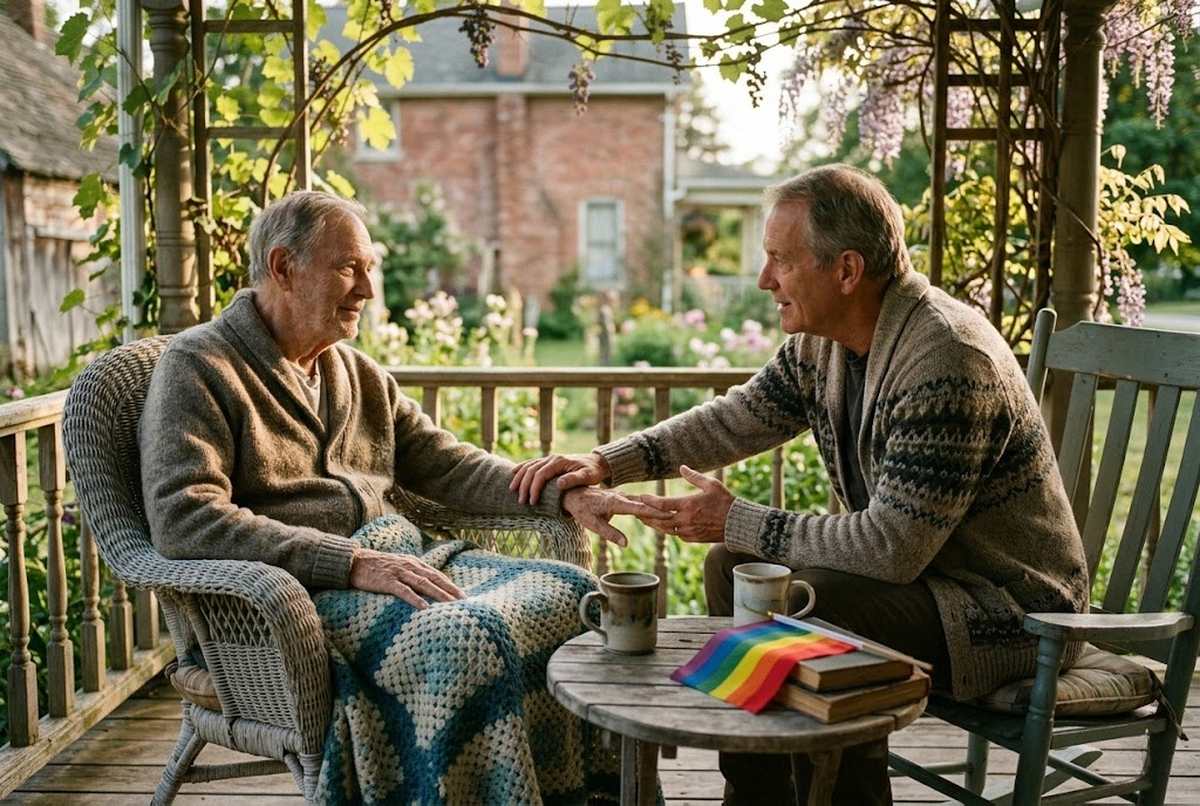
June is Pride Month, and most of the coverage you'll see will focus on parades and rainbow flags. I want to talk about something else. I want to talk about the seventy-year-old who is suddenly the only person standing between her wife and a hospital that doesn't know her, the seventy-five-year-old man whose husband of thirty years has just been diagnosed with Parkinson's, the older couples who came of age in a country that did not recognize them and now find themselves caregiving with a thinner safety net than most of us realize.
The Generation That Grew Up Hiding
The LGBTQ+ adults who are seniors today did not have the option of being out for most of their lives. Many were teenagers when the Stonewall riots happened in 1969. Many lost friends and partners during the AIDS crisis of the 1980s and 1990s with no legal recognition of their grief. They built lives in a country that, until 2015, did not federally recognize their marriages.
Which means the support systems most of us take for granted, they had to build from scratch.
Researchers and advocacy groups call this "family of choice": the network of friends, neighbors, former partners, and chosen kin that older LGBTQ+ adults often rely on instead of, or alongside, their families of origin. SAGE, the national organization for LGBTQ+ elders, reports that older LGBTQ+ adults are twice as likely to live alone and four times less likely to have children to help them. (You can read more at sageusa.org.) Roughly one in five has experienced rejection from their family of origin. For some, the people who would otherwise be the first call in a caregiving crisis are simply not in the picture.
This matters for caregiving in a way that's hard to overstate. When the spouse becomes the caregiver, the spouse is often the only caregiver. There's no daughter driving in from Atlanta. No son flying in from Seattle. There's the two of them, and the friends they've kept, and whatever they've put in writing.
What the Numbers Tell Us
SAGE estimates that by 2030, the population of LGBTQ+ Americans aged fifty and over will approach seven million, based on Movement Advancement Project projections drawing on Census Bureau and Gallup survey data. Not a small community on the margins.
The Movement Advancement Project's 2024 analysis, drawing on SAGE data, found that older LGBTQ+ adults face higher rates of social isolation, lower average household incomes, and higher rates of poor mental health outcomes. They are less likely to have biological children. They are more likely to be primary caregivers for partners. They are also more likely to delay or avoid care because of past experiences of discrimination. Researchers call it "medical avoidance."
A Kaiser Family Foundation analysis published in 2024 noted that LGBTQ+ adults over fifty report worse self-rated health and higher rates of disability than the general population at the same age. (See kff.org for their ongoing reporting.) More health needs, less family support, residual fear of the medical system: that combination creates a caregiving picture harder than the one most American families face.
Same-Sex Spouses Under Federal Law, Right Now
Here's what most older couples don't fully realize: the legal protections for same-sex spouses, post-Obergefell, are real and they're substantial.
The Department of Health and Human Services and the Centers for Medicare and Medicaid Services treat legally married same-sex spouses identically to opposite-sex spouses for every federal program. That includes Medicare, Medicaid, Social Security survivor benefits, and the spousal protections built into long-term care planning.
Medicaid's spousal-impoverishment rules, the provisions that protect a healthy spouse from financial devastation when the other spouse goes into a nursing home, apply equally regardless of the gender of the spouses. The community spouse resource allowance, the minimum monthly maintenance needs allowance, and the home equity exemption all work the same way. If you're trying to understand how this affects your situation, our piece on whether Medicaid pays for assisted living walks through the basics.
Hospital visitation rights are protected too. The 2010 CMS rule on Conditions of Participation requires every hospital that accepts Medicare or Medicaid funding (which is essentially all of them) to allow patients to designate any visitor of their choosing, regardless of gender or relationship. A spouse cannot be turned away because of who they are. A designated friend or partner cannot be turned away either, if the patient has named them. Section 1557 of the Affordable Care Act adds a second federal layer: it prohibits discrimination on the basis of sex — interpreted under current HHS rules to include sexual orientation and gender identity — by any health program or activity receiving federal funding. The protection sits in the underlying statute, not just an agency rule.
The rules are clear. The enforcement varies. Which is why paperwork still matters.
There is also, I want to acknowledge gently, real concern in the LGBTQ+ legal community about the durability of some of these protections. Court rulings can be revisited. Federal rules can be rewritten. Whatever your political view of all that, the practical takeaway is the same one I've been giving families for forty years: put it in writing. Put it in writing while everyone is well. Put it in writing today.
The Folder Every Older Couple Should Have
I've started calling this the "caregiver folder" in my conversations with couples, because the word "binder" makes people think of three-ring binders from 1992, and the word "file" makes them think of taxes. A folder. Something you can hand someone in a crisis.
Here is what belongs in it.
HIPAA release forms for both spouses, naming each other and any trusted person who should be able to receive medical information. Every doctor's office and hospital has its own. Fill out a fresh one once a year.
Medical Power of Attorney for both spouses, naming the other as primary decision-maker, with a clear backup. The single most important document. We have a state-by-state walk-through on medical power of attorney and advance healthcare directives if you're starting from zero.
Living Will or Advance Directive for both spouses, spelling out preferences for end-of-life care.
Marriage certificate, original or certified copy. Extra certified copies are cheap to order, and they end bureaucratic arguments fastest.
Designated Healthcare Decision-Maker form if your state has one separate from the medical POA.
A short document listing both names, birth dates, Social Security numbers, primary care physicians, current medications, allergies, and emergency contacts. Couples freeze at intake when asked to recite a medication list at 2 a.m.
Keep one copy at home. Give a sealed copy to a trusted friend or chosen-family contact. Email a scan to yourself. Belt and suspenders!
SAGECare and Where to Find Care That Won't Make You Explain
One of the harder pieces of caregiving for older LGBTQ+ couples is finding home care, assisted living, memory care, or hospice that doesn't require either spouse to spend the first three visits explaining who they are.
SAGECare is the cultural-competency training program run by SAGE that credentials providers who have completed LGBTQ+ aging training. As of 2026, more than 970 organizations across the country hold SAGECare credentials, including hospices, home care agencies, assisted living facilities, and senior centers. The list is searchable at sageusa.org/sagecare. If you're looking for a provider in your area, this is where I'd start.
A SAGECare credential isn't a guarantee that every staff member will be perfectly trained, but it tells you the organization has put resources into educating its people, has policies that address LGBTQ+ inclusion, and has made a public commitment to serving the community. That's not nothing. In a healthcare landscape where many older LGBTQ+ adults still report having to closet themselves to receive respectful care, it's quite a lot.
If there's no SAGECare provider near you, the questions you ask when evaluating any home care agency become even more important. Ask directly. "Have your staff received any LGBTQ+ aging training?" "What is your policy on supporting same-sex spouses and chosen family during care?" Listen to how they answer. The pause matters as much as the words.
A woman in one of my caregiver circles, retired from teaching high school art for thirty-five years, told me she had called four home care agencies before finding one whose intake coordinator did not visibly stiffen when she said "my wife." That is the work of finding affirming care in 2026. It is still real work. It should not be, and it is. The woman ended up at a small, family-owned agency in Buncombe County whose owner had completed SAGECare training the previous year. Her wife's home health aide now arrives every Tuesday and Friday and asks about the wife by name, the way you would expect anyone to. It is a small thing. It is also everything.
The SAGE Hotline
If you're an LGBTQ+ older adult or you're caring for one, write this number down. SAGE runs an LGBT Elder Hotline at 877-360-LGBT (that's 877-360-5428). It's free and confidential, staffed by trained peer counselors who understand the specific issues that come up for older LGBTQ+ adults — caregiving, grief, isolation, Medicare questions, finding affirming providers, processing the long history many older LGBTQ+ adults carry.
I've recommended this hotline to people who I knew would never call a generic helpline. Sometimes the difference between making the call and not making it is knowing the person on the other end won't need anything explained.
When Family of Origin Is Not the Family You Have
For many older LGBTQ+ adults, the people who will show up are not the people on the next-of-kin form. A former partner who became a lifelong friend. A neighbor of fifteen Thanksgivings. A church family from an affirming congregation. The friend who has had the spare key for two decades.
Legally, if you want those people to make medical decisions or visit you in the hospital, you have to name them. The federal hospital visitation rule lets any patient designate any visitor by putting it in writing.
Without a designated decision-maker, healthcare providers default to biological family in most states. If your biological family isn't the family that knows you, name the people who do. Put them on the form. Communities like senior cohousing, where neighbors agree in advance to look out for one another, can be especially meaningful for couples whose support networks are spread thin.
What Caregiving Inside a Long Marriage Asks of You
I want to close with the part of this that has nothing to do with paperwork.
When you've spent forty years building a life with someone in a country that took most of those forty years to acknowledge your relationship as real, the caregiving season carries a weight that's hard to put into words. There's the grief that comes with watching the person you love become more vulnerable. There's also a kind of grief specific to this generation — the awareness of how long the road has been, how much was lost along the way, how many friends didn't get to grow old at all.
A woman I sat with in a Seasons of Grace circle two years ago put it this way. She had been married to her wife for thirty-eight years, and her wife was in early-stage Alzheimer's. "We finally got to be old together," she said. "And now I'm losing her, and I am so grateful for every day, and I am so angry at how long it took to get here."
Gratitude and anger can share the same chest. So can love and exhaustion. So can hope and grief. None of these cancel the others out.
If you are caring for the person you have loved for decades, you are doing one of the oldest and most sacred kinds of work a person can do. The world has not always made room for you to do it openly. It does now, more than it used to. Some days that will feel like enough. Some days it won't, and on those days the signs of caregiver burnout deserve your attention before they deserve anyone else's.
What I've found, sitting with hundreds of couples through the hardest seasons of their lives, is that the practical preparations and the emotional work are not separate things. The folder on the kitchen counter, the SAGECare provider you've already met, the friends who know where the spare key is — these are not paperwork. They are love made visible. They are how you say to each other, without needing the words: I am not going to leave you alone in any room you walk into. Not the doctor's office. Not the hospital intake desk. Not the long, quiet afternoons that come at the end.
That is the safety net. We build it together, while we still can. And we keep building it for each other, because no one was ever supposed to walk this path alone.