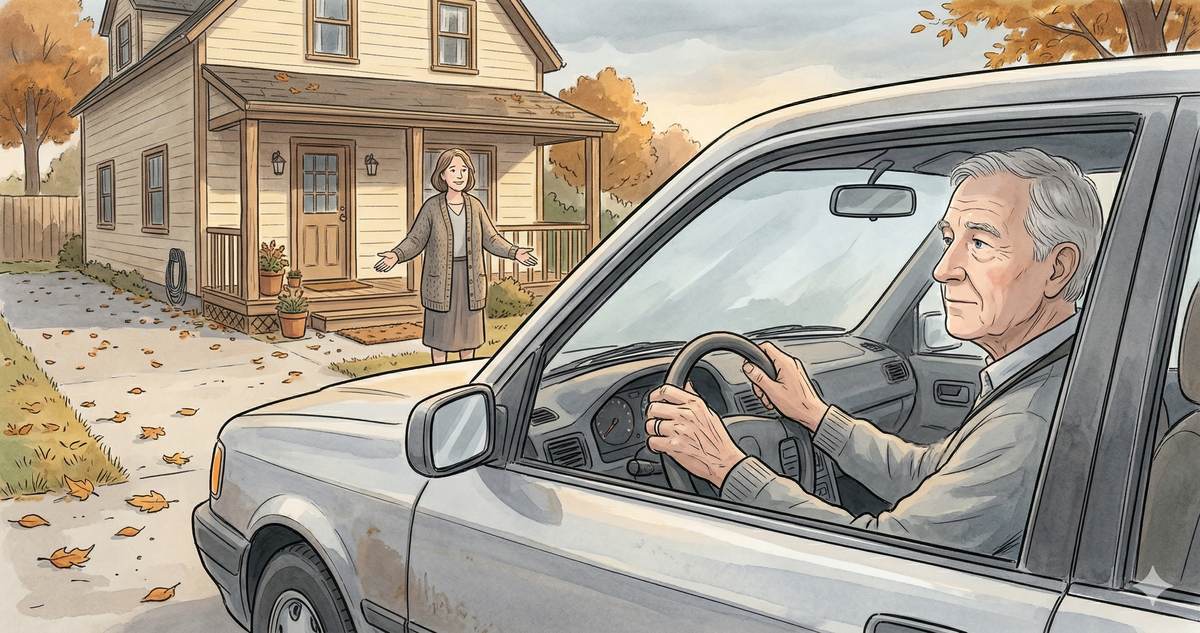
Three weeks ago, looking for a flashlight in our Scottsdale garage, I pulled down a cardboard box labeled "MOM - MISC" in my own handwriting.
Sat on the garage floor for forty minutes.
Inside: Dorothy's address book with the leather cover peeling off. A recipe card for beef stroganoff in her handwriting, the letters tight and precise even in her seventies. Three Christmas ornaments wrapped in newspaper from 2011. A coffee mug from a teacher supply store reading "World's Okayest Secretary," given to her as a joke in 1983 and used every single morning until she couldn't anymore.
Dorothy died in 2012. My father Robert died in 2008. Clearing both their homes taught me something every well-meaning article about estate cleanouts gets wrong: it is not a project. It is not a checklist. It is standing in your dead mother's kitchen holding a spatula, realizing she'll never flip another pancake, unable to decide whether keeping it or tossing it feels more like betrayal.
Done it twice. Neither time got easier.
Don't Rush. Grief Needs a Lease, Not a Deadline
When Robert died in October 2008, Tom called from Denver the next week. "We should get the house cleared before the holidays."
Tom. Practical, organized, the kind of person who owns a label maker.
"Tom," I said, "your grandfather has been dead for nine days."
"I just thought..."
"The estate can wait."
It could. We didn't touch Robert's house for three months. Unless you're hemorrhaging money on a mortgage or the property faces some immediate danger, you do not have to empty a deceased parent's home in thirty days. You don't have to do it in sixty. The estate attorney wants to close probate. The real estate agent wants to list. Your siblings want resolution. Everyone has a timeline except the person who just lost a parent.
A 2023 survey by the National Association of Senior & Specialty Move Managers found the average family takes four to six months. The families who rushed reported more regret about items discarded and higher conflict between siblings.
Four to six months. Write it down and show it to anyone pushing you.
Financial realities exist, obviously. Robert's house in Evanston cost about $2,100 a month to maintain empty. We budgeted three months of carry costs. If the house is paid off, your runway extends. Sit down with a calculator before you sit down with a dumpster.
Start With the Bathroom. Trust Me
When we began on Robert's house, I made the mistake of starting in his bedroom. Opened his closet. Saw his grey cardigan with the elbow patches hanging there. Had to leave for two hours.
Lesson learned. Dorothy's house, four years later? Bathroom first.
Bathrooms are emotionally neutral territory. Expired prescriptions, half-used bottles of Suave shampoo, a drawer of sample-size hotel lotions from the nineties. Nobody cries over a tube of Crest. You bag it, toss it, wipe the shelves, and twenty minutes later you have one finished room. Momentum without a breakdown.
After the bathroom: kitchen non-sentimentals (spices, cleaning supplies, the fifteen plastic bags stuffed inside a plastic bag under the sink). Then hallway closets, garage, basement. Leave bedrooms and living spaces for dead last.
Three categories per room. Keep. Donate. Trash.
And a fourth nobody mentions: Not Sure. Anything you can't decide about in ninety seconds goes in a sealed box. Date it. Revisit in thirty days. By then your brain has processed enough grief to think clearly about whether you need your father's 200 matchbooks from restaurants that closed in the eighties. You don't. But you might want five of them.
What to Keep, What to Let Go
Everybody says you can't keep everything. True. Also unhelpful.
Here's the thing. My rule, earned across two houses: keep what's irreplaceable and what you will actually look at or use. Not might. Will.
Dorothy's address book? Kept it. Robert's National Geographic collection, 1974 to 2006? Every issue lives online. Kept three, one for each grandchild's birth month. Her everyday dishes went to Goodwill. Her handwritten recipe cards are in a binder in my kitchen right now.
The coffee mug sits in my cabinet. Mornings when the missing hits hardest, that mug comes out.
For donations: Habitat for Humanity ReStore takes furniture and appliances. Goodwill and the Salvation Army accept clothing and housewares. Vietnam Veterans of America does free pickups at 1-800-775-8387. For medications, use a DEA-authorized collection site. Do not flush them!
When Your Siblings Can't Agree
My brother Wayne lives in Michigan. My sister Joanne lives in Minnesota. When Robert died, the three of us had to clear a four-bedroom house in Evanston while living in three different states, grieving at three different speeds, and holding three completely different opinions about his recliner.
Wayne wanted to keep it. Joanne wanted to donate it. My vote was fire, but only because grief needed a target and the recliner was there.
Actually, no. The recliner wasn't the problem. The problem was my father wasn't sitting in it.
A 2019 study in the Journal of Family Issues found 44 percent of families experience significant conflict settling a parent's estate. Personal property disputes outrank financial disagreements two to one. People don't fight about the stock portfolio. They fight about the china.
What worked for us:
Round-robin selection. Drew numbers from a hat. First pick, second pick, third pick, around and around. Felt silly, like a draft for dead people's furniture. But it killed the "I called it first" problem cold.
The 48-hour rule. Before anyone claimed an item, it sat for two days. Sleep separates genuine attachment from grief-fueled hoarding.
One walk-through, one list. A single Saturday, room by room, shared Google Doc of every significant item. No sidebar calls. No asking Mom's friend what something was worth. Decisions made together, in person.
Joanne still thinks she should have gotten the kitchen table. Eighteen years later. Brings it up at Thanksgiving. Just how it goes.
The Estate Sale Math Nobody Does
Dorothy's china: Noritake Rothschild, service for twelve, gold rim, purchased in 1967. Sixty years of hand-washing. Appraised by an estate sale company called Prairie Estates at $120 total. After their 35 percent commission? I would have received $78 for my mother's wedding china.
Donated it instead. The tax write-off at fair market value netted more.
Estate sales work for furniture in good condition, working appliances, tools, and collectibles with actual demand. They do not work for china, crystal, or encyclopedias. The formal dining market collapsed about fifteen years ago. Companies charge 25 to 50 percent of gross. A full-house sale bringing in $8,000 to $15,000 is considered good. After commission, minus your time, your emotional bandwidth, and the experience of watching strangers negotiate over your parent's belongings? Sometimes donating makes more sense all around.
Alternatives: MaxSold runs online estate auctions with no upfront cost. Facebook Marketplace moves furniture fast. Better World Books sends free shipping labels for book donations.
Or do what we did with Robert's workshop tools. Called his neighbor Marv, a retired electrician who'd borrowed Robert's table saw for twenty years, and said, "Come take what you want." He showed up with a truck. Took the saw, the drill press, a set of chisels. Shook my hand in the driveway. "Your dad was a good man," he said. Some things are worth more as gifts than as line items on a receipt. Every time!
The Smell in the Closet
Nobody prepares you.
Dorothy's closet. Chanel No. 5 and something underneath, something just her, and when the door opened it hit so hard I sat on her bedroom floor and stayed. Not crying exactly. Breathing it in. Knowing it would fade. Knowing every visit would take a little more until one day it would be gone entirely, another small death inside the big one.
Took a blue cardigan home. Pills on the elbows, nothing special. Sealed it in a Ziploc bag. Still in my closet in Scottsdale. Frank knows. Never mentions it.
Grief hides in objects. In pencil marks on the kitchen doorframe where Robert measured the grandchildren every Christmas. In a junk drawer with a roll of Scotch tape, a Phillips-head screwdriver, three rubber bands, and a note in Dorothy's handwriting: "call plumber re: kitchen sink." Undated. Unfinished. A regular Tuesday that became the last one.
Practical advice for the middle of it: let yourself feel what you feel, but set a timer. Literally. When the grief hits, sit with it for ten or fifteen minutes. Then stand up, take a breath, and put three things in the donation box. The house won't clear itself. Your heart won't heal on a schedule. Both can be true.
If someone you love is going through this, say the right thing. Not "let me know if you need anything." Try "I'm coming Saturday. What room are we starting in?"
Logistics Worth Knowing Before You Start
A dumpster. You will need one.
A literal 20-cubic-yard roll-off, rented from Waste Management or a local hauler for $350 to $600 per week. We went through two during Dorothy's house. Broken furniture, stained mattresses, Christmas lights from 1999. A lifetime of living produces a staggering volume of un-donatable, un-sellable material.
Mail forwarding: file with USPS immediately, $1.10 online. Otherwise you're driving weekly to collect credit card offers addressed to someone gone. Maddening.
Utilities: keep electric and water on until the house is cleared. Cancel cable immediately.
Documents first: before touching anything, find the will, deed, insurance policies, tax returns, bank statements, safe deposit box key. Robert kept his in a shoebox in the hall closet because he was an accountant who trusted shoeboxes more than safes. Honestly, it worked.
Photos: the real bottleneck. Dorothy had boxes, plural, spanning 1950 to 2010, most unlabeled. Spent two weekends sorting. Scanned with a Fujitsu ScanSnap ($419 at the time, worth every cent) and shared a digital album with Wayne and Joanne. If you're the adult child helping a parent plan ahead, label the photographs now. Write names and dates on the back while someone alive can still tell you who these people are.
What Gets Clearer With Time
Fourteen years since Dorothy. Eighteen since Robert. Two houses cleared, a sibling fight about a recliner, four truckloads to Goodwill, a sweater held to my face in an empty bedroom, and beef stroganoff made from a recipe card in handwriting that will never write anything again.
You will keep too much the first time. Fine. You can let go later. You cannot get back what you threw away at 7 AM on a Saturday when you were exhausted and sad and just wanted it done.
You will fight with your siblings. Forgive them. Grief makes people grip things because gripping is the opposite of letting go, and letting go is what the whole terrible exercise asks of you.
Hire help if you can afford it. A Senior Move Manager runs $50 to $150 an hour. Estate cleanout services charge $1,500 to $5,000 for a full house, depending on size and location. They handle the physical labor so you can focus on the emotional kind, which is the actual hard part. Worth every dollar.
And the thing nobody tells you: it ends. The house gets empty. The dumpster gets hauled away. The keys get handed over. Then you drive home with a box in your trunk labeled "MOM - MISC" and you put it on a shelf in the garage and you don't open it for thirteen years, until a Tuesday evening when you're looking for a flashlight and you find your mother instead.
The flashlight was behind the paint cans. Frank was right.
Dorothy's coffee mug is in the dishwasher right now. Used it this morning. Will use it tomorrow. Not because some decluttering method told me to keep it, but because my mother drank from it every day for thirty years, and now I do, and someday Carrie or Emma will.
Not clutter.
Inheritance.