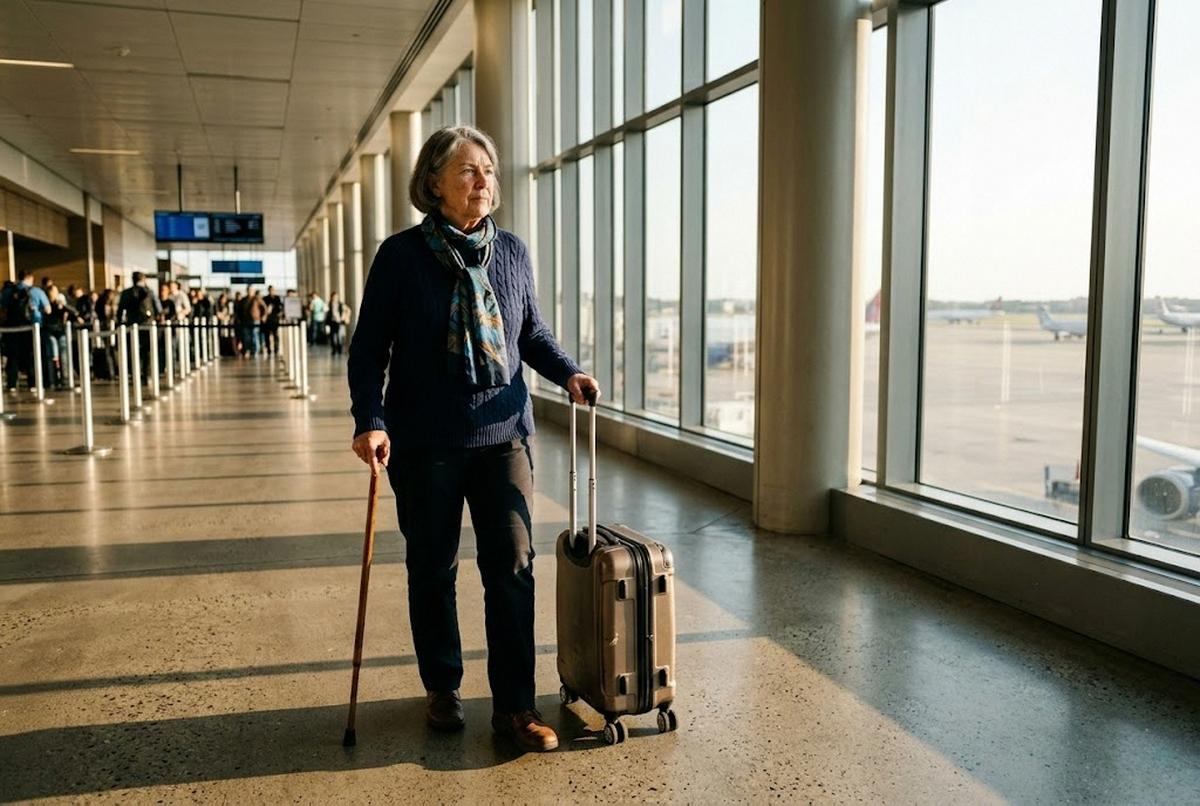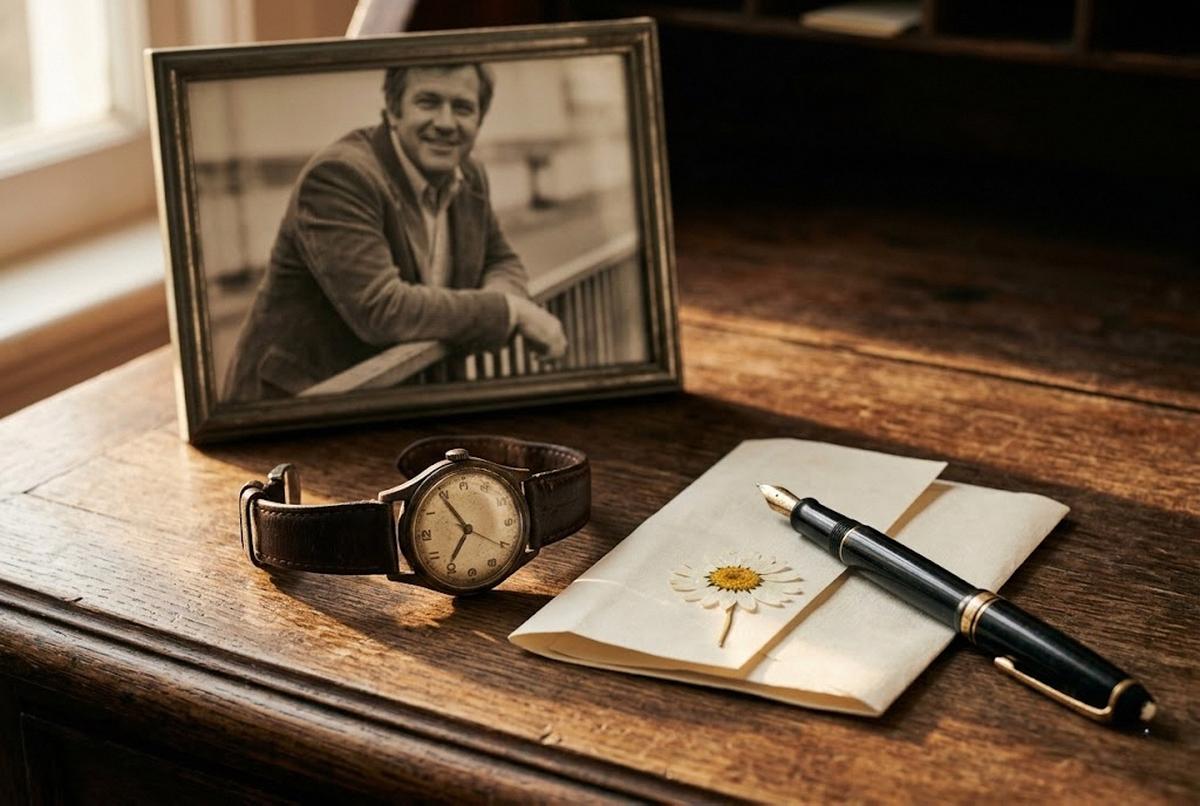
I went to my father's grave last week, on a Tuesday morning, because Tuesday morning is the only time the cemetery in Evanston isn't full of landscapers running leaf blowers loud enough to wake the dead, which seems both rude and counterproductive given the clientele.
My father, Robert Callahan, has been gone since 2008. Eighteen Father's Days. I still don't know what to do with that Sunday in June. The greeting card aisle is a particular flavor of cruel — all those blue cards with golf clubs and ties on them, asking you to pick the right one for a man who is no longer reachable by mail.
I brought him coffee, which I know is ridiculous. Black, no sugar, the way he drank it for fifty years. I poured a little on the grass and drank the rest sitting on the bench they put there for people like me. Frank thinks this is morbid. I think Frank doesn't understand that grief, after enough years, becomes a kind of conversation. You bring the coffee. You say what you've been meaning to say. You leave.
Here's the thing — and I'll get to the gifts in a minute, I promise. I went to the cemetery because I'd been working on this article, the one you're reading, about what to give an aging father for Father's Day, and I realized I had spent forty-five minutes scrolling Amazon for products that promised to make my father's life "easier" and I don't have a father anymore. I have a memory and a grave and a coffee mug that says WORLD'S OKAYEST DAD that he kept on his desk at the accounting firm for thirty-one years, which Carrie has now, in her kitchen in Chicago.
So this is an essay about Father's Day gifts, written by a woman who would give anything to be standing in a Hallmark store, paralyzed by the choice between two cards. I have opinions. I've earned them. Some of them are practical. One of them is the only one that matters.
The Gift Industry Has Decided Your Dad Is Helpless
Walk into any Brookstone, scroll any "gifts for elderly fathers" listicle, and you'll see the same products marketed with the same lazy, condescending language. Big-button phones. "Easy" remote controls. Pill organizers shaped like little days of the week. Slippers with grippers. A robot that reminds him to take his medicine in the voice of a kindergarten teacher.
Look. Some of these things are genuinely useful. My father used a pill organizer the last six years of his life and there was nothing demeaning about it — he was an accountant, he liked things organized, the man would have used a pill organizer at thirty-five if he'd had pills to organize.
The problem isn't the products. It's the marketing. Anything labeled "for seniors" or "easy" or "simple" is, almost by definition, trying to sell you the idea that your father has become a simpler version of himself. He hasn't. The man who built a deck in 1987 with no instructions and a borrowed circular saw is the same man who now needs reading glasses to read a menu. The eyesight changed. The man didn't.
My granddaughter Emma, who is 16 and therefore knows everything, calls this "infantilizing." She learned the word in eighth-grade health class and she has been using it correctly and aggressively ever since. She is, as usual, right.
What Not to Buy
Quick list, because some of these need to die.
- Anything called a "senior phone." It's a phone with three buttons and a logo. He has a smartphone. He's fine.
- The talking medication reminder. It is a clock that yells at him. He raised three children. He doesn't need a clock to yell at him.
- A novelty t-shirt that says "World's Best Grandpa." Unless he wears novelty t-shirts. Mine didn't. He wore the same five button-downs in rotation and would have looked at a graphic tee like it was a tax audit.
- A subscription box of "snacks for seniors." This is just a box of snacks with a markup and a condescending bow on top.
- Anything labeled "easy-grip," unless he has actually mentioned, in conversation, having difficulty gripping things. Don't preempt the indignity.
The rule is simple. If the marketing copy assumes he's frail before you do, skip it.
The Practical Gifts That Don't Insult His Intelligence
Here's where I'll be useful for a minute. There's a category of gift I've come to call "flatter the independence." These are tools and objects that quietly make life easier without announcing themselves as accommodations. Frank, who is 74 and recently had a knee replaced, is my unwilling test subject for most of these.
A genuinely good toolbox. Not a starter kit. A real one — Husky or Craftsman, the kind that lasts. My father had a red metal toolbox he bought in 1971 that outlived him. Tom, my oldest, inherited it. Tools say: I still build things. I still fix things. I still matter in the way a man with tools matters, which is a specific way that men of a certain generation understand in their bones.
A stadium seat with a back. Sounds boring until you're 74 sitting in aluminum bleachers watching a grandchild's baseball game and your spine considers retirement. Frank uses one. He pretended to think it was silly for about four minutes.
A magnetic glasses holder. It clips to a shirt. The glasses snap onto it. He stops losing them. He stops swearing about losing them. You stop hearing about it. Everyone wins.
A weighted blanket. Not because he's anxious — because it sleeps better. Frank refused one for two years. Then I bought one anyway. He has not given it back. He will not give it back. He pretends he doesn't use it.
A nice flashlight. I know. But there is a class of man who has strong feelings about flashlights, and a real one — a Streamlight or a Fenix, $60 or so — is the kind of object he'll keep on his nightstand for a decade and mention at parties.
The pattern: each of these is a tool, not a treatment. Each says, "You are still a person who does things," not, "You are deteriorating, please use this carefully."
The Tech Gifts Worth Considering
This is the section where I have to admit that some of the much-marketed products are actually fine. I am not above changing my mind. (Okay, I'm somewhat above it. But I can do it.)
JubileeTV (jubilee.tv) turns any TV into a video calling station. Roughly $199 for the box, $29 a month. My friend Margie's father — 88, lives alone in Wilmette — has one. He talks to his great-grandkids on the TV he's been watching since 1994. No phone to find, no password to remember. Margie said it changed everything. I believe her.
GrandPad is the same idea but a tablet — a walled-garden device with only the apps the family pre-loads. About $79 a month including the device. A neighbor's father, ninety years old in Sarasota, has one. He has not, to his credit, accidentally video-called a dental office, which is more than I can say for myself with a regular iPad.
The caveat: these devices work if your father is genuinely struggling with regular tech. If he's still managing his iPhone, do not buy him a GrandPad. You will insult him, and he will be right to be insulted.
The One Gift That Matters More Than All the Others
Okay. Here's the part I went to the cemetery to figure out how to write.
The best Father's Day gift for an aging father is not a thing. It's a recording.
I mean that literally. Buy a digital voice recorder — the Sony ICD-PX470 is fine, around $60 — or use the voice memo app on your phone. Make a list of twenty questions. Sit down with him for an afternoon. Ask the questions. Press record.
Ask him what his mother smelled like. Ask him what he was scared of when he was twelve. Ask him about the worst boss he ever had. Ask him what he thought when you were born — not what he was supposed to think, what he actually thought. Ask him about the song that was playing at his wedding, the one he doesn't usually mention. Ask him what he thought he was going to do with his life when he was twenty-two, before the kids and the mortgage and the job that lasted thirty-one years.
If you don't want to make your own list, StoryWorth does this for you. It's a memoir service — about $99 a year — that emails your father one question a week for fifty-two weeks. He answers in writing or by phone. At the end of the year, they bind his answers into a hardcover book. DailyCaring, a caregiving site I trust, calls it "a thoughtful, lasting gift" and I agree, except I'd add: it's not really a gift for him. It's a gift you're giving yourself, with his help, and he gets to feel useful and seen in the giving of it.
My father died on a Tuesday in March 2008, in a hospital in Evanston, of pancreatic cancer that had been quiet for too long and then very loud for nine weeks. I have one voicemail of his. One. I saved it from an answering machine in 2007 — he was calling about a tax return he was helping me with, and at the end he said "Love you, kiddo," the way he always said it, the way nobody has said it to me since.
I listen to it on the anniversary. I listen to it on his birthday. I have listened to it, in moments I will not describe, more than I should admit. It is forty-seven seconds long. It is the most valuable object I own.
If I could go back, I'd record everything. I'd ask him about the war years he never talked about. I'd ask him why he chose accounting when he wanted to be an architect. I'd ask him about the brother he lost in 1962 whose name I learned only at the funeral. I'd ask him to read a chapter of David Copperfield aloud, because Dickens was his favorite, and then I'd play it for my grandchildren, who never met him, so they could hear a voice they didn't know was theirs to inherit.
I didn't. I thought there was time. There was, and then there wasn't.
What I'd Tell You, If You Still Have Your Father
Don't wait for the diagnosis. The understanding arrives late, every time, and never on schedule.
If your father is still here this June — irritating you about the lawnmower, stubborn about his hearing aids, driving you crazy the way only a father can — buy him the toolbox. Get him the flashlight. Those gifts are real.
But also: bring the recorder. Bring the questions. Bring an afternoon you don't rush. The gift is not the thing in the box. The gift is that you sat there, and he talked, and the machine on the table caught his voice and held it for the people you haven't even met yet.
For the harder conversations — money, paperwork, the things nobody wants to bring up at a barbecue — I've written about how to talk to your parents about finances and the flip side, how to tell your adult kids you're fine. Both apply here. So does the truth I keep circling back to in the things nobody warns you about retirement — the years go faster on the back end, and the people in them go faster still.
The Cemetery, Again
I wrote about my grandmother once, and the particular grit she carried out of the South, and a reader wrote me to say her own grandmother was the same way — armored in humor, soft underneath, gone too soon. We agreed that some people leave a shape in the air after they go, and you spend years walking around it.
My father left a shape. Robert Callahan, accountant, Dickens reader, terrible singer, kind man. The shape is in my kitchen when I make his coffee. It's in my handwriting, which is his. It's in the cemetery on a Tuesday morning when the leaf blowers are quiet.
Frank, who has known me long enough not to ask, brought me a sandwich when I got home that day. Tuna on rye. He set it down without comment. He's read every retirement-hobbies list, every senior gadget review, every article I've ever written about aging and gifts and what we owe the people we love. He doesn't say much. He brings the sandwich.
If your father is still here, and you have something funny to do with your weekend, look up the absurd hobbies retirees actually pick up and laugh with him about which one he'd never try. Then, while you're laughing, press record.
You'll be glad. I promise you you'll be glad.
I was fifty-five when my father died. I am seventy-two now. I have had eighteen years to think about what I would have done differently, and the list is short.
I would have brought the recorder.