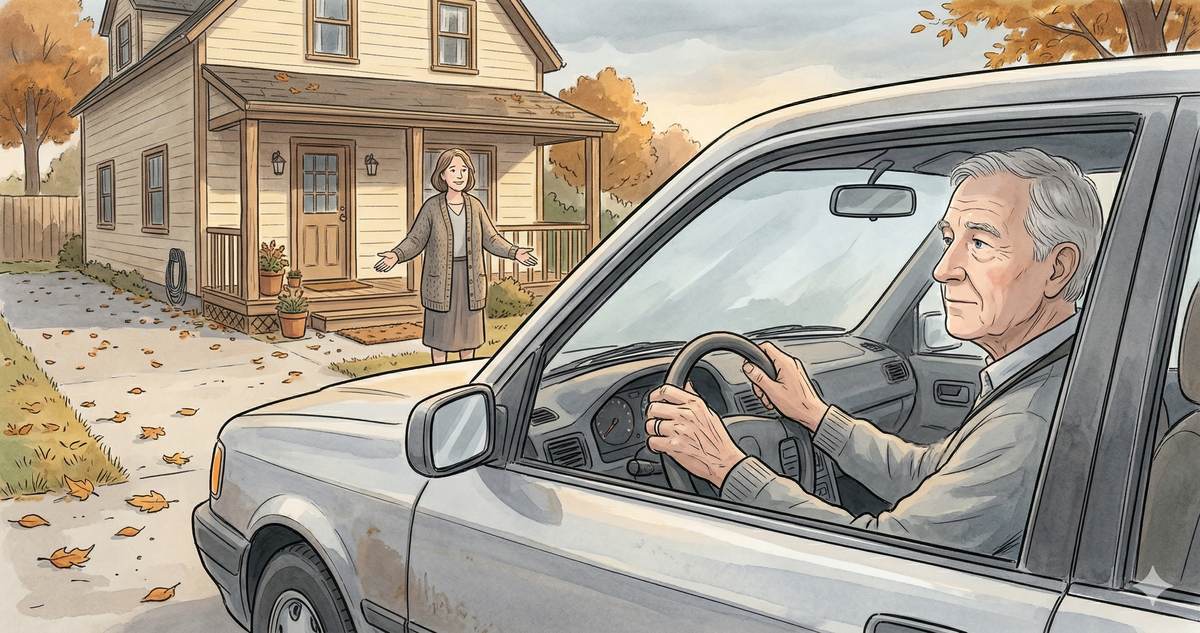
My friend Lynne handed her father's car keys to her brother in a Denny's parking lot on a Tuesday in October, and she cried harder than she did at her own divorce.
Lynne is 70. Her father, Arnie, was 93. He'd been driving his 2003 Mercury Grand Marquis, burgundy, with a dent in the rear quarter panel he couldn't explain and a scratch along the passenger side he blamed on "the parking lot at Walgreens." Twenty-one years behind the wheel of the same car. The dent was new.
I wasn't there. Lynne told me about it three weeks later at Desert Glow Salon, both of us in foils, Maria working her magic while Lynne stared at the ceiling and said, "I feel like I took his legs."
Frank still drives. He's 74, sharp, golfs three times a week, handles his Buick Enclave competently and calmly with both hands on the wheel. No concerns. Not yet. But I watched Lynne's face in the salon chair and I thought, someday this will be us. One of us will have to say something to the other, or one of our kids will have to say it to us.
So I've been thinking about how to do this right. Before we need to.
The Warning Signs Nobody Wants to See
Arnie's family didn't miss the signs. They saw them. They just didn't want to believe what they were seeing, which is a completely different problem and a much harder one to fix.
The National Highway Traffic Safety Administration lists the signs plainly: drifting between lanes. Running stop signs or red lights. Confusion at intersections. Driving well below the speed limit. New dents with no explanation. Getting lost on familiar routes. Other drivers honking constantly.
Lynne told me Arnie ran a solid red light on McDowell Road in Mesa last September. The car behind him honked. Arnie said the sun was in his eyes. Two weeks later, his neighbor Glen found Arnie sitting in the Grand Marquis in the Safeway parking lot, engine running, unable to remember why he'd driven there.
One incident is a bad day. Two is a pattern.
The AAA Foundation for Traffic Safety reports drivers 65 and older are involved in roughly 7,500 fatal crashes per year. Per mile driven, crash rates climb around age 70 and spike after 80. Plenty of 80-year-olds drive better than my son Tom in a parking garage. But the risk curve is real, and loving someone doesn't bend it.
Check the car. Walk around it. New damage you haven't heard about is the clearest signal.
Why This Conversation Feels Like a Funeral
I taught high school English for 34 years. I've had approximately 600 difficult conversations with parents who didn't want to hear what I was saying about their child. None come close to this one.
Because driving equals identity. The car isn't transportation. The car is "I can go where I want, when I want, without asking anyone's permission." The car is Tuesday mornings at the coffee shop with Dale. The car is the pharmacy and the doctor and the friend whose house is eleven miles away with no bus route.
Take the keys and you're not removing a privilege. You're removing a self.
My mother, Dorothy, stopped driving at 78. Not because anyone made her. She scraped the garage door frame for the third time, looked at it, and said, "Well, I suppose that's so." Said it the way you'd announce a weather change. But I remember the months afterward. She asked me for rides in a voice she'd never used before. Smaller. Not angry. Just... reduced.
Dorothy, who once told a bank manager his tie was "an act of aggression against the eyes." Asking me in a quiet voice if I could take her to the Jewel-Osco on Thursday. If you've ever tried telling your adult kids you're fine when they won't stop worrying, imagine how much harder it is when you're the one who isn't fine anymore.
No wonder Lynne cried in the parking lot. You're not taking keys. You're watching someone become a passenger in their own life.
How to Have the Conversation Without Starting a War
Lynne did it wrong, and she knows it. She got frustrated, said "Dad, you can't drive anymore," in the Denny's, and Arnie didn't speak to her for nine days.
Nine days!
So how do you do it right?
The Hartford Center for Mature Market Excellence and MIT AgeLab developed a free guide called "We Need to Talk," available at thehartford.com. Best resource I've found. No magic words, but a framework giving you a chance of being heard instead of shut out.
First, don't ambush. Not in public, not at a holiday dinner, not with the whole family assembled like an intervention. "We've all been talking" is the phrase that makes every parent on earth feel ganged up on.
Pick one person. The one the parent trusts most — which might be the youngest or the daughter-in-law or the golfing buddy. Sometimes the right messenger isn't family at all.
Start with concern, not conclusions. "I've noticed a few things and I'm worried" lands differently than "You need to stop driving." One opens a door. The other slams it.
Ask questions. "How do you feel about driving lately?" You might be surprised. Some older adults are already scared behind the wheel and relieved someone finally asked. The Hartford guide found many seniors had already limited their own driving before anyone said a word. No highways, no night driving, no rain. They'd noticed. They just hadn't said it out loud because saying it makes it real.
Don't make it all-or-nothing. "Maybe we start with no night driving" is easier to accept than "hand over the keys forever." Multiple small talks over months work better than one confrontation.
And have a plan for what comes next. If you say "stop driving" with no answer for "then how do I get to the pharmacy," you've told someone they're trapped.
The Alternatives That Actually Work
Most articles skip this part, and it makes me furious. You can't tell someone to stop driving and then shrug about what replaces it.
Ride services: GoGoGrandparent lets seniors book rides by calling 1-855-464-6872, pressing 1, and a car shows up — no app, no smartphone. Cost runs $8 to $30 per trip plus a $0.27/minute concierge fee. Not cheap. Actually, wait — it's far less than the $12,000 annual cost AAA estimates for owning a car. SilverRide and Via are expanding in more cities with trained drivers who walk you to the door and help with groceries. If you're comparing the real costs of aging at home, transportation is the line item people forget.
Community transit: Most cities operate paratransit for seniors. In the Phoenix metro, Valley Metro's Dial-a-Ride serves adults 65+ for $4 per trip, door-to-door, booked 24 hours ahead. Call the Eldercare Locator at 1-800-677-1116 to find what exists where you live.
Family schedules: Lynne and her brother set up a shared Google Calendar. Each sibling claimed two days a week. Arnie's granddaughter Megan, who works from home, took Thursday afternoons. It lasted three months before the schedule slipped, because real life doesn't pause for logistics. Lynne hired a part-time aide for the gaps — $18 an hour, three afternoons a week.
Volunteer programs: The ITN (Independent Transportation Network) provides rides on a membership basis. Faith-based programs like Rides to Church offer free medical transportation. AARP has a searchable database at aarpdriverresource.org.
The alternative doesn't have to be one thing. It's a patchwork. Uber on Monday. Granddaughter on Thursday. Paratransit to the doctor. No single solution replaces a car in the driveway. Four or five together can come close.
When the Doctor Needs to Be the Bad Guy
Sometimes you've had the conversation and your parent said no. Or said yes and kept driving anyway. Or said, "My driving is fine," in the tone meaning the discussion is over.
Bring in the doctor.
I don't say this lightly. But here's the thing: doctors can order driving assessments, and in many states they're required to report patients who may be unsafe behind the wheel.
Fifteen states and D.C. require physicians to report potentially unsafe drivers to the DMV. In Arizona, reporting is voluntary. In California, it's mandatory for dementia diagnoses. Pennsylvania mandates reporting for specific conditions. Look up your state at seniordriving.aaa.com.
Occupational therapists specializing in driver rehabilitation can administer a Clinical Driving Assessment, typically $250 to $500, evaluating reaction time, vision, cognition, and actual behind-the-wheel performance. If the assessment says someone isn't safe, the family didn't take the keys. The data did.
Arnie's doctor, Dr. Vasquez, made the difference. She told Arnie she wanted him to take a driving assessment, framed it as something she asks all her patients over 90. Arnie agreed because it wasn't his daughter calling him incapable. It was his doctor suggesting a test. Men of Arnie's generation respond to professionals in a way they will never respond to their children. (I taught their children. Trust me on this!)
He scored poorly on vision and reaction time. The assessor recommended he stop driving. Arnie accepted it from a stranger with a clipboard in a way he never would have accepted from Lynne in a Denny's.
State License Renewal: What the DMV Requires After 65
Every state handles this differently, and most people have no idea what their state requires.
Illinois, where I spent most of my life, requires a road test for every renewal after age 75. No exceptions. Arizona, where I live now, requires a vision test but allows renewals stretching up to 12 years. An 80-year-old who renewed at 77 might not see the DMV again until 89. That gap bothers me.
The strictest: Illinois and New Hampshire (road test at 75+), Iowa (in-person renewal every two years after 72). The loosest: Alaska, Montana, Maine, with no age-based requirements.
An 85-year-old in Florida can renew online without leaving the couch. No vision test. No road test. No driving evaluation of any kind. Nobody watching.
The DMV is not your safety net.
In most states, any concerned person can submit a Request for Reexamination to the DMV, usually anonymously. The DMV contacts the driver, schedules a test. Not perfect, but it puts the evaluation in neutral hands.
What I Haven't Said to Frank
We were driving home from dinner last Saturday. Frank behind the wheel, me in the passenger seat, audiobook paused because I had something to say.
The conversation didn't happen. I looked at him driving, checking mirrors, smooth lane changes on Shea Boulevard, stopping fully at the yellow. He's fine. Genuinely fine.
But I called Tom on Sunday. Not because anything was wrong. Just to say, "When the time comes, for either of us, I want us to already have a plan."
Tom, being Tom, said, "I've already drafted a spreadsheet."
Of course he has.
Carrie called twenty minutes later because Tom texted the sibling group chat. "Mom, is Dad okay?" I said, "Your father is fine. I'm planning ahead because I'm not going to wait until someone has to cry in a parking lot."
Then she said, "What about you?"
Good question. I'm 72. I parallel parked outside a restaurant in Old Town Scottsdale last week without thinking about it, and the space was tight enough that even a cohousing design committee would have needed three meetings to approve the maneuver. But I won't always be fine. Neither will Frank. The hardest part of this whole conversation is admitting the person who needs to hear it might eventually be you.
Frank came into the kitchen while I was finishing this piece. Read over my shoulder for a minute, standing there with his coffee like an editor who charges nothing and says very little.
"Good article," he said.
Then, after a pause: "When it's me, don't take me to Denny's."
Forty-seven years, and the man can still make me laugh when I'm trying not to cry. That's a kind of grace you don't find in any driving manual. Told him we'd go somewhere with better coffee. He said fair enough. Then he went back to his golf magazine, and I sat there grateful for a man who can talk about the hard thing and then let it be.
Call your siblings. Make the plan. Don't wait for the dent you can't explain.