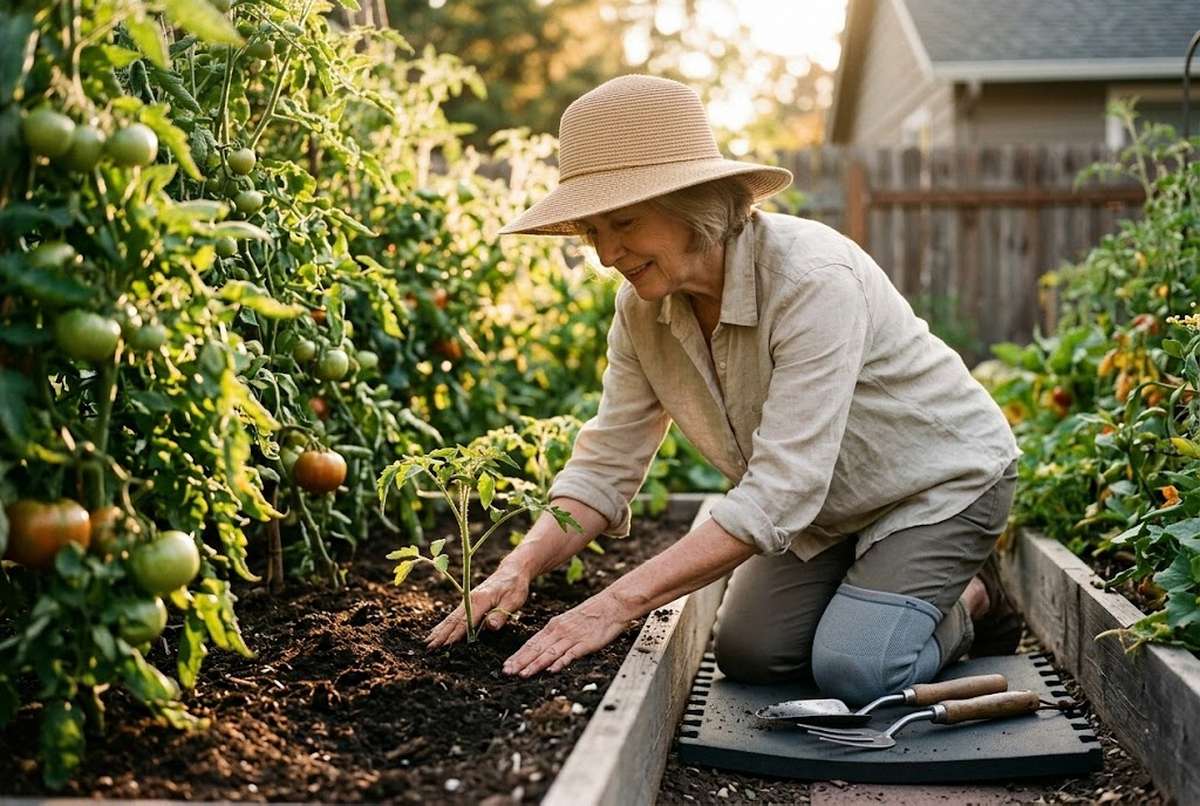
It was a Tuesday in mid-April, around seven in the morning, and I was on my green foam kneeling pad in front of the bed where I plant the tomatoes every year. I had a trowel in one hand and a six-pack of Early Girls in the other, and I was about to do the thing I've done in some form every spring since 1981. Get up.
I couldn't.
Not a dramatic couldn't. A polite couldn't. My right knee had a very firm opinion about the whole project, and my left knee, which has historically been the responsible one, had decided to file a sympathy strike. I sat back on my heels in the dirt for a minute. Then I rolled, sideways, like a beached seal, until I could push up off the patio. Frank watched all of this from the kitchen window with his coffee — did not laugh, which I love him for — but he did say, when I came in with my knees streaked in potting soil, "Maybe it's a raised bed year."
It was a raised bed year.
The Argument I Had With Myself
For about three weeks I refused.
Not out loud. Out loud I was very reasonable. Inside, I was running a one-woman protest movement against the whole concept of adapting. Raised beds were for people who had given up. Raised beds were for the brochures at the garden center, the ones with the silver-haired model smiling at a marigold like it just told her a joke. I was not that woman. I'd been gardening on my own actual ground since I was 28, with my hands in actual dirt.
My daughter Carrie, who has the patience of a saint and the bluntness of a saint who's had enough, listened to all of this on the phone and said, "Mom. You're 72. You taught Death of a Salesman for eighteen years. You know what happens to people who refuse to update."
She is, occasionally, the worst.
She was also right. Here's the thing nobody warns you about getting older as a gardener: your body changes faster than your habits do. The habits are 40 years old. The body is the body. What I had to admit, somewhere around the fifth conversation with myself in the kitchen, was that I wasn't choosing between real gardening and the easy version. I was choosing between gardening and not gardening.
So I called the lumber yard, and then I called a guy named Ramon who builds things in Scottsdale for people who can no longer build things, and I ordered two cedar raised beds, 30 inches tall, four feet wide, eight feet long.
What Gardening Is Doing for Your Skeleton
Here's what nobody told me until I started looking it up: gardening counts. It counts as exercise. Real exercise. The CDC includes gardening in its list of moderate-intensity physical activities, and the National Institute on Aging lists it as weight-bearing, which is the kind your bones care about.
This matters more after 70 than it did at 50. Weight-bearing activity (anything where you're upright and your body has to push back against gravity) is one of the few things that slows bone loss. Walking counts. Dancing counts. Carrying a watering can with two gallons of water in it from one end of the patio to the other counts. Pulling weeds, hauling a bag of compost, twisting to get at a stubborn dandelion: that's resistance training in a sun hat.
Which is not a license to lift the 40-pound bag of soil yourself. If you have osteoporosis or are on the watch list, the rule of thumb most physical therapists land on is a 10-pound lift cap. That's a half-full watering can. That's a flat of seedlings. It is not a bag of mulch, and it is absolutely not the cedar plank you're trying to drag out of the truck because Frank is on the seventh hole. (Ask me how I know.) The work that keeps you doing the work is happening at the gym in winter, which is why I keep nagging anyone who'll listen about strength training for seniors after 70. The garden is the payoff — the squat rack is the rent. And for the days when the knees are loud anyway, the OTC options worth knowing about are a separate conversation I'm not going to dodge.
The other quiet bonus: balance. Every time you step around a hose, shift your weight to lean over a tomato cage, or stand up from a kneeler, you're practicing the exact motions that keep you upright the rest of the year. There's a reason every list of falls prevention exercises for seniors reads like a description of a Saturday in the yard.
Tools That Earned Their Keep
I bought a lot of things in April. Most of them earned their keep. A few I would like a refund on, but the catalog company is unreachable by phone and I have given up.
What actually works:
- A garden kneeler with side handles. Mine is a steel-frame model that flips over and turns into a low bench. The handles are the whole point. That's what you push off when your knees decide to negotiate. About $45 on Amazon. Frank assembled it in eleven minutes and one mild sigh.
- A rolling garden seat. A low padded seat on four wheels, sometimes with a tray underneath for tools. You scoot down the row instead of crab-walking. About $60. The wheels are loud on the patio pavers, which Frank has called "acoustically distinct," but on the soft beds it glides like it was designed for the job, which it was.
- Long-handled tools. A stand-up weeder (Fiskars makes one for around $45 that grabs the root and yanks it up so you don't have to bend), a long-handled hand cultivator, and a long-reach pruner with a rotating head — the rotating head matters, because the wrist twist is what hurts. The principle is simple: every inch you don't have to bend is an inch your back doesn't owe you tomorrow.
- Felco hand pruners. I'm not going to be subtle about this one. A pair of Felco No. 6 pruners costs around $58 and they are the only thing in my garden shed I would replace immediately if the shed burned down. Sharp, fit a small hand, the spring opens them for you so your thumb does less work, last decades. My old pair, bought in 1998, finally needs sharpening. That's the whole maintenance log.
- Drip irrigation on a timer. Frank's contribution, and I'll give him credit forever. A basic kit from the irrigation aisle at Home Depot cost about $80, plus a $25 battery timer that screws onto the hose bib. It runs at 5:30 a.m. for eighteen minutes. I do not lift a watering can anymore. My tomatoes have not noticed a difference. My lower back has noticed a tremendous one.
What doesn't:
- Anything advertised on Facebook reels at midnight. I plead the Fifth on what I bought.
- The little glass watering globes that promise to keep your plants alive for two weeks. They are decorative. They are not irrigation. Mine became a hummingbird's confused drinking fountain.
- Gel kneeling pads thicker than two inches. They sound great in theory. In practice you cannot get up off them, because the gel absorbs your push instead of giving it back. I learned this the day I started this article.
On the Sun, Which Is a Frenemy
In Scottsdale in May, the temperature at 6:45 a.m. is 71 degrees. By 11:00 it's 94. By 2:00 it's whatever the patio thermometer reads before I stop wanting to know. I do not garden in the afternoon between May and October. I'm not being cute about this. The CDC notes that adults over 65 are significantly more vulnerable to heat-related illness because the body's thermoregulation gets less efficient with age, and a lot of common medications (blood pressure pills, diuretics, antihistamines) make it worse.
So I work mornings. Out the back door by 6:30 with a travel mug of coffee, done by 8:30, before the sun is doing anything but warming the patio stones. A full glass of water before I go out and another when I come in, which is its own conversation, because hydration matters more for senior health than I gave it credit for in my forties, when I could go a full afternoon on iced tea and indignation.
Those morning sessions are doing something I didn't expect. According to research summarized by the Cleveland Clinic, 10 to 15 minutes of mid-morning sun on your forearms most days is generally enough to support healthy vitamin D synthesis, and after 70 your skin makes vitamin D less efficiently than it used to. So the garden is also a slow-release supplement, if I get the timing right. I've written more elsewhere about vitamin D in senior health and I won't repeat it here. But I'll say this: gardening is the only "medicine" I take that also produces a tomato.
The thing nobody puts on the brochure: sunscreen anyway. I have had two precancerous spots removed since I moved to Arizona and I will not have a third. Long sleeves, broad-brim hat, SPF 50 on the back of my hands and my neck. Skin cancer is the most common cancer in this country, and the American Academy of Dermatology has been shouting about it for thirty years. I'm finally listening.
What the Beds Cost
I'll show my numbers, because gardening articles tend to be vague about money in a way that drives me up a wall.
My two cedar beds, 30 inches tall, four by eight feet, came to $487 each, delivered and assembled by Ramon. Soil was another $310 from a local landscape supplier. Drip kit, $80. Timer, $25. Total damage: $1,389.
That's the high end. A pair of cedar raised bed kits from a big-box store in the 24-inch version runs $100 to $300. A premium 30-inch kit with corner posts you can lean on runs $400 to $700. DIY plans using cedar from the lumber yard run $50 to $150 per bed if you have a teenager with a drill.
Twenty-four to thirty is the sweet spot for arthritic joints. Below 24 and you're still bending. Above 30 and you can't reach the middle.
Do it before the body decides for you.
A Brief, Slightly Embarrassing Note About Why
I was going to leave this part out. I'm leaving it in because the lifestyle articles I trust are the ones that don't pretend the whole story is about ergonomics.
My grandmother grew tomatoes on a small plot in Georgia and used to tell me, when I was seven, in a dress, with my hair in two braids, that the smell of a tomato vine on a hot day was the closest thing to a prayer she knew. She was not a religious woman. She was, in fact, a woman with very firm opinions about pew-sitting. But she meant it about the tomato vines. I've written about her elsewhere, in a piece called Southern Roots and Starry Skies, and I'm not going to retread that ground.
What I will say is that when I knelt on that foam pad in April and couldn't get up, and Frank suggested raised beds, the thing I was actually mourning for those three weeks of resistance was not the act of kneeling. It was the version of myself who didn't need to think about it.
That woman is gone. I miss her. I also have a new bed full of Early Girl tomatoes that I planted standing up, on a Saturday morning in May, with my coffee on the lip of the bed and the irrigation hissing on at 5:30 the next morning without me having to think about it. The first ripe one is a couple of weeks out. I'm 72 years old, and I'm going to be the woman who eats it.
Without apology.
If You're Standing in Your Own Yard This Week
Start smaller than you think. One bed, not three. Get the height right: 24 to 30 inches. Keep the width to four feet. Morning sun for six hours, afternoon shade by two.
Buy the long-handled tools before you think you need them. Drip irrigation on a timer is the single best decision you can make.
Go out before the day gets loud. Drink water. Wear the hat. Put on sunscreen even if you think you don't need it. Especially if you think you don't need it.
The reason any of this is worth doing is not the tomato. The tomato is the cover story. The reason is that on Saturday mornings now, at 6:45, I'm outside before Frank is awake, with my coffee, with my hands moving, and I'm thinking about nothing. The mind goes quiet in a garden in a way it doesn't go quiet anywhere else — not in the kitchen, not at the desk, not in the car.
My knees have opinions. I have raised beds. We've reached an understanding.
The tomatoes don't care either way.