I packed for that trip the way some people pack for war.
It was a Tuesday in October, four years ago, and I was flying from Phoenix Sky Harbor to Hartford, Connecticut, to sit with my friend Ruth for a week. Her husband Alan had died in early September. By October she was past the casseroles and into the part nobody warns you about, the part where the house is too quiet and you start narrating your day to the dishwasher. So I told Frank I was going. Frank, who is not a flyer and also not invited, said, "Take the good suitcase."
I took the good suitcase. I also took a left knee that had been making editorial comments every time I climbed stairs since approximately 2019.
Here's what I didn't take: a clue.
The morning of, in three acts
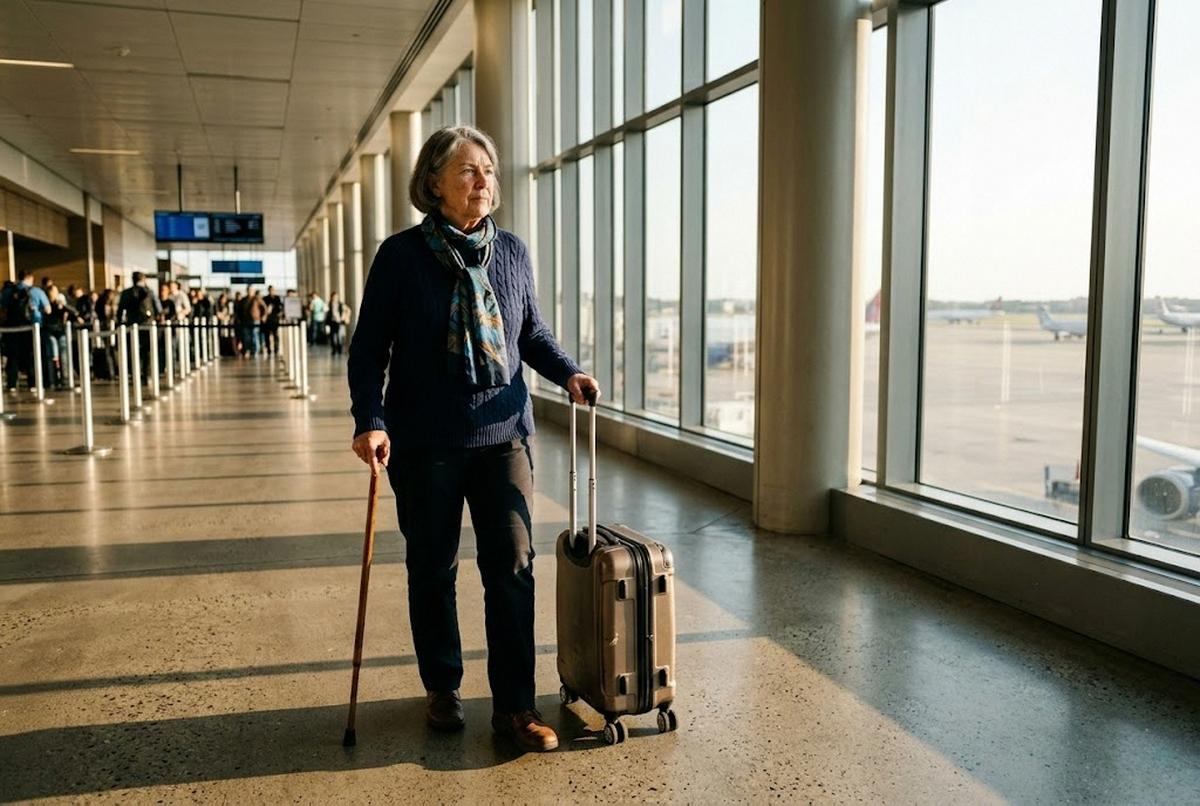
Frank dropped me at Terminal 4 at 5:47 AM. I had a 7:35 flight, a roller bag, a tote, a paperback (Louise Penny — judge me), and a small zippered pouch that contained more medication than I'd realized I take until I had to put it all in one place. Blood pressure pill. Statin. Eye drops for the dry-eye situation that started in 2018 and never left. A half-empty bottle of Tylenol Arthritis. And, for reasons I cannot now explain, a single Pepcid.
I rolled into the terminal feeling brave. Frank and I have been to twenty-three countries. But I had never, not once, flown alone. Anything I'd read about solo travel after 60 had been theoretical. Frank handled the boarding passes. Frank handled the bags. I handled the snacks.
And now I was all of it.
The kiosk asked twelve questions, only one of which I understood. A young man in a Southwest vest pressed a button. "You're all set, ma'am." Ma'am. Twenty minutes in and I'd been ma'amed.
Then I saw the security line.
The security line, if you can call it that
It was less a line and more a slow-moving herd of people who had collectively decided that this was the day to wear shoes with laces. The man in front of me was wearing a fleece. The man in front of him was wearing two fleeces. The woman in front of him had a stroller, a baby, a diaper bag, and the expression of someone who had not slept in a calendar year.
My knee, which had been quiet in the car, woke up like it had something to prove.
Forty-five minutes later, I was at the front. I had taken off my shoes (a mistake; my socks had a hole in the left toe). I had dug my laptop out of my tote, which I'd packed under the paperback and the medication pouch. I had un-unzipped the pouch and re-zipped it because I wasn't sure if the eye drops counted as a liquid. I had, for the first time in my adult life, considered crying in public.
The TSA officer, a young woman named Amber according to her tag, looked at me and said, very quietly, "Ma'am, do you want a chair?" Amber, you are still a small saint to me.
Reader, I wanted a chair.
She pulled one over. She told the man behind me to wait. She walked me through the metal detector, not the body scanner, the standing one. She asked if I needed a hand with my bag on the other side. I said yes. She got it.
I sat down at the recombobulation area (an actual sign, somewhere — Milwaukee has one, I think, but Phoenix had the spirit) and put my shoes back on with shaking hands. A woman next to me, maybe sixty-five, said, "First time alone?"
"That obvious?"
"You've got the look," she said. "Did anyone tell you about TSA Cares?"
What Amber didn't have time to say
They had not. Nobody had told me about TSA Cares. The travel agent hadn't mentioned it. Southwest hadn't mentioned it. Frank, bless his heart, had said take the good suitcase and then driven home to watch the Diamondbacks lose.
The woman at recombobulation, Jeanette, was flying to Boston. She'd had a hip replacement in 2022 and traveled alone twice a year to see her sister. She explained it to me in about ninety seconds, which is more than the entire travel industry had managed in six decades.
TSA Cares is a program for travelers with disabilities, medical conditions, or just the kind of body that doesn't appreciate a forty-five-minute stand-up comedy routine in line. You call them at 855-787-2227 at least 72 hours before your flight. You tell them your flight number, your terminal, and what you'd like help with. On the day of your trip, a Passenger Support Specialist (a real person, not a recording) meets you at security and walks you through it. They cannot skip the line for you. They can, however, get you a chair, screen you separately if you need it, help with your bags, and stand there while you put your shoes back on.
You can also use the online request form if you'd rather type than talk, which I would, every time.
Jeanette wrote it on the back of a Starbucks receipt. I still have it somewhere.
The flight home was a different country
I spent the week with Ruth. She cried a little, I cried a little, we watched two terrible Hallmark movies. By Sunday she was laughing again — not all the way, but enough. (I've written before about the part of solo aging nobody mentions, and Ruth was now in it.)
The flight home, I tried it.
I called TSA Cares on Friday, three days before my Monday return. Lorraine asked three questions. Flight number. Mobility aids. Anything else. I told her about the knee. She said, "We'll have someone meet you at the security entrance."
Monday morning at Bradley International, a man in a navy polo shirt was waiting with a clipboard. "Mrs. Sinclair? I'm your Passenger Support Specialist. Let's get you through this."
It took eleven minutes.
Eleven. A different planet.
Separate screening lane — not faster, exactly, but quieter, with chairs. He explained I could leave my shoes on, which I had not known was a thing humans were allowed to do. He flagged my medication pouch for me and explained that prescription liquids over 3.4 ounces are exempt from the 3-1-1 rule if you declare them. I was carrying a small bottle of artificial tears I'd been hiding from my own conscience for an hour. He said, "That's fine. They just need to know."
Fifteen years of flying with Frank, and I had never once been told that.
The things you can ask for, in plain English
Let me save you the receipt-on-the-back-of-a-Starbucks-cup education. If any of this applies to you, write it down somewhere you can find it.
- TSA Cares — call 855-787-2227 at least 72 hours before your flight, or use the online form. They'll arrange a Passenger Support Specialist to meet you at security and walk you through screening. Free. No "membership." No card to lose.
- Curbside wheelchair service: call your airline directly, at least 24 hours ahead. Free. Someone meets you at the curb with a wheelchair and pushes you to the gate. You tip (I tip $5–$10), but the service itself is included. This is one of the things nobody warns you about retirement: asking for help gets easier the older you get, but only because the alternatives get worse.
- Mobility aids ride through with you. Canes, walkers, rollators, wheelchairs go through the X-ray belt or get screened separately. You do not have to abandon them.
- If you are 75 or older, TSA has modified screening for you. You don't have to remove your shoes or your light jacket. You can request the metal detector instead of the body scanner. (I am still not 75, but the day will come, and when it does, I will use this so hard.)
- Medications stay in your carry-on. Original containers if possible, though TSA officially says it's not required. Liquids over 3.4 ounces (insulin, eye drops, liquid pain meds) are allowed under the 3-1-1 medical exemption. You just have to declare them. Don't hide them in shampoo bottles. Just say so.
- CPAP machines, oxygen concentrators, insulin pumps get screened separately. Tell the officer before you put them on the belt. They have a procedure. They use it every day.
- The Hidden Disability Sunflower lanyard: a small green lanyard with sunflowers on it, free or low-cost from hdsunflower.com, recognized at airports in over thirty countries. It signals to staff that you may need extra time or patience. I bought one for Ruth last Christmas.
The PreCheck question, briefly
Everybody asks me about TSA PreCheck now, which is funny because nobody asked me about it before. It costs $77.95 for five years as of 2026 (it used to be $85; I do not know who decided $77.95 was the friendlier number, but I salute their pricing committee). You apply online, do a fingerprint appointment, and get a Known Traveler Number that goes on every boarding pass.
What PreCheck does: lets you keep your shoes, light jacket, and belt on. Lets your laptop stay in your bag. Shorter line, usually.
What PreCheck does NOT do: get you a chair. Get you a Passenger Support Specialist. Help with bags. Skip the medication conversation. Replace TSA Cares.
If you fly more than twice a year and you're not over 75, PreCheck is worth it. (For more on planning the trip itself, I've laid out my honest take on solo senior travel in 2026: tour companies, single supplements, all of it.) If you have a mobility issue, get PreCheck and call TSA Cares. They are not the same thing. They solve different problems. Anyone telling you PreCheck is enough has never tried to tie a shoelace at 6 AM with a knee that's filing a grievance.
What I tell my book club now
The book club has gotten interested in travel since Ruth started flying again. Her husband had handled all of it for forty-one years, so when he died she had to learn what an aisle seat was. ("It's the one on the aisle, Ruth." "I know that now, Victoria.")
When one of them tells me they're nervous to fly alone, I say three things.
One: call TSA Cares. Even if you don't think you need it. Lorraine and her colleagues are not gatekeepers. They are professionals who would rather help you for ten minutes than watch you cry at recombobulation.
Two: call your airline 24 hours ahead for curbside wheelchair service if your knee, hip, back, or general spirit is iffy. You are not weak. You are saving yourself an hour for the cost of a small tip.
Three: pack medications in original containers, in a clear pouch, at the top of your carry-on. Not the bottom. Not under the sweater. Not, God help you, in your checked bag. (If you plan groceries the way I plan medication packs, my honest review of online grocery delivery will explain itself.)
And pick a book that won't make you cry, because nobody warns you about that either. I read Louise Penny on the way to Hartford. By landing I was sniffling into a cocktail napkin and the businessman next to me, headphones in, completely uninvolved, wordlessly handed me a fresh tissue from the seatback pocket. I have thought about that man often.
The receipt
I still have Jeanette's Starbucks receipt. Faded latte order on the front. 855-787-2227 on the back, in blue ballpoint, in a stranger's handwriting. I keep it in the front pocket of my passport wallet.
By the fourth trip to see Ruth, the Passenger Support Specialist at Sky Harbor recognized me. His name is Marcus. He once asked about my knee. I once asked about his daughter.
The TSA line did almost break me. It didn't.
If you're thinking about flying alone, to see a friend, a grandchild, whatever's on the other side of a runway: go. Just call 855-787-2227 first. And take a paperback that won't ruin you.