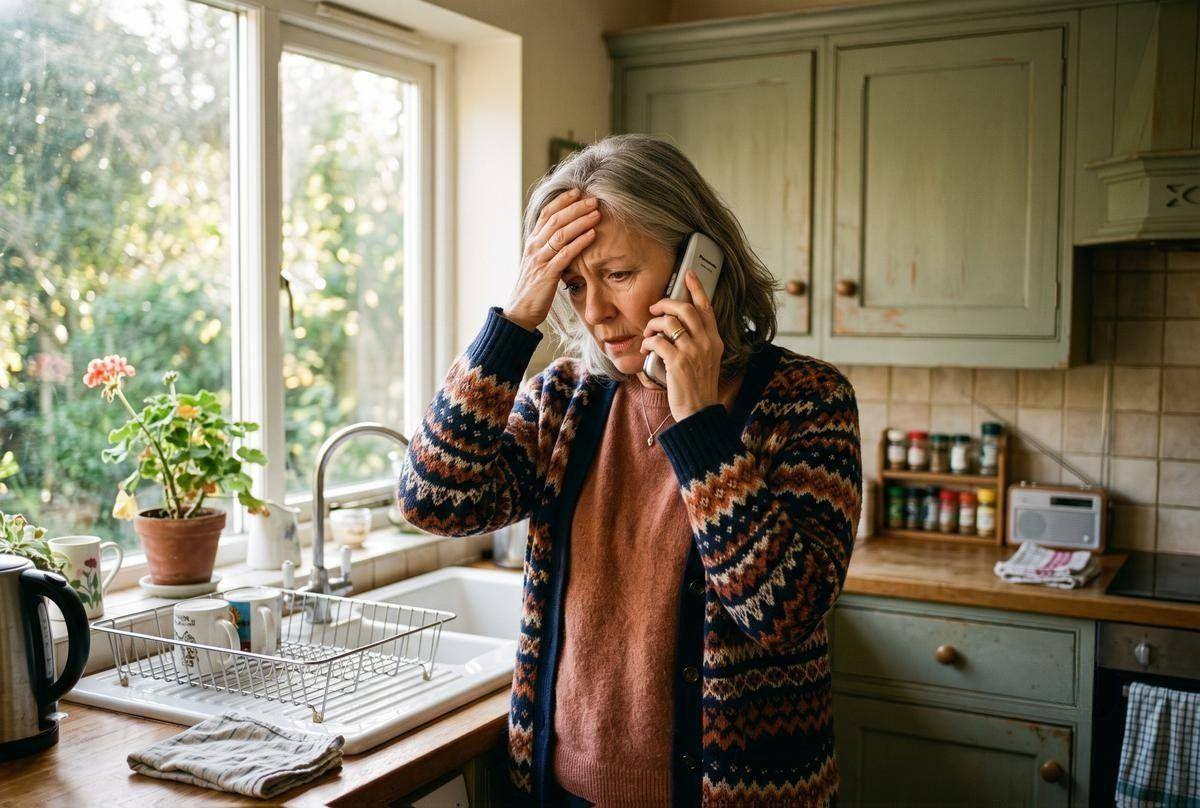
The phone rang at ten past eleven on a Tuesday night last October. I was still up, reading Wendell Berry in the chair by the lamp, and I knew before I answered who it was. Vivian, seventy-four, a retired school librarian who'd been coming to my Seasons of Grace group for three years. She wasn't in crisis. She was just awake. Again.
"I've been lying here since nine," she said. Her voice had that flat, worn quality I've come to recognize — not panicked, just tired in a way that sleep is supposed to fix but hasn't. "I counted the ceiling fan rotations. I got to four hundred and something. Eleanor, I can't keep doing this."
I sat with her on the phone for twenty minutes. Not solving anything. Just being there in the dark with her. And the next morning, over coffee, I wrote her a name on a sticky note. Not a pill. A therapist. Someone trained in a treatment most people have never heard of, even though the American College of Physicians has been recommending it as the first choice for chronic insomnia since 2016.
It's called CBT-I. And it changed Vivian's nights.
What CBT-I Actually Is
CBT-I stands for Cognitive Behavioral Therapy for Insomnia. Not talk therapy in the way most people picture it — no couch, no childhood deep dives, no open-ended sessions about feelings. CBT-I is a structured program, usually six to eight sessions, designed to retrain the way your brain and body relate to sleep. It has five core components: sleep restriction, stimulus control, cognitive restructuring, sleep hygiene education, and relaxation training.
Let me be specific about those, because the names sound clinical but the practice is surprisingly concrete.
Sleep restriction means temporarily limiting the time you spend in bed to match the time you actually sleep. If you're lying in bed for nine hours but only sleeping five, your therapist might have you start with a five-and-a-half-hour sleep window. Sounds counterintuitive. Sounds a little brutal, honestly. But it builds sleep pressure, your body's natural drive to sleep, and within a few weeks, the window expands as your efficiency improves.
Stimulus control is about reclaiming the bed as a place for sleep, not for worrying, scrolling, watching the news, or lying awake calculating how many hours remain before the alarm. The rule is simple: if you're not asleep within about twenty minutes, get up. Go to another room. Do something quiet and boring. Go back when you're drowsy. Your brain relearns that the bed means sleep instead of frustration.
Cognitive restructuring targets the anxious thought spirals. "If I don't fall asleep in the next ten minutes, tomorrow will be ruined." "I haven't slept well in months, so I'll never sleep well again." A CBT-I therapist helps you examine those thoughts the way you'd examine a suspicious charge on your bank statement: closely, skeptically, without panic.
Sleep hygiene covers the practical habits: consistent wake times, limiting caffeine after noon, keeping the bedroom cool and dark. And relaxation training teaches techniques like progressive muscle relaxation or guided breathing to quiet the body when the mind won't cooperate.
None of this involves medication. All of it works.
Why the Pills Are a Problem
I understand the appeal of a sleeping pill. Truly. When you haven't slept well in weeks and someone offers you a tablet and says "this will help tonight," you'd take it. I would too.
But for those of us over sixty-five, the risks aren't small.
The 2023 American Geriatrics Society Beers Criteria flags both benzodiazepines (drugs like Valium, Ativan, Klonopin) and Z-drugs (zolpidem, sold as Ambien, and similar medications) as drugs to avoid in older adults. The reasons are serious: increased risk of falls, fractures, cognitive impairment, delirium, and car accidents. Long-term benzodiazepine use in older adults has been linked to increased risk of dementia. In April 2019, the FDA added a black box warning to zolpidem after reports of sleepwalking, sleep-driving, and other complex behaviors people had no memory of performing. Injuries. Deaths.
Let me put a face on this. Curtis, a retired electrician who attended one of my Tuesday wellness groups, had been taking Ambien for eleven years. Eleven years! His doctor prescribed it after his wife's death, and nobody ever revisited the prescription. He told the group he'd fallen twice in the past year, once in the hallway at 2 AM, once getting up for the bathroom. He thought he was just getting clumsy. He wasn't clumsy. The medication was sedating him past the point where his reflexes could catch up.
The other problem is dependency. These medications work at first, sometimes dramatically. But the body adapts. Within two to four weeks, you often need a higher dose for the same effect. And stopping them can trigger rebound insomnia worse than what you started with, which convinces people they can't live without the pill. It's a trap dressed up as a solution.
The American College of Physicians says it plainly: CBT-I first. Medication only if CBT-I alone hasn't worked, and even then, only short-term, with a shared decision between doctor and patient about the risks.
What the Research Shows
The numbers support this in a way that should get far more attention than they do.
A 2022 systematic review and meta-analysis of CBT-I specifically in older adults found significant improvements across the board: sleep efficiency improved by over 8 percent, the time it took to fall asleep dropped by more than 9 minutes, and time spent awake after initially falling asleep decreased by over 23 minutes. For anyone who's lain in the dark watching the clock crawl from 2:17 to 2:40 to 3:05, those minutes are not abstract.
They're everything.
Across studies, 70 to 80 percent of people who complete CBT-I see meaningful improvement. In adults over seventy-five, the effects were among the strongest observed, particularly in insomnia severity and sleep efficiency. This isn't a treatment that fades as we age. If anything, the evidence suggests it sharpens.
And unlike sleeping pills, the benefits persist. CBT-I teaches skills. Skills don't wear off when you stop taking them. A randomized controlled trial of digital CBT-I in older adults, published in npj Digital Medicine, found nearly half of participants no longer met the criteria for insomnia at the one-year follow-up. One year later. No pills. Just a different relationship with sleep.
Why Sleep Changes as We Get Older
I should say something about what's normal, because I think a lot of fear around sleep comes from not knowing what to expect.
Up to 50 percent of adults over sixty report difficulty sleeping. Half of us. And most assume it's just what happens when you get older. But difficulty sleeping and chronic insomnia are different things, and understanding that difference takes some of the terror out of the 3 AM ceiling stare.
Our circadian rhythm shifts earlier as we age. The suprachiasmatic nucleus, the tiny region in the brain running our internal clock, deteriorates over time. Melatonin production drops. We get sleepy earlier in the evening and wake earlier in the morning. We spend less time in deep, restorative slow-wave sleep. We wake more often during the night.
None of this means something is broken.
But it does mean we're more vulnerable to insomnia when stress, pain, grief, medication side effects, or health conditions pile on. Women are hit harder: a large study of adults over seventy found 35 percent of women reported moderate to severe insomnia, compared to 13 percent of men. The reasons are layered. Hormonal changes. Arthritis pain that flares at night. Caregiving stress. The particular kind of worry arriving only when the house goes quiet.
The pattern I keep seeing is that many people accept poor sleep as the price of aging. Rosalind, a woman in my Seasons of Grace group, said it to me last spring while stirring cream into her coffee with the slow deliberateness of someone who hadn't slept past 4 AM in months. "I'm seventy-two, Eleanor. What do I expect?" But waking frequently doesn't have to mean suffering. The changes are real. The hopelessness is optional, if you know where to look for help!
What Six Weeks of CBT-I Actually Looks Like
Vivian, the woman who called me that October night, started CBT-I with a psychologist in Asheville in November. I asked her, months later, to walk me through what it was like. She did, sitting on the bench outside our community room, late-afternoon light coming through the bare trees.
Week one was mostly information gathering. Her therapist explained the two-process model of sleep: sleep drive and circadian rhythm working together like a seesaw. Vivian kept a sleep diary for two weeks, recording when she went to bed, when she thought she fell asleep, how many times she woke, and when she got up. "Writing it down was the first time I realized how bad it actually was," she said. "Seven hours in bed, four hours and forty minutes asleep."
Weeks two and three introduced sleep restriction and stimulus control. Her therapist set a sleep window of five hours: 12:30 AM to 5:30 AM. Vivian hated it. She told me so directly, with the particular bluntness of a woman who'd spent forty years running a school library. But she followed the instructions. When she couldn't sleep, she got up and sat in her kitchen reading old Agatha Christies until drowsiness pulled her back.
Weeks three and four added cognitive restructuring. The thought "I'll never sleep normally again" became, under examination, less like a fact and more like a fear wearing a fact's clothing. Her therapist taught her to challenge catastrophic thinking the same way you'd fact-check a rumor.
Weeks five and six expanded her sleep window as her efficiency climbed. By the end of the program, she was sleeping six hours and fifteen minutes in a seven-hour window. Not perfect. Functional. The ceiling fan counting stopped.
"I didn't believe it would work," Vivian told me. "I thought it was going to be someone telling me to drink chamomile tea and think happy thoughts." She paused. "It was harder than that. And better."
Medicare Covers This
If you've read this far and you're wondering what it costs, here is the part worth knowing. (Not sure whether Medicare covers a specific service or item? Try our Medicare coverage checker — it answers the most common 'does Medicare cover _?' questions in plain English.)
Medicare Part B covers CBT-I when provided by a qualified mental health professional, which includes psychologists, licensed clinical social workers, and psychiatric nurse practitioners. It falls under outpatient mental and behavioral health benefits. After meeting your Part B deductible ($257 in 2025, $283 in 2026), you pay 20 percent of the Medicare-approved amount. Most sessions run $20 to $50 out of pocket.
If you have a Medicare Advantage plan, coverage may be broader. Many Advantage plans offer additional mental health and telehealth benefits beyond what Original Medicare provides.
And here's a development most people have missed: starting January 1, 2025, Medicare began covering FDA-cleared digital CBT-I programs under new Digital Mental Health Treatment billing codes. SleepioRx, a prescription digital CBT-I program cleared by the FDA in 2024, is now reimbursable under Medicare when prescribed by a physician. You complete the program on a phone or tablet, on your own schedule. It's not a replacement for working with a therapist face-to-face, but for people in rural areas or anyone who can't easily get to a specialist, this didn't exist two years ago!
The VA also offers a free app called CBTI Coach, built in partnership with Stanford University and designed as a companion to in-person CBT-I. And Insomnia Coach, another VA-developed app, is available to everyone.
The barriers are lower than most people think. The problem is most people don't know this treatment exists.
How to Find a Provider
The Society of Behavioral Sleep Medicine maintains a searchable directory of certified providers at behavioralsleep.org. You can filter by state. These are clinicians with specialized training in behavioral sleep medicine, not general therapists who mention sleep on their website.
Psychology Today's therapist directory lets you filter by "insomnia" and "CBT" and your zip code. Not every therapist listed will have formal CBT-I training, so ask directly: "Have you completed specific training in CBT-I protocols?" A qualified provider won't be offended by the question.
Telehealth has changed everything here. Your CBT-I provider doesn't need to be in your town. A 2020 survey found fewer than 1 percent of psychologists in the U.S. had formal CBT-I training, so the shortage of local providers is real. But telehealth expansion means you can work with a specialist three states away from your living room couch.
At your next appointment, say these words to your doctor: "I'd like a referral for CBT-I for my insomnia. The American College of Physicians recommends it as first-line treatment." Naming the clinical guideline matters. It tells your physician you've done your homework, and it opens a door a vague "I can't sleep" sometimes doesn't.
If you're already working with someone for anxiety or depression, mention the insomnia. These conditions travel together. Treating the sleep piece often improves everything else.
The Question I Wish I'd Asked Sooner
During my mother's Alzheimer's years, when I was driving between Asheville and Savannah every other week and holding my own life together with both hands, I stopped sleeping through the night. I could fall asleep fine. But I'd wake at 3 AM with my jaw clenched and my mind already running the next day's logistics, and sleep would not come back. I'd lie there for two hours, get up, make coffee, and power through.
This went on for the better part of a year before a colleague said, gently, "Eleanor, you look exhausted in a way that coffee isn't touching."
She was right.
I didn't know about CBT-I then. What I knew was Tylenol PM and half a glass of wine, which is what a lot of us reach for, and which doesn't work, and which I'm not proud of admitting. If someone had handed me the name of a provider in 2002, I believe my body would have thanked me for years after.
The reason I tell you this is simple: if you're lying awake tonight, or if someone you love is, this is not something you have to accept. Not at sixty-five. Not at seventy-five. Not at eighty-two. There are real strategies for protecting your mental well-being that don't come in a bottle, and CBT-I may be the most powerful one most people have never heard of.
Start Here, Tonight
If sleep doesn't come within twenty minutes, get up. Sit somewhere quiet. Don't reach for your phone. Pick up a book, a magazine, even a catalog. When drowsiness arrives, go back to bed. If it doesn't, another chapter and try again.
That's stimulus control. You've already started.
Tomorrow, write these words on a sticky note and bring them to your next doctor's visit: "CBT-I referral. First-line treatment. Covered by Medicare Part B." Vivian would approve.
Sleep is not a luxury we outgrow. It's how our bodies repair, how our memories settle into place, how the heart finds its rhythm again after a long day. You have spent a lifetime showing up for the people you love. Showing up for your own rest is not indulgence.
I hope you sleep tonight. And if you don't, I hope you get up, sit somewhere kind, and know there's a path forward that doesn't require a prescription. Just a willingness to learn what your body already knows.