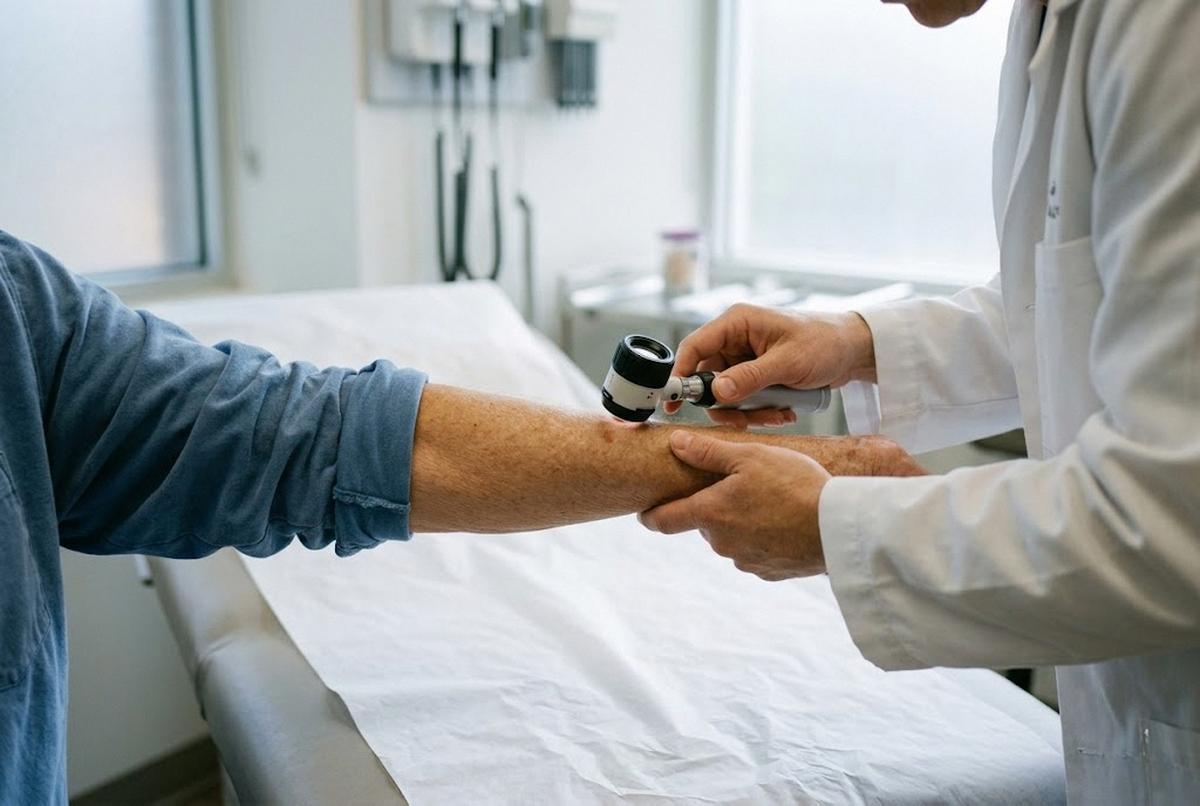
Last May, a woman named Eunice sat across from me at a Seasons of Grace gathering and rolled up the back of her cotton blouse three inches. She was seventy-six. A retired postal clerk with a laugh like a screen door slamming. She'd been gardening that morning and her granddaughter, helping her with sunscreen, had pointed and said, "Grandma, this freckle looks weird."
Eunice almost waved it off. She'd had freckles her whole life. The skin on her back had been freckled since the summer she worked as a lifeguard in 1967. One more spot didn't seem worth a doctor's visit, and the last time she'd called her primary care office she'd spent twenty minutes on hold listening to a song she suspected was supposed to be soothing.
Her granddaughter was twenty-six and stubborn. She made the appointment for her.
The spot was a melanoma. Stage one. Caught early. Removed with a margin and clear pathology. Eunice is fine, more than fine — she sent me a picture of her tomato plants in April and the caption read, "Still here, still bossy."
I tell you this not as a scare story. I tell you because the appointment that saved Eunice's life almost didn't happen, and the reason almost wasn't fear. It was confusion about what Medicare would cover.
The Wording That Changes Everything
Here is the part most people don't know. Original Medicare does not cover a routine, full-body "screening" skin check the way it covers a screening mammogram or a screening colonoscopy. There is no preventive billing code for a just-in-case dermatology visit. If you walk into a dermatologist's office in June and say, "I'd like a full-body skin check, just to be safe," Medicare may pay nothing. You'll get the bill.
But the same visit, with one different sentence, becomes covered.
If you walk in and say, "I have a mole on my left shoulder that's changed color over the last two months, and another spot on my scalp that hasn't healed since March," the visit is now a diagnostic evaluation. Part B covers it as a medically necessary appointment under the standard outpatient rules. According to AARP's guidance on Medicare and dermatology, the trigger is concern, not curiosity. You need a reason. The dermatologist needs something to look at and document.
I know how that sounds. Almost like coaching. Like you have to learn the password to get inside.
But listen. The wording isn't a trick. It's how the entire diagnostic side of Medicare works. The same logic governs why a routine cardiology check-up isn't covered but a visit for chest discomfort is. Medicare reimburses for the evaluation of specific concerns. So when you're sitting at your kitchen table this week, before you call to make the appointment, take five minutes and look at your skin. Make notes. The spot on your forearm that bleeds when you towel off. The mole on your back that your husband mentioned looks darker. Write it down.
This isn't dishonest. It's accurate.
What You're Actually Looking For
Dermatologists teach the ABCDE rule because it works.
- Asymmetry. One half of the mole doesn't match the other
- Border. Edges ragged, notched, or blurred. More like a coastline than a circle
- Color. More than one color in the same spot
- Diameter. Larger than six millimeters, roughly a pencil eraser
- Evolution. A spot that is changing — new itching, bleeding, or crusting
E is the letter that saved Eunice. The freckle had always been there. It had also started changing.
If you have personal history of skin cancer, or a parent or sibling with melanoma, tell your doctor explicitly. "My sister had melanoma at fifty-eight" belongs in your chart, and it changes how Medicare evaluates the medical necessity of every dermatology visit you ever schedule.
The Cost Math, in 2026 Dollars
Let me walk you through what you'll actually pay, because vague answers help nobody.
In 2026, the standard Medicare Part B premium is $206.50 a month, and the annual Part B deductible is $283. After you've met the deductible, Medicare pays 80 percent of the approved amount for outpatient visits, and you pay 20 percent coinsurance with no out-of-pocket cap unless you carry a Medigap plan.
A dermatology evaluation visit, billed as a level-three new or established patient E/M code, runs roughly $150 to $250 depending on your region and the complexity of the exam. After the deductible, your share lands around $30 to $50.
If the dermatologist sees something concerning and does a punch biopsy that day, add roughly $150 to $300 for procedure plus pathology. Your 20 percent share is $30 to $60.
If the biopsy comes back as basal cell or squamous cell carcinoma, the two common slow-growing skin cancers, most cases are treated with excision or Mohs surgery. Healthline's overview of Medicare and skin cancer screening notes Mohs surgery for facial or recurrent cancers typically runs $1,500 to $3,500. Your share, after deductible, runs $300 to $700. Medigap pays your share if you have it. A Medicare Advantage plan caps out-of-pocket spending but adds the referral wrinkle I'll explain in a moment.
This is not cheap. It is also not catastrophic if you catch things early. The expensive cancers are the late ones. The late ones are the ones nobody looked at in time.
The Medicare Advantage Wrinkle
If you're on Medicare Advantage, your path looks different. Most Advantage plans require a PCP referral before you see a specialist, and some HMO-style plans won't cover the dermatology visit at all without that referral on file.
Call member services before you book. Ask: Do I need a referral? Is this dermatologist in-network? What's my specialist copay? Write the answers down with the date and the rep's name. I've watched too many seniors get blindsided by a $400 bill because the call wasn't documented.
The Free Screenings Most People Don't Know About
There is one more piece of this puzzle, and it costs nothing.
The American Academy of Dermatology runs a program called SPOTme, which offers free skin cancer screenings every May at locations across the country. The screenings are quick — usually a focused exam of areas you point to or that the dermatologist notices, not a comprehensive head-to-toe. They're staffed by volunteer dermatologists. They don't replace a real medical visit. But they catch things.
The AAD website has a screening locator you can search by zip code. Some events run later into June. Some communities have year-round free clinics through dermatology residency programs at teaching hospitals. Search "free skin cancer screening" plus your nearest mid-sized city. If you live in a rural area, ask your primary care doctor whether they participate in any community health screening days. They often do.
Eunice found her dermatologist through the regular Medicare process, not a free clinic. But two of the women in her support circle have used SPOTme and one of them had a basal cell carcinoma found at a free screening in a strip mall in Hendersonville. Funny world.
What I Want You to Do This Week
This week, before the heat settles in and you forget you read this, I want you to do something small.
Take fifteen minutes in front of a mirror with a hand mirror angled at your back. Or sit on the porch with your spouse or a trusted friend and ask them to look at the places you can't see — your scalp under your hair, the back of your shoulders, behind your ears, the soles of your feet. Yes, the soles. Acral melanoma develops on the bottoms of feet and palms of hands and is more common in older adults and in people with darker skin tones, where it's frequently missed.
Make notes about anything that looks new, different, or has changed. If you find one thing, even one, call your primary care provider's office tomorrow and say, "I have a spot I'm concerned about and I'd like to see a dermatologist." That sentence is the entire password. Walk in with the annual physical and screening calendar you should already be using as a baseline anyway, and add this to it.
You don't need to be performative about it. You don't need to manufacture worry. You just need to actually look. Most of us don't, because the body becomes invisible to us after a certain age. We dress quickly, we shower in the dark, we stop seeing what's there.
Looking is not vanity. Looking is care.
And if you have a telehealth-enabled primary care setup, some practices now offer initial dermatology consults by photo or video — a way to share a worrying picture with your PCP before the in-person visit. Useful if you live forty miles from the nearest specialist or if mobility makes appointments hard.
When the Doctor Says Don't Worry About It
One more thing, because I've heard this story too many times.
If you bring a concern and the answer is "that's just an age spot, don't worry about it," and your gut says otherwise, push. Politely. Firmly. The same way I'd want you to push if you'd been told a real symptom was just aging. Ask: "Can you document in my chart that we discussed this and you don't think it needs a biopsy?" Then watch the conversation shift. Documentation requires confidence. Vague reassurance does not.
A second opinion is your right. A dermatologist is the right person to make this call, not a busy primary care doctor with seven minutes per patient. If you have to drive an hour to an office that takes Medicare, drive the hour. Bring a friend, listen to a podcast, make a day of it.
Older skin also gets dry, and dry skin gets cracked, and cracked skin sometimes looks alarming when it isn't. A good moisturizing routine reduces background noise so the actual concerning spots stand out. It also makes self-exams easier because you're paying attention to your skin already.
A Family Story I Carry
My own mother had three basal cell carcinomas removed from her face between 1995 and 2002. Savannah sun. Decades of summers on Tybee Island with my father at the propane burner and the rest of us at the waterline, no SPF, no hats, no idea. Her dermatologist found two of the three at routine follow-up visits she only kept because my brother James drove down from his postal route in West Savannah and brought her in person.
Skin cancer is one of the most preventable, catchable cancers we get. The screening just has to happen.
One Last Thing
This isn't medical advice. Talk to your provider. Bring your concerns written down on a piece of paper if your memory plays tricks the way mine does some days. You are allowed to look, allowed to ask, allowed to take up the few minutes of professional time it takes to know.
Eunice sends me pictures of her garden every spring. She told me last week that she does a self-check on the first of every month now, the same morning she pays her Part D premium for her blood pressure prescription. Two minutes. A mirror. A small ritual she didn't have before her granddaughter pointed at her back and said, "This one looks weird."
I hope you have someone who will say that to you. And I hope you say it to someone you love this summer, before another season passes.
The sun will keep doing what it does. We just have to keep looking.
Not tomorrow. This week.